


Maria Tsybulskaya. «We Decided to Make a Dugout as a Base for the Future»: The Dugout Movement of the Mid-1960s–Early 1990s and Its Inspirer, I.K. Pisarev. Moscow: Kanon+, ROOI «Rehabilitation,» 2027. Content. Fragment

Beyond obedience, the modern (authoritarian or totalitarian) and postmodern (liberal democratic) state demands that citizens choose between two modes of existence: either be an active part of what, for lack of a better word, is called «the system,» or be passive. The first mode ties a person's existence entirely to the state—either serving it as an official, judge, or part of the charitable or repressive apparatus, or, conversely, resisting the system. This doesn't mean that the secret police officer and the dissident, the executioner and the victim, the warden and the prisoner, the informer and the one informed upon, are one and the same (although there are exceptions). It's simply that all the mundane affairs of «active» people are drawn, as by an electromagnet, to the state, affirming its totality.
In pre-modern society, a person could be born, live a life of toil, a life determined by God, produce offspring, or not, and then die without ever knowing they were citizens or subjects of any state. In remote Moldovan villages after the war, peasants were genuinely surprised to learn they were collaborators with some Romanian «unclean spirits,» and during interrogations, they struggled to recall: a few years earlier, soldiers had come to the village, given a rifle, and ordered them to shoot if anyone appeared on that hill beyond the field. Thus, yesterday's farmer learned that somewhere in the world there was the Third Reich, and somewhere else, the Soviet Union, but he didn't always understand why he needed this knowledge. In a modern state, such things are impossible. Even if a person (doesn't) choose the second mode—to be «passive,» to go with the flow while his hut remains on the edge—he still feels every second like a citizen of one state or another, something every state persistently reminds him of—each in its own way: with an insurance number, a pot-bellied passerby in a T-shirt with the coat of arms of his native country, a blow to the back of the head with a hoe.
In general, so-called binary oppositions force each of us to be either an «activist» or a «philistine,» one of two despicable entities. But where so-called binary oppositions exist, there will always be those who seek strategies to undermine them. One such inevitably unsuccessful, yet nevertheless coveted, strategy was the dugout movement, which arose largely as a reaction to the end of Khrushchev's thaw and the onset of Brezhnev's stagnation, which hastily cut off what many considered air. «We decided to make a dugout as a base for the future,» is how its initiator and longtime ideologist Igor Pisarev (1940–1994), a poet, builder, and practicing philosopher, defined the essence of this movement. This phenomenon of the Soviet underground emerged in 1967 from the KSP and as a radical alternative to amateur song clubs, which were inextricably linked to the state through Komsomol organizations, censorship, and self-censorship.
What exactly is a dugout? It's a simple dwelling, the foundation of which lies literally beneath the ground. It's relatively easy and quick to build, provides the bare minimum of heat necessary for survival, and, if desired and with the resources available, can be upgraded into a fully functional home. It's no coincidence that the dugout, originally a peasant dwelling, became firmly entrenched in the post-war consciousness as an essential part of soldier or partisan life. This structure possesses two qualities essential in war and resistance: firstly, it's inconspicuous; secondly, it meets the demands of mobility—quickly erected from surrounding materials, it can be just as quickly destroyed if necessary.
Over the years of the movement's existence, Pisarev and his associates built, according to their calculations, sixteen dugouts in the forests near Moscow, the vast majority of which turned out to be temporary, subjected to destruction. But, despite their temporariness, they were territories autonomous, territories independent of public and state control, culture and counterculture, «where the most important principle of life was shared, unpaid, often useless labor as the medium and basis for communication.» The Pisarevites built their structures selflessly, like a beaver constructing a dam even outside its natural habitat, and the temporary, autonomous dugouts responded just as selflessly—providing privacy in a global space where everything is illuminated, eavesdropped on, and, if necessary, blocked. In these temporary, autonomous dugouts, one could listen quietly to «enemy voices,» since radio broadcasts were jammed only within the city limits; but, more importantly, one could openly discuss what one heard and share discoveries from the realm of what the state excluded from the legal—that is, in Soviet reality, permitted.
Even then, and even more so now, the Collective Action Party (CAP) is associated with an extreme degree of creative and, at the same time, moral amateurism, with what the officialdom dubbed «low-grade vulgarity,» with the cacodemoniac mania of the Grushinsky Festival in its current form. Maria Tsybulskaya's book refutes this notion of a large and important layer of the young intelligentsia's life, but at the same time confirms it. The «Strawberry People,» as we already know, arose from a split in the CAP, which, in the opinion of Pisarev and his supporters, had ceased to cope with its tasks. Those who retreated into the forest to build dugouts, as the reader of this memoir will note, were distinguished by their completely serious attitude toward what others considered frivolous, akin to a carnival sanctioned and approved by the authorities. The Pisarevites did not coordinate their carnival of collectively constructing the future with anyone except a small circle of participants, to which professional «builders of the future» were not admitted. Anyone who lingered in this association was extremely demanding of themselves, of those around them, and of culture, which they were expected not to consume but to utilize for spiritual and civic growth, like using an axe to straighten a log. The Pisarevites« range of songs and, importantly, readings was noticeably broader than that of the average KSP member, who remained within the clearly defined confines of the »system«: the works of Daniil Kharms, Venedikt Yerofeyev, Alexander Solzhenitsyn, and later Viktor Pelevin, were circulated in the dugouts. (It's noteworthy that the most important carrier of unauthorized information was tape, onto which the strawberry-lovers themselves read books for later listening. The performances of the »homemade« musicians were documented in the same way, and it's not hard to imagine how, within the confines of a single reel, simple songs about forest or geological romance could alternate with OBERIUT macabre—a sort of »Communism« before »Communism.")
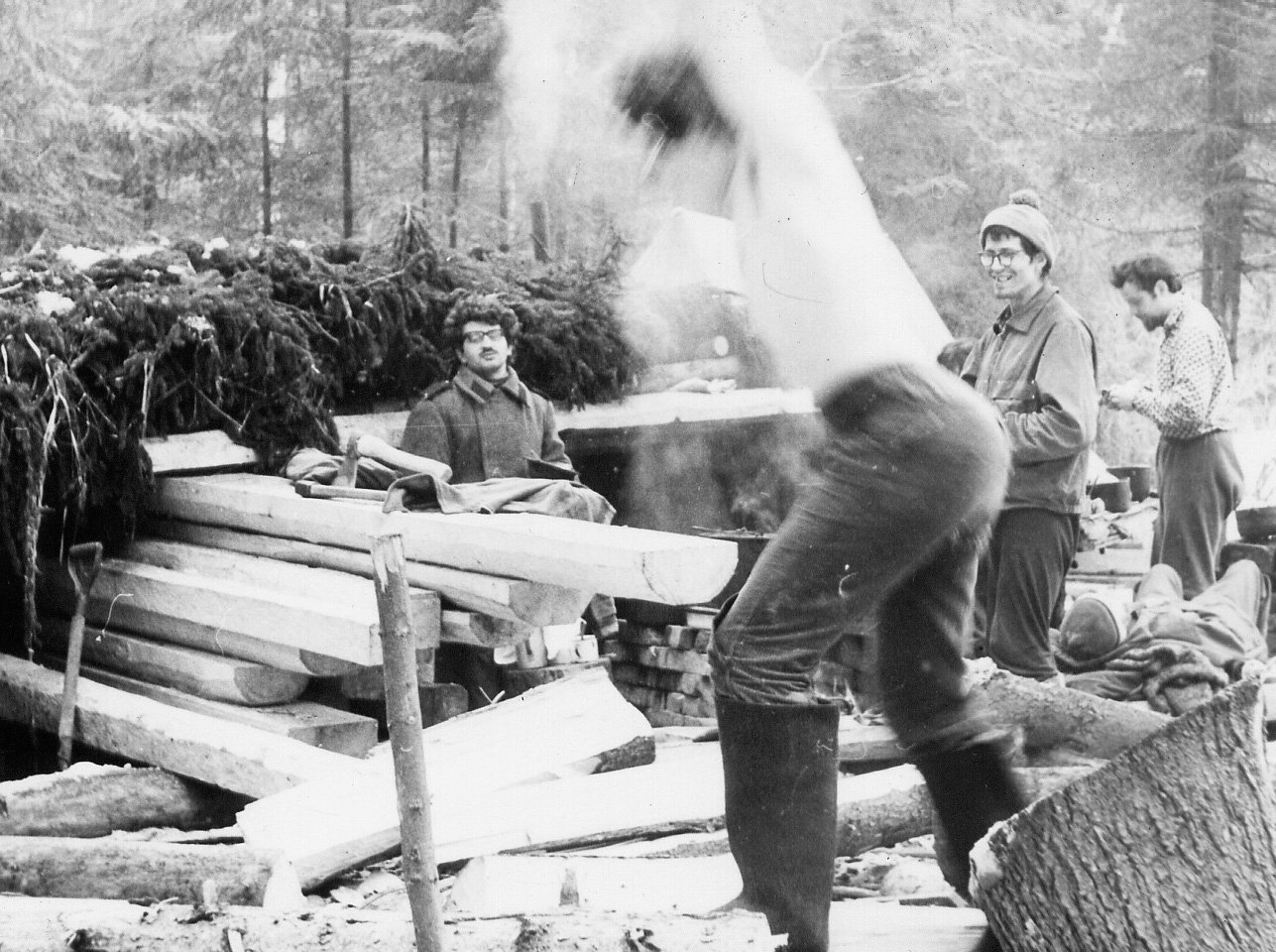 Andrei Demin swings a cleaver, chopping wood. In the background are Igor Pisarev, Vasily Gruzinov, and Alexander Krylov. The beginning of the dugout in Turist. Photo from the book.
Igor Pisarev's informal organization was, as they would say today, highly exclusive; participation was permitted only after passing an equally informal, but nonetheless extremely strict, filter. Above all, it was essential to keep potential informers—whether real, merely suspected, or even imagined—out of the closed community. This was achieved through personal guarantees and the approval of candidates by the one who would assume the unwanted role of leader of a movement that had fled all forms of leadership. Those who passed all stages of approval were subject to a test of labor, which ultimately weeded out those unsuitable for this utopia, those seeking purely idle entertainment in interesting company. At least, this was the case until the dugout enthusiasm, like any such phenomenon, became truly widespread and therefore uncontrollable.
Pisarev and his comrades, prone to heightened self-reflection, were well aware of both the utopian nature of their project and its inevitable failure, the doomed nature of the very idea of a «community of free people» and the negative answer to the question he posed: «Can people truly be happy?» The group's leader «always gave all new people, before sending them out to work, a brief overview of what would happen here in five years: we'll build a dam here, we'll have an island here, we'll deepen this stream, there'll be a workshop there, there'll be a music library.» He, however, was burdened by the power heaped upon him, which revealed in Pisarev, a youth who had been the spitting image of Leon Trotsky, extremely authoritarian traits, if not habits («A free, voluntary association of free people was replaced by voluntary submission to me as a leader, who exercised pressure and even violence»). Here's a typical case of a spontaneous spillover of power, born out of a kind of «revolutionary necessity» to protect an exclusive utopia. Here's what strawberry expert Alexander Kostromin recounts about Pisarev's reaction to the discovery of a competitor's hut being built nearby:
«At some point, Pisarev gathered the guys, grabbed saws, and went to the newly discovered structure, which they successfully cut in half—the long logs from which it was constructed—making it unusable. This provoked, how can I put it, a legitimate reaction from Sasha Zlatopolsky: „What kind of disgusting thing is this? People are working, and you come along and destroy everything. How can this be?“—„You don't understand how two bears can't live in the same den, and the forest is small.“ This moment wasn't received unambiguously, and in particular, the Kostino team later consisted largely of people who perceived Pisarev's idea as wrong. So Pisarev himself didn't go there for a while, to Kostino. He'd drop in occasionally as a guest. Such a moment in one's biography—a stain, so to speak.».
The state can only discover a temporary, autonomous dugout by incarnating it in its most extreme form—violence. It's telling how the very first Pisarev dugout was discovered only after years of successful operation: a soldier escaped from his military unit, and the army went in search of him, only to discover an unauthorized structure in the middle of the forest with suspicious individuals inside. It was destroyed, and the members of the group were summoned one by one to the KGB. Fortunately, by that time, the Soviet government, according to its assurances, had rounded up all the «forest brothers» and their Caucasian associates; otherwise, one can imagine the fate that awaited the men and women found in an obviously inhabited building with no address. Another principled opponent of the dugout dweller is, of course, the policeman, who, «by duty,» is disgusted by any «disorder,» even if this disorder may be more respectable than other permitted and approved practices. Finally, the third and most important enemy of the forest enthusiast is the hunter who reports every dugout to the appropriate authorities and explains his sabotage by saying that tourists are scaring away the animals.
As is easy to see, all three cases involve people who have been granted the right to bear and use arms by the state, blurring the fundamental distinction between a hunter who wields a gun for recreation, a policeman who carries a pistol to protect himself and others, and a soldier who is armed by the state for the fulfillment of his patriotic duty. Due to the constant possibility of encountering not only natural violence, but also artificial, institutionalized violence, the Soviet forest becomes a territory that continually invites transgression. And the strawberry pickers readily followed this urge even in situations that did not involve direct confrontation with authorities, including through the destructive, yet liberating, practice of self-poisoning: «Once Nariman [Araslanov] was sent a Kiev cake. It lay at home for a while, and his wife told him it was spoiled. Then he brought it into the forest. So I prepared some boiled water for myself in case anything went wrong. And then everyone started rushing in, like, „We want to poison ourselves with Kyiv cake, too, to conduct an experiment, so to speak.“.
The main foundation of Pisarev’s «base of the future» was absolute spontaneity«This [the construction of dugouts] is a creative endeavor. It's a completely unpredictable thing. And when we started doing all this there, we didn't understand—I myself didn't really know—what would happen. I had no pre-plan. Everything that was supposed to appear there had to be the product of everyone's creativity.» However, according to some participants in the movement, Pisarev's utopia only succeeded in proving «that in such a collective, totalitarian, barracks-like communism is possible.».
The phenomenon of the dugout dwellers undoubtedly deserves the most careful and, most importantly, comprehensive study, which we hope will follow the publication of Maria Tsybulskaya's book. Of course, like almost any memorial work, it may not be entirely accessible and understandable to the casual reader: some information may seem redundant and insignificant, while others may seem enigmatic and in need of clarification. For example, why «the leaders of the Communist Party of Russia accused Igor of becoming an ant.» For us, however, this book is, above all, a stunning document about a layer of Soviet reality that remained unnoticed because it aspired to be so. In this sense, the dugout builders, unlike the builders of communism, realized their utopia entirely and completely. The reasons that drove this collective to realize this project, parallel to reality, are distinctive but not unique; in some ways, they are even universal.
The impulses and experiences of the Strawberry People force us, on the one hand, to perceive them as part of the larger world of Moscow's escapist underground, which also sought temporary autonomous zones and found them in the small space near the Mayakovsky monument and in numerous «salons» (the «Sixtiestites»), in cemeteries, barracks, and on the outskirts of the capital (the «Yuzhintsy»), in the same forest or on a snowy field (the «Collective Actions» group). Equally important is the fact that during those same years, young intellectuals in capitalist countries, unburdened by the experience of living in a totalitarian reality, were also expressing similar intentions. In the 1960s, the British architectural group Archigram began designing deliberately unrealistic buildings that would be erected and then dismantled and moved after events had taken place in them. But most of all, the experience of the strawberry farmers is reminiscent, perhaps, of the Situationist commune «Exploding Galaxy,» founded in 1969, whose most famous member later became the musician and artist Neil Andrew Megson.
Like Pisarev, the members of Exploding Galaxy strove for the total spontaneity of collective creativity; their lives were determined by the daily redistribution of roles by lottery, and their goal was to seek alternatives to the universe around them. Tellingly, some of them found these alternatives outside the commune, but with the benefit of their experiences: Neil Andrew Megson became Genesis Breyer P-Orridge, and Michael Derek Elworthy Jarman became the Derek Jarman known to connoisseurs of free cinema. And here's the most remarkable thing: when P-Orridge founded his Industrial Records label, which radically changed the face of popular music, he inexplicably chose the silhouette of the Auschwitz death camp as its logo, while the logo of his anti-authoritarian creative group Throbbing Gristle was a lightning bolt, indistinguishable from the symbol of the British Union of Fascists. The dugout dwellers had a large dugout, almost the size of the concert hall at the Center for Artistic Song. The Pisarevites called it the «Führer-bunker.» Another dugout boasted a scorching oven: the temperature in the upper bunks, where the heat flowed, reached 50 degrees Celsius. This part of the dugout was nicknamed «Auschwitz.».
How and why the state penetrates temporary autonomous dugouts—even symbolically, but still in its most brutal form—is a very complex question to which we have no answer. But it clearly requires vigilance.