


Konstantin, «My Unhealed Bird» covers poems written between 2019 and 2024. The blurb calls it a kind of «novel in verse,» and one review said, «This is almost like the Song of Solomon.» Do you perceive it as a coherent narrative, a love story—or did the book come together after the individual poems were written?
— Both. Of course, a book of poetry isn't written, but rather put together, brick by brick—by feeling, by sensation, if you're lucky—and by insight. In this case, life itself gave the book its integrity. On the one hand, it's an intimate lyrical diary, kept by someone accustomed to expressing themselves and the world through poetry. On the other, it's a book with an internal dramaturgy, a clear composition, and a multi-stage development of a lyrical plot. And between these poles, there's simply a heart-to-heart conversation, a speech addressed to the person you've loved and love («About love in the past tense—not a word»). A poem was written to accompany this book: «We speak in the past tense / About those with whom we were destined to part. / There's no time for the future, / And in the present—you can't stay...» Unfortunately, I had to live through this experience as a human being. past tense. But poetry, if it's not just rhyming words, knows only two tenses: the present and the future. And if a book manages to infuse «life, tears, and love» into the reader, then the bird has found wings.
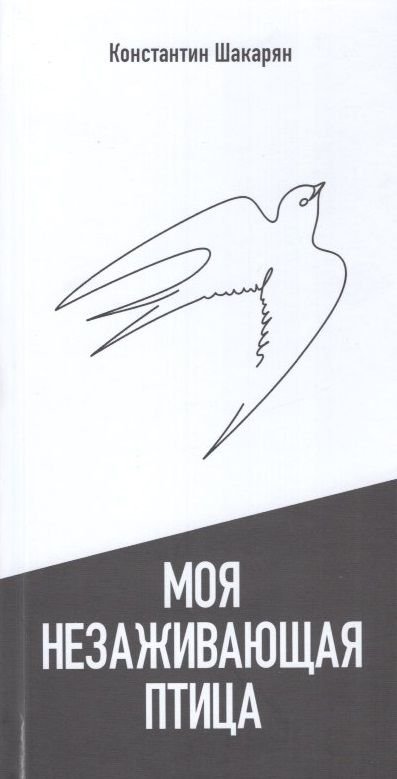
The title «My Unhealing Bird» derives from the image of love that sometimes approaches, sometimes retreats, but never disappears. Why did a bird become your symbol of this love? What is more important in this image—flight, distance, return, or wound?
— The title arose from a line that, quite involuntarily, as usually happens, fluttered out at the end of the poem «The days of Great Lent have come…» Many of my fellow readers liked these verses, they were reprinted many times, and the line itself was stitched into various materials and statements about me. I listened to it again, this time from a distance, and it seemed to me that a better title for the book could not be found. And what is more and more important in this image (I agree with everything)
(listed by you) - it is up to the reader to determine.
— In the book, love exists largely at a distance: «You've left. You're far away again.» Could it be said that distance in your poetry becomes not just a circumstance, but an independent artistic character?
Distance as time and as space is a truly important aspect of the book, as evidenced by the «Poem of Distances»—two cycles with subtitles: «Time» and «Space,» respectively. In the first case, there is the distance between two people, each having traveled their own paths, a distance one longs to overcome with love, but which is objectively insurmountable. The second is objectively entirely surmountable, but subjectively, in our case, a long-term ordeal, which ultimately becomes something like the crack described in the poem: «From the crack between us, / The insurmountable shoots of poetry sprout...».
— The book's poems reveal a tension between the hope of a reunion and the understanding of its impossibility. What's more important for a poet—preserving love in reality or preserving it in memory and poetry?
"It's a terrible question, to which there is no definitive answer, and there can't be one. I'm wary of the idea that the source of lyricism is necessarily suffering, pain, any kind of pain at all." non-realization On a human level. Thank God, our poetry offers examples of the opposite, poems written in a happy exhale. And they're not far to find—Alexander Kushner recently celebrated his 90th birthday. His very name evokes a sense of light in the soul, «a tablecloth, joy, grace,» all those elements of small (and great) human happiness, so meticulously described in his poems. There's also a certain «rhyme» here in the context of our conversation: the first response to «Bird» belongs to Alexander Semenovich himself; those few words, dear to me, on the cover with a quote from the poem that opens the book.
You're simultaneously a poet, a translator, and a literary scholar. Does the researcher within you ever hinder your poetic side? Does your knowledge of a vast literary tradition ever force you to consciously seek a different path?
— As strange as it may seem to me, I've never felt any «pressure» from any particular poet I've studied on any of my inner poetic intonations, let's call it that. Perhaps it's precisely a matter of tradition. The tradition of Russian verse is a vast, spreading tree, with many branches and fruits. There's the tradition of Pushkin and the tradition of Khlebnikov. Minor traditions of Mayakovsky, Yesenin, Akhmatova, and Selvinsky have operated in poetry at various times, but they all arose at the intersection of the two main ones mentioned above. Let's add here the evolutionary and the revolutionary paths. We all, the majority of Russian poets, follow the first path. And one shouldn't think, based on the names listed above, that it's only a matter of scale and that the path of revolution is the destiny of the greatest talents. Nekrasov, Mayakovsky, and Selvinsky are «revolutionaries,» but Tyutchev, Mandelstam, Chukhontsev, and many others are not. And this, of course, doesn't mean that the evolutionary path excludes innovation. On the contrary, this is where the most interesting part begins: innovation, so to speak, intonational, a new voice in its purest form—one that breaks through «transparent dimensions, / familiar words» (V. Sokolov) and reorganizes them in its own way. In this syllabo-tonic organic structure of Russian verse, for me, what's most interesting is experiencing myself and the word that is given to me to express.
You mentioned Ilya Selvinsky, whose poetry you've studied extensively, including examining his verse novel «Pushtorg» as a key work of Russian constructivism. What specifically about Selvinsky remains relevant to you today: his approach to form, historical time, language, or his attempt to connect poetry with modernity?
«I'll quote Khodasevich about Selvinsky: „...Something completely incongruous is happening here. Here, buried alive under the tombstone of “pseudoclassicism,» lies a truly enormous poet, one of whom any other literature, more retentive (and therefore more developed), would be proud to this day.« This was said about Derzhavin. But replace the conventional and meaningless »pseudoclassicism« with the equally meaningless »socialist realism,« and you get a statement about Selvinsky, who, in my deep conviction, is one of the most interesting and ambitious poets of the 20th century. We need to develop an approach to Selvinsky: he is not a lyricist in the simple and convenient sense of the word; he is, first and foremost, the first Russian epic poet of the modern era, a poet-playwright of immense power, as well as a critic and theorist, a mentor to several generations of poetry. He saw his task in art as »to restore poetry to the path of giants—Shakespeare, Goethe, Byron, Pushkin—by linking it to the problem of types and characters and to the genres of the epic poem, the novel, and others, which make it possible to depict historical events." As you can see, we are talking here about a scale that our time is simply incapable of containing and digesting. However, to the grateful reader (and reader-researcher), Selvinsky, this last titan of the epic genre, a most subtle lyric poet and a living scholar of verse, has much to offer.
You primarily research poets of the so-called Soviet school of thought and have compiled books by Nikolai Tikhonov, Selvinsky, and Nikolai Aseyev. Why are you drawn to this particular line of Russian poetry? What, in your opinion, hasn't been sufficiently explored in it by modern readers?
"It itself is a phenomenon and a condensation of the spiritual energy of time, which poetry is in principle, but here the time factor is, of course, especially obvious and tangible. This line became the first victim of the rudeness of recent decades, which we are only now struggling to overcome.".
The phrase «Soviet poetry» was vulgarized to the extreme by our glasnost vulgarizers and became a kind of bogeyman, which in itself is neither good nor bad, because in the end there is no Soviet poetry It doesn't exist. There is Russian (and also Georgian, Armenian, Uzbek, etc.) poetry of the Soviet period, in which a special, central place is occupied by what I call the Soviet ideological branch. This is the core poetry of their time; these poets were true creators of a new world, distinguished by an enormous centripetal force in everything: from the verse itself to their faith in the truth of their times. I'm not even mentioning the colossal material resistance they overcame at every level in the name of expressing this truth, understood in their own way. All of this is exceedingly complex and multilayered, requiring a very thoughtful approach. Let's not forget that this triune phenomenon of poetry, history, and idea is unique and unrepeatable, like any genuine artistic phenomenon.
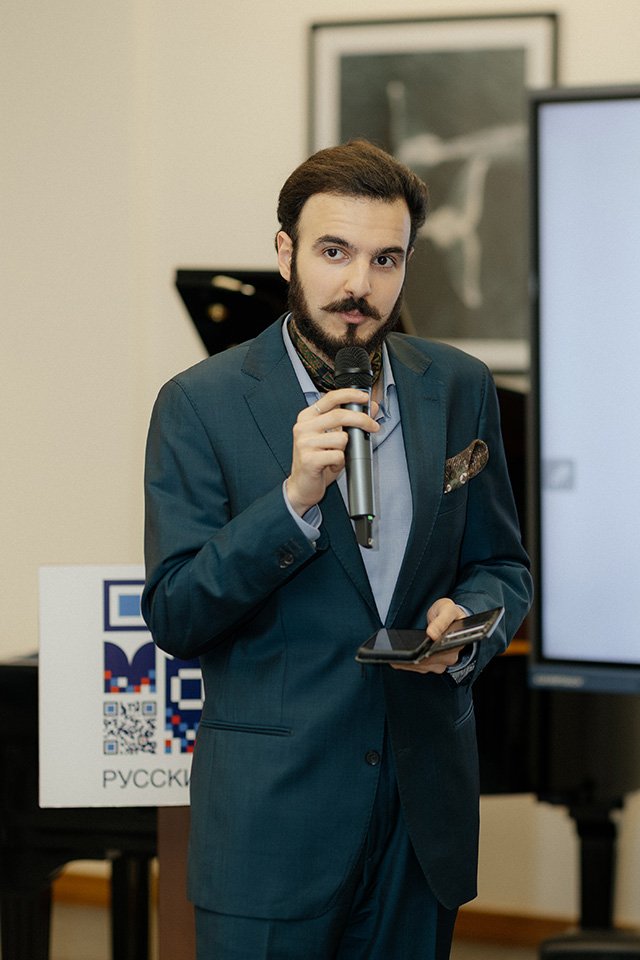 Konstantin Shakaryan. Photo from personal archive
— Your own poetry, however, is very far from the notion of poetry as a purely ideological or social statement. How do you relate personal lyricism to historical consciousness? Should a poet even feel a responsibility to the era?
I relate to Blok's words: «The more sensitive the poet, the more inseparably he senses what is „his“ and what is „not his“; therefore, in times of storm and anxiety, the most tender and intimate aspirations of the poet's soul are also filled with storm and anxiety.» A poet, it seems to me, feels, above all, a responsibility to his word—the rest will come of its own accord; he will inevitably channel the currents of time, those of them that he is given the power to express. Yaroslav Smelyakov has a poem about the touch of modernity on history, in which he writes in the first person: «As if I had foolishly touched / high-voltage wires.» One way or another, we cannot avoid touching them.
You were born in Moscow, but have lived in Yerevan since childhood. You write in Russian and translate Armenian poetry. One of your poems contains the phrase, «Russia and Armenia... Two distances, / Two mothers, two lives, two lands...» What does it mean for you today to exist between two cultural spaces?
I don't quite agree with the formulation: if I exist in any kind of «cultural space,» it's exclusively in Russian, imperial, if you will (let those who speculate with it be wary of this term, whether in a positive or negative sense). Another question is that the more languages a person knows, the richer their worldview—and I'm glad that I speak Armenian and can read great Armenian literature in the original (and sometimes even try my hand at translating it into my creatively native Russian).
If we talk about the fact that today I am not in Moscow, where I was born, but in Yerevan, then this has given me a lot in terms of independence. More precisely, it gave me the chance to find it. A paradox? I'll try to explain: you and I know very well what the literary process is, how young people often find themselves in its whirlwind, the degree of fuss and bustle in all this, and how little the texts themselves, their quality, and the faces—the uncommon expression of those who stand behind them—sometimes mean in this masquerade. A modern young writer is almost always a «homo tusovicus.» Get-togethers on the level of the current Literary Institute, all sorts of seminar get-togethers, young writers' conferences, etc., all this linden A forge of talent—what is that if not a great temptation for someone entering the literary field? I was lucky: I was physically far from all of this—even before I realized how far it all was from genuine creative independence. Thus, I was known not through flashes of light, but exclusively through my poetry, and then—essays, articles, translations, notes… And returning to the «cultural space»: I don’t think I occupy any less a place in it today than my peers who took the path of least resistance. And what place each of us will occupy (if any), not in the literary process, but in literature as such, will be seen later.
You started publishing at a very young age and have already won several literary awards. Does recognition change the way you approach your own work? Or does a poem, even after publication and awards, still remain something deeply personal to you?
— My previous answer might suggest my attitude toward prizes, which are the flip side of what I mentioned above. There are, however, magazine prizes, which at the very least preclude competitive sack races (which are fundamentally inapplicable to poetry). The less fuss there is about longs and shorts, the better. Most prizes were given to me in recognition of my poetry publications and critical writings. Naturally, no external awards influence, nor can influence, the inner life of a poem.
In your autobiographical text, you write, «Poetry began for me at fourteen,» and then formulate a paradoxical thought: «At first, you simply write as you live, and then... suddenly you notice that you live as you write.» At what point, in your opinion, does a poem cease to reflect a biography and, on the contrary, begin to shape a person's biography itself? And can we say today that you already understand how your own poetry has changed your life?
"I think a successful poet is someone who has deeply and thoroughly felt themselves, and who still has the words to share this with others. It sounds almost egocentric, but lyricism is impossible without an active, vibrant, unique, and unique spirit." «I». It is the forerunner of those the only words in the best order, which is known as, and to a certain extent is, the art of poetry. In this regard, I often recall Goethe's words: «In the plastic arts and in poetry, personality is everything.» And of course, «there are secret, powerful connections» between personality and poetry on the path to unity: to a complete poetic personality.