

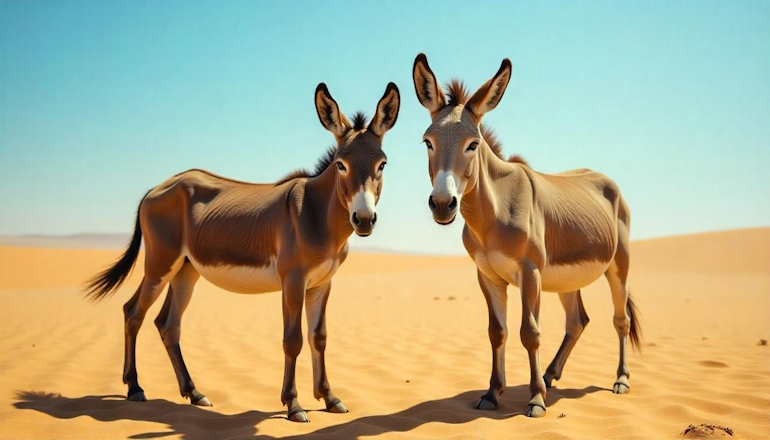
The difference between a donkey and a male ass often causes confusion. Both animals belong to the equine family, have similar appearances, and can even interbreed.
Description: Donkeys and asses – what's the difference? Learn about their origins, appearance, habits, and human uses. A full explanation of the differences.
However, there are significant differences between them, including their origins, appearance, habits, and uses in humans. Let's examine these in more detail.
Origin and distribution
Donkey (Equus asinus, aka Ass (in English) is a domesticated descendant of the African wild ass (Equus africanus). Its domestication occurred approximately 5,000–6,000 years ago in North Africa and the Middle East. Donkeys have spread widely throughout the world, including Europe, Asia, and the Americas.
Donkey (aka Donkey (in English) is not a separate biological species, but a regional name for the donkey, used in Central Asia, the Caucasus, and some Eastern countries. In other words, every donkey is a donkey, but not every donkey is a donkey.
Many people believe that a donkey is a type of ass among Asians and is one and the same animal...
Roughly speaking, yes, but not quite. An Ishak is a domesticated donkey common in Central Asia, the Caucasus, and the Middle East. Essentially, "Ishak" is a regional name for a donkey, which was used primarily as a pack animal.
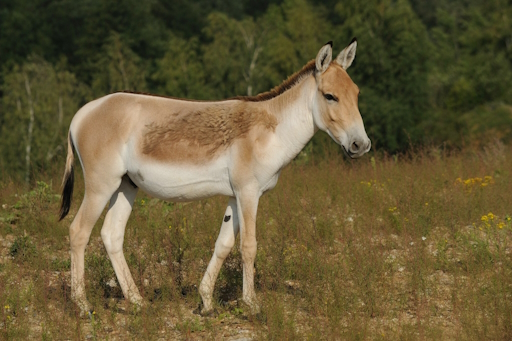
But there are nuances. Donkeys as a species include both wild and domesticated individuals. Wild donkeys, such as the kulan and onager (pictured above), live in the wild and are not domesticated. Domestic donkeys, which include the ass, are descended from the African wild ass. The difference between the ass and the donkey is often related to local breeding traditions, physical characteristics (Asian donkeys can be smaller and more robust), and their use in farming.
That is, technically, a donkey is also a donkey, but with cultural and regional characteristics.
External differences

Although the donkey and the ass look similar, there are some nuances:
- Dimensions. Donkeys can vary in height: from dwarf (80–100 cm at the withers) to large breeds reaching 160 cm. The Central Asian donkey is usually short – 100–120 cm.
- Physique. Donkeys are distinguished by their leaner bodies, dry limbs, and lighter weight. Donkeys in other regions can be stronger and heavier.
- Wool. Donkeys have a short, dense coat adapted to hot climates. Donkeys from northern regions may have thicker and longer coats.
- Ears. All donkeys have large ears, but donkeys may have proportionally longer ears.
Character and habits
Donkeys are renowned for their willfulness and endurance. They are patient, yet stubborn and cautious. In Central Asia, donkeys are often used as pack animals for travel in mountainous terrain, where caution is required.
Donkeys generally have similar traits, but behavior varies depending on breed and living conditions. Some donkeys are more docile and easy to train, especially in Europe and America, where they are used for farm work and even for carrying children.
Human use
- Cargo transportation. Donkeys traditionally serve as pack animals, especially in the mountains. They can carry loads along narrow paths where horses cannot pass.
- Agriculture. In some countries, donkeys are used for plowing fields and other agricultural work.
- Milk production. In the Mediterranean, donkey milk is valued for its beneficial properties and is used in cosmetics.
- Work in the tourism industry. In Egypt, Morocco, and Greece, donkeys carry tourists through narrow streets and mountain roads.
The main difference is that "ishak" is a regional name for a donkey, most often of the Central Asian type. Donkeys can vary in size, color, and purpose depending on the region. However, essentially, the donkey and ass are the same animal.