

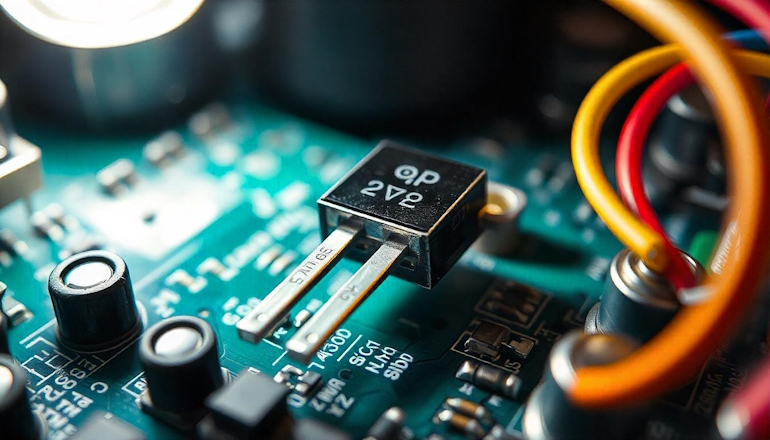
Transistor – is one of the most important components of modern electronics.
It is used in devices to control current, amplify signals, and perform logic operations.
Since their invention in 1947, transistors have replaced bulky vacuum tubes, revolutionizing electronics. Today, they form the basis of microprocessors, smartphones, computers, and many other technologies.
The operating principle of a transistor is based on the properties of semiconductor materials such as silicon or germanium. These materials have the ability to change their electrical characteristics when exposed to external voltage. It is this property that allows the transistor to act as a switch or amplifier.
In simple words
A transistor is a small electronic device that functions as a switch or amplifier. Think of it like a faucet: when you turn the valve slightly (sending a signal to the transistor's control terminal), water begins to flow. In the case of a transistor, this "valve" controls the flow of electrical current between two other terminals—the input and output. This allows you to either turn the current on and off or amplify it to create a stronger signal.
Inside a transistor are special materials called semiconductors. They allow current to flow only under certain conditions. When you apply a signal to a control terminal (like a "valve"), it opens a path for current, and the transistor begins to operate. This makes it a key component in computers, smartphones, and even simple radios.
Types of transistors
There are two main types of transistors: bipolar (BJT) и field effect transducers (FET).
Bipolar transistors (BJT):
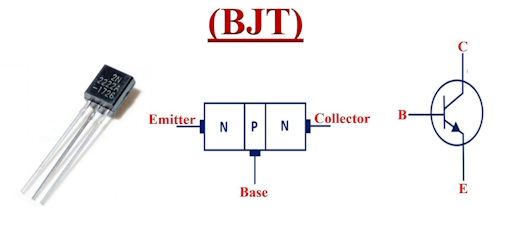
They consist of three layers of semiconductor materials, alternating in conductivity type: pnp or npn. The main elements are the emitter, base, and collector. Bipolar transistors operate due to the flow of electrons and holes through the base, which controls the current between the emitter and collector.
Field Effect Transistors (FET):
They operate by manipulating an electric field. The main elements are the source, gate, and drain. FETs come in two varieties: MOSFETs (metal-oxide-semiconductor) and JFETs (junction field-effect transistors). MOSFETs are widely used in integrated circuits due to their high operating speed and low power consumption.
The working principle of a transistor
The simplest way to understand how a transistor works is to think of it as a water faucet. The current flowing through the transistor can be regulated by a control voltage applied to the base (in a BJT) or the gate (in a FET).
- In boost mode:
In a bipolar transistor, a small current at the base controls a large current between the emitter and collector. For example, when amplifying an audio signal, a weak audio signal is amplified to a higher level, sufficient to drive speakers. - In switch mode:
A transistor is either fully open (conducting current) or fully closed (not conducting). This mode is used in logic circuits, where transistors represent digital "0" and "1.".
Examples of transistor application
An example is the operation of a microprocessor, where billions of transistors simultaneously perform complex computational tasks. Transistors are also used in power supplies, audio and signal amplifiers, voltage regulators, and even sensors.
In simple applications, such as radio, a transistor amplifies a weak signal from an antenna to a level sufficient for audio reproduction. In more complex devices, such as processors, transistors form complex logic circuits that perform billions of operations per second.
The Importance and Future of Transistors
Transistors continue to shrink in size thanks to advances in nanotechnology. Modern processors contain transistors smaller than 10 nanometers, allowing for increased performance while reducing power consumption.
Furthermore, scientists are working on creating new types of transistors, such as graphene or molecular ones, which could replace silicon ones in the future. These technologies promise further increases in computing power and energy efficiency.
Conclusion
A transistor operates by controlling current through semiconductor materials. It is the foundation of all modern electronic devices and is constantly being improved. Understanding the operating principles of a transistor is important for both electronics professionals and those interested in technology.