

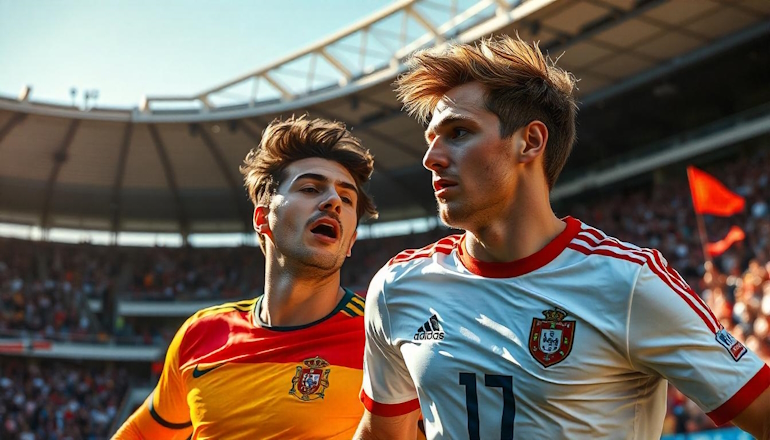
Spanish and Portuguese They belong to the Romance group and have common Latin roots, but the differences between them are still significant.
These two languages emerged on the Iberian Peninsula and developed in parallel, which explains their similarities. However, historical, geographical, and cultural factors have led to differences in vocabulary, pronunciation, and grammar.

First of all, pronunciation is a key difference. Spanish (Castilian dialect) sounds softer, while Portuguese is rougher and more nasal. For example, the Spanish word “hablar” (to speak) is pronounced “falar” in Portuguese. The letter “s” at the end of words is often pronounced as an [sh] sound in Portuguese, which is not the case in Spanish. Portuguese pronunciation is considered complex due to its large number of nasals and reduced vowels. In this regard, Spanish is easier for foreigners to learn.
Vocabulary and grammar also differ. Some words with similar spellings can have different meanings. In Spanish, “embarazada” means “pregnant,” while in Portuguese, “embaraçada” translates as “confused.” Portuguese grammar is more conservative, retaining older forms, such as the compound future tense, which is almost no longer used in Spanish. Spanish, on the other hand, has simplified many grammatical constructions and become more straightforward.
Historically, the differences are explained by political and cultural processes on the Iberian Peninsula:
- After the fall of the Roman Empire, the region came under the influence of various barbarian tribes, and then the Moors. Spain was under Arab rule for a longer period, which influenced the Spanish language, introducing many loanwords.
- Portugal, on the other hand, freed itself from the Moors earlier and developed more independently, preserving ancient Latin forms and adopting fewer oriental elements.
Despite their differences, Spanish and Portuguese remain mutually intelligible. This means that speakers of one language can, in most cases, understand the other with minimal difficulty. However, there's a joke that Portuguese speakers understand Spanish speakers more easily than vice versa because Spanish speakers aren't accustomed to the complex pronunciation of Portuguese. For example, the sentence “You speak Spanish and speak Portuguese” would be “You speak Spanish and speak Portuguese.” The similarity is obvious, but pronunciation can be challenging.
Today, Spanish and Portuguese are global languages. Spanish is second only to Chinese in terms of speakers, while Portuguese has become global thanks to Brazil. Both languages are actively developing, yet retain their uniqueness, rooted in the historical context of their development.
Comparisons with other languages
Differences between Spanish and Portuguese can be partially compared to language pairs like Russian and Belarusian or Turkish and Azerbaijani, but there are important differences. All of these pairs come from the same linguistic root: Slavic or Turkic. Spanish and Portuguese also have common Romance root, which originates from Latin. Therefore, they contain similar words, grammatical constructions, and the pronunciation of some phrases.
However, the differences between Spanish and Portuguese are more noticeable than those between Russian and Belarusian. Portuguese has a complex, nasal pronunciation, while Spanish is clearer and more open. This can be compared to the more pronounced accentual contrast between Turkish and Azerbaijani. Grammatical differences are few, but Portuguese includes more exceptions and specific constructions.
Geographical and historical factors played a significant role. Portugal and Spain developed as two independent powers with distinct cultural and linguistic processes. This added more unique features than in the case of neighboring Slavic or Turkic languages, where political and cultural ties persisted longer.