


The underwater world is striking in its diversity. Among the most famous sea creatures are octopuses and squids.
Despite their superficial similarities, their differences are far greater than meets the eye. These mollusks belong to the cephalopod class and have a highly developed nervous system, but their biology, behavior, and ecology are unique.

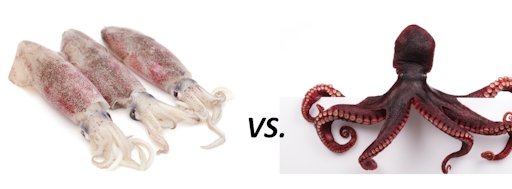
Octopuses (pictured left) and squids (pictured right) have distinctive features that distinguish them from each other.
- Number of tentacles
Octopuses have eight tentacles, each with two rows of suckers. Squids, in addition to their eight tentacles, have two elongated tentacles for capturing prey. - Body and shape
An octopus's body is soft, round, and devoid of any hard structures. Squid, on the other hand, have a more streamlined shape with an elongated body and an internal "handle"—a remnant of the shell that serves to support the body's shape. - Fins
Squids have fins located on the sides of their bodies, making them fast swimmers. Octopuses lack these fins and propel themselves either with the help of their tentacles or by jet propulsion, pushing water through a siphon.
Their lifestyles and habitats also differ. Octopuses and squid inhabit different parts of the ocean, which is related to their lifestyles. Octopuses prefer coastal areas with plenty of shelter, such as coral reefs, rock crevices, or sandy burrows. They are solitary, rarely interacting with other octopuses except during breeding season. Squid, on the other hand, live primarily in the open ocean, often at great depths. These animals form large schools, which helps them hunt effectively and defend themselves from predators.
- Habitats
Octopuses prefer to hide in sheltered areas such as caves or coral reefs. They are solitary. Squid are more common in the open ocean, often forming large schools. - Modes of transportation
Octopuses move slowly, preferring to crawl along the bottom. Squid, on the other hand, are capable of high speeds, which helps them evade predators and hunt. - Diet
Both species are predators. Octopuses mostly hunt crabs and mollusks, while squid feed on small fish and plankton.
There are also differences in intelligence. Octopuses have long been recognized as among the most intelligent creatures in the marine world. They demonstrate remarkable intelligence: they solve complex puzzles, remember routes, and use various objects as tools. For example, octopuses can hide in coconut shells or use stones to create barriers. Squid are also quite intelligent, but they rely more on group behavior than individual abilities.
- Intellectual abilities
Octopuses are considered among the most intelligent animals on the planet. They are capable of solving puzzles, using objects as tools, and exhibiting complex behavior. Squid are also intelligent, but their intelligence is less well understood. - Hunting and protection
Both species use camouflage for protection. Octopuses change the color and texture of their skin to blend in with their surroundings. Squid also change color, but their abilities are limited compared to octopuses. - Reproductive behavior
After mating, the female octopus lays eggs and guards them until hatching, often dying shortly thereafter. Squid reproduce en masse, laying eggs in the water before abandoning the nest.
Both of these marine species also have commercial significance. Both octopuses and squid are important in the food industry:
- Culinary uses: Both species are used in a variety of dishes. Octopus is popular in Mediterranean cuisine, while squid is popular in Asian cuisine.
- Fishing: Squid fishing is more widespread due to their high numbers and rapid breeding cycles.
Octopuses and squid are fascinating marine life, differing in structure, behavior, and lifestyle. Each plays a vital role in ecosystems and has its own unique history of interaction with humans. Understanding these differences helps us better understand the underwater world and its inhabitants.