

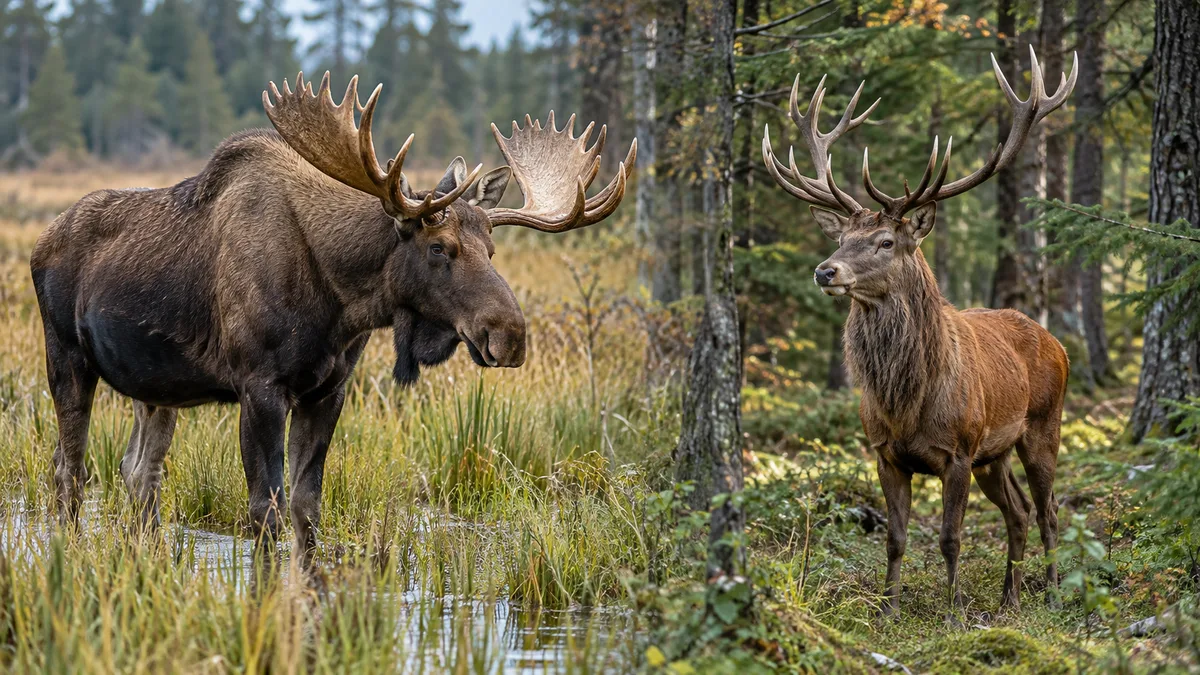
The elk differs from the red deer primarily in size and antlers: it is significantly taller and heavier, has a hump at the withers, a drooping muzzle and flat, spade-shaped antlers, while the red deer is more slender and has branched antlers consisting of rods and legs. Both species belong to the deer family and are found in Poland, but they also differ in habitat, lifestyle, tracks and excrement.
To sum it up
- Dimensions: The elk reaches approximately 2 m in height at the shoulders, the red deer - approximately 1.4 m.
- Horns: The elk has flat shovels (spade blades) or stems (badilyartsy), the deer has multi-legged antlers.
- Excrement: Moose droppings are noticeably larger and often form soft clumps in summer; deer droppings range from 1.5 to 2.6 cm in length.
- Habitat: The elk lives in swamps, marshes and forests with birch and aspen trees, the deer lives in various types of forests, meadows and fields.
Elk and deer - size and appearance
Elk (Alces alces) — the largest representative of the deer family. Males reach a shoulder height of about 2 meters and weigh up to 600 kg; females (moose) are smaller. They have a massive build, with a pronounced hump at the withers , very long legs and a relatively short body. The head is large, with a fleshy muzzle hanging over the jaw, and a fold of skin called wart, hanging below the throat. The fur is dark brown, and the legs are lighter.
Red deer (Cervus elaphus) The Siberian Husky is noticeably smaller in size. According to educational materials from the State Forestry Department, its height at the withers ranges from 75 to 140 cm, its length from 175 to 265 cm, and its weight from 68 to 210 kg. Its body is slender and proportional, with a narrow head and a long neck. Its coat is brownish-beige or red in summer and grayish in winter.
The structure of elk and deer antlers
Antlers are the easiest way to identify a male deer. Only males have them—both males and females have no antlers.
Elk antlers (rods) grow from the ridges to the sides, almost horizontally. In old males in good condition, they form wide, flat shovels with protrusions (sharp ends) along the edges - such a male is called shovel-headed . Males without spade-shaped horns consisting of branched "stems" are called meadow harriers . Elk shed their antlers relatively early – older males usually in November, young ones – in December and January.
Deer antlers have a circular cross-section and consist of two rods , each with branch ; In older males, a crown forms at the top of the antler shaft. The growth direction is more vertical, upward and backward. Deer shed their antlers in late February and early March, later than moose.
In both species, new antlers grow covered in highly vascularized skin called shield . When the antlers are ready, the male rubs his shield against bushes and young trees, leaving scraps of bark on them.
How to distinguish between elk and deer droppings?
Excrement is often the most easily detectable trace of an animal's presence. In both species, it takes the form litter , but they differ in size and how they change throughout the year.
- Deer excrement: elongated, dung-like lumps, similar to roe deer excrement but larger in size. According to the WWF guide, The length of one deer dropping is 1.5–2.6 cm, and the width is 0.7–1.3 cm (roe deer droppings: 0.8–1.2 cm in length).
- Moose droppings: Oval droppings, noticeably larger than those of deer. In winter, when moose feed primarily on shoots, twigs, and bark, the droppings become tough and fibrous. In summer, when they feed on succulent and aquatic plants, the droppings become soft, even resembling cow dung .
Helpful tip: If you find scat within the specified length range for deer and heart-shaped tracks 6-10 cm long, it's most likely deer. Very large scat or soft spots near swamps and birch thickets are more likely to indicate moose. Don't touch scat with bare hands—it can carry parasites and diseases.
Elk and deer - differences in the table
| Characteristic | Elk | red deer |
|---|---|---|
| Height at withers | Up to approximately 2 m | 75–140 cm |
| Weight of a bull | Up to approximately 600 kg | Up to approximately 210 kg |
| Silhouette | Massive, hump at the withers, long legs, bell under the throat. | Slender, proportional, long neck |
| Horns | Spatulate (or stem-like) plants that grow sideways. | Shoots with branches and a crown grow upwards. |
| Shedding antlers | November–January | February–March |
| Hook | The hooves are set wide apart, approximately 15.5 cm in length. | Approximately 6-10 cm, heart-shaped. |
| Excrement | Large oval beans, soft pancakes in summer | Beans 1.5–2.6 cm |
| Pairing | Bukovisko: September – October. | Rutting period: second half of September |
Habitat, nutrition and lifestyle
Moose Moose prefer mixed forests dominated by deciduous trees, especially birch and aspen, as well as swamps and marshy areas. Their long legs and widely spaced hooves facilitate movement through muddy ground and deep snow. They feed on aquatic plants, leaves, and the soft tops of young trees, and in winter, on bark and shoots. They usually live alone or in small groups (with calves). In Poland, the largest moose population is concentrated in the eastern and northeastern regions of the country, including the Podlaskie and Warmian-Masurian voivodeships. Since 2001, moose have been under year-round protection.
Red deer They live in coniferous, deciduous, and mixed forests, and feed in meadows, pastures, and fields. In summer, they feed primarily on grass and plants, and in winter, on heather, blueberries, blackberries, twigs, and bark. Stripping bark from tree trunks with their teeth is called barking . Red deer live in herds (packs) - females and their young live separately, and males, outside the mating season, live alone or in small groups.
How to recognize elk and deer in the field?
- Look at the silhouette: A hump, long legs and a "heavy" muzzle are an elk; a thin neck and a narrow head are a deer.
- Inspect the horns: Flat plates or stems diverging laterally in elk; vertical rods with branches in deer. Females of both species lack antlers.
- Measure the footprint: A track longer than 10 cm in wet terrain is more likely to belong to an elk.
- Listen: The loud roar of bulls in autumn is the cry of a deer during the rutting season.
- Be especially careful on the road: Moose are very tall and heavy, and their dark fur makes them difficult to spot at night. Reduce your speed in areas marked with "Caution: Wildlife" signs.
Frequently Asked Questions (FAQ)
Is an elk a deer?
Elk belong to the same family as deer—Cervidae—but are a separate species and genus (Alces). Therefore, they are not a species of deer, but a more distant relative.
How to distinguish moose droppings from deer droppings?
Red deer droppings are 1.5–2.6 cm long and resemble enlarged roe deer droppings. Elk droppings are significantly larger, oval-shaped, hard and fibrous in winter, and often form soft clumps in summer, similar to cow dung.
What is a shovel and forage harvester?
These are hunting names for male moose, based on the shape of their antlers. A spadetail moose has wide, flat antlers, while a male's antlers consist of branched, narrow "stems" without antlers themselves.
Which is bigger - an elk or a deer?
Elk reach a shoulder height of about 2 m and weigh about 600 kg, while red deer reach a shoulder height of about 1.4 m and weigh a maximum of about 210 kg.
When do moose and deer shed their antlers?
Elk shed their antlers earlier – usually in November for older males, and in December and January for younger males. Males shed their antlers around the turn of February and March. New antlers grow in the following months.
See also
- What is the difference between a fallow deer and a red deer?
- What is the difference between a viper and a snake?
- What is the difference between a bee and a wasp?
- What is the difference between a llama and an alpaca?
- What is the difference between a marten and a weasel?