

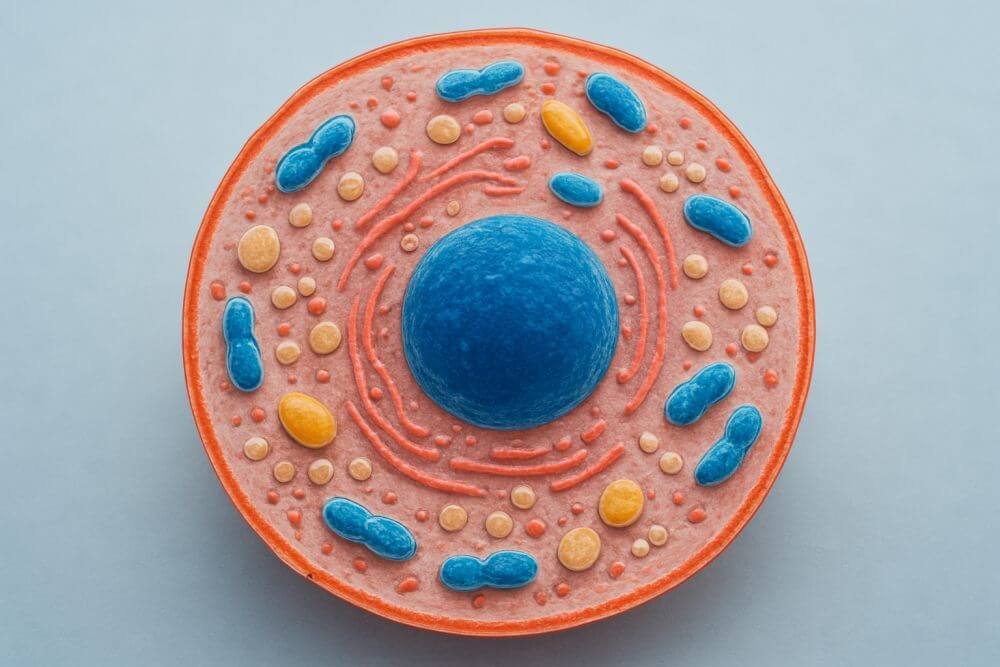
A plant cell differs from an animal cell primarily in that it has cellulose cell wall, chloroplasts and a large vacuole , which an animal cell does not have. Instead, an animal cell has centrioles and lysosomes and stores energy in the form of glycogen, not starch. However, both are eukaryotic cells, so they share most of the same organelles.
To sum it up
- Only a plant cell has a rigid cell wall made of cellulose; an animal cell is surrounded only by a cell membrane.
- Chloroplasts (and other plastids) are found only in plants, which is why plants are autotrophs and animals are heterotrophs.
- A plant cell usually has one large central vacuole; in an animal cell, vacuoles are small or absent.
- Centrioles and typical lysosomes are characteristic features of the animal cell; the plant stores starch and animal glycogen.
What do plant and animal cells have in common?
Before delving into the differences, it's worth remembering that both cells are eukaryotic — they have a nucleus surrounded by a cell membrane containing genetic material. They also have the same basic structure:
- A cell membrane that separates the interior of the cell from the environment and regulates the transport of substances.
- cytoplasm with cytoskeleton,
- mitochondria, where cellular respiration occurs (plants also breathe, and not just photosynthesize).
- ribosomes, endoplasmic reticulum and Golgi apparatus.
The differences are mainly due to their different lifestyles: a plant is sedentary and produces its own food, while an animal must obtain it from outside and moves frequently.
The cell wall is the most noticeable difference
The plant cell is surrounded cell wall , the main component of which is cellulose. The wall, located outside the cell membrane, gives the cell its permanent shape, provides mechanical protection, and, together with the vacuole, helps maintain tissue density (turgor). This is why plant cells, under a microscope, usually appear like regular "building blocks.".
In animal cells no cell wall — their boundaries are defined by the membrane itself. This allows animal cells to take on a wide variety of shapes, from elongated nerve cells to spherical egg cells. Adjacent plant cells connect through thin channels in their walls, called plasmodesmata .
Chloroplasts and plastids – why do only plants perform photosynthesis?
Plant cells contain plastids . The most important of them are chloroplasts , which contain chlorophyll and are the site of photosynthesis—the conversion of carbon dioxide and water into sugars and oxygen using light energy. Other plastids include chromoplasts (which, for example, give color to fruits and flower petals) and leucoplasts (colorless plastids that store, among other things, starch).
In an animal cell no plastids . Therefore, an animal cannot independently produce organic compounds from light – it is a heterotroph and obtains energy from food, which it breaks down in the mitochondria.
Not every plant cell contains chloroplasts—root cells, for example, do not. Other features, primarily the cell wall, indicate that a cell is plant.
Vacuole, lysosomes and centrioles
In a mature plant cell vacuole The vacuole typically consists of a single large vacuole occupying the central portion of the cell. It is surrounded by a membrane called the tonoplast and filled with cell sap. The vacuole stores water, mineral salts, and organic compounds, helps maintain turgor pressure, and also performs digestive functions. In animal cells, vacuoles, if present, are small.
Lysosomes These are tiny vesicles containing digestive enzymes produced in the Golgi apparatus. They break down substances entering from outside the cell, as well as worn-out structures within the cell itself. They are typical of animal cells; in plant cells, their role is primarily performed by the vacuole.
Centrioles Centrioles are cylindrical structures composed of microtubules. In animal cells, a pair of centrioles forms a centrosome, which organizes the mitotic spindle. Seed plant cells lack centrioles, but they form the mitotic spindle in a different way.
Reserve material and cell division
Plants store energy primarily in the form of starch , while animals store it mainly in glycogen (in humans, primarily in the liver and muscles) and fat. Both polysaccharides are composed of glucose molecules but differ in their chain structure.
Cytokinesis , The division of the cytoplasm after nuclear division also occurs differently. Animal cells divide by constriction—the membrane invaginates until the cell splits into two parts. Plant cells, surrounded by a rigid wall, cannot "constrict," so a septum (cell plate) forms within them, from which a new wall is formed.
Table: Animal and plant cells
| Characteristic | Plant cell | Animal cell |
|---|---|---|
| Cell wall | It's (mostly cellulose) | No, only the cell membrane. |
| Plastids (chloroplasts) | They are present (not in every cell). | Flaw |
| Vacuole | Usually one, large, central. | Small or absent vacuoles |
| Lysosomes | In rare cases, this function is performed by a vacuole. | Are |
| Centrioles | Absent in seed plants. | Are |
| Spare materials | Starch | Glycogen, fats |
| Form | Constant, usually regular | Changeable, very diverse |
| Cytoplasmic division | Through the septum (cell plate) | Through the narrowing |
How to recognize plant and animal cells under a microscope?
In biology class, we most often see onion skins or seaweed leaves (plant cells) and oral epithelium (animal cells). Simple questions can help with identification:
- Do you see the thick, clear border and the correct shape? This is the cell wall - a plant cell.
- Are there any green seeds in the cage? These are chloroplasts—plant cells (for example, aquatic plants). Onion skins don't have chloroplasts, but they do have a cell wall.
- Is the core being pushed to the edge by the light space? This is a large vacuole - a plant cell.
- Are the cells irregularly shaped, with fine outlines and a nucleus in the center? This is a typical image of animal cells.
With a typical school light microscope, centrioles, lysosomes, and ribosomes are usually not visible; these differences are known from images obtained with an electron microscope.
Frequently Asked Questions (FAQ)
What are the 3 main differences between a plant cell and an animal cell?
Plant cells have a cellulose cell wall, chloroplasts, and a large central vacuole. Animal cells lack these structures, but they do have centrioles and lysosomes.
Do animal cells have mitochondria but plant cells don't?
No – both cells have mitochondria. Plants also perform cellular respiration; chloroplasts do not replace mitochondria, but produce organic compounds through photosynthesis.
What does an animal cell not have?
Animal cells lack a cell wall, plastids (including chloroplasts), and a large central vacuole. They also do not store starch; their reserve food is glycogen.
What does a plant cell lack?
Seed plant cells lack centrioles, and typical lysosomes are rare, as the vacuole serves digestive functions. Furthermore, they do not store glycogen.
Why do animal cells not have a cell wall?
A rigid wall would restrict shape change and movement. Animal cells, among other things, form muscles and nerves and absorb nutrients from the environment, which requires a flexible boundary in the form of the cell membrane itself.