

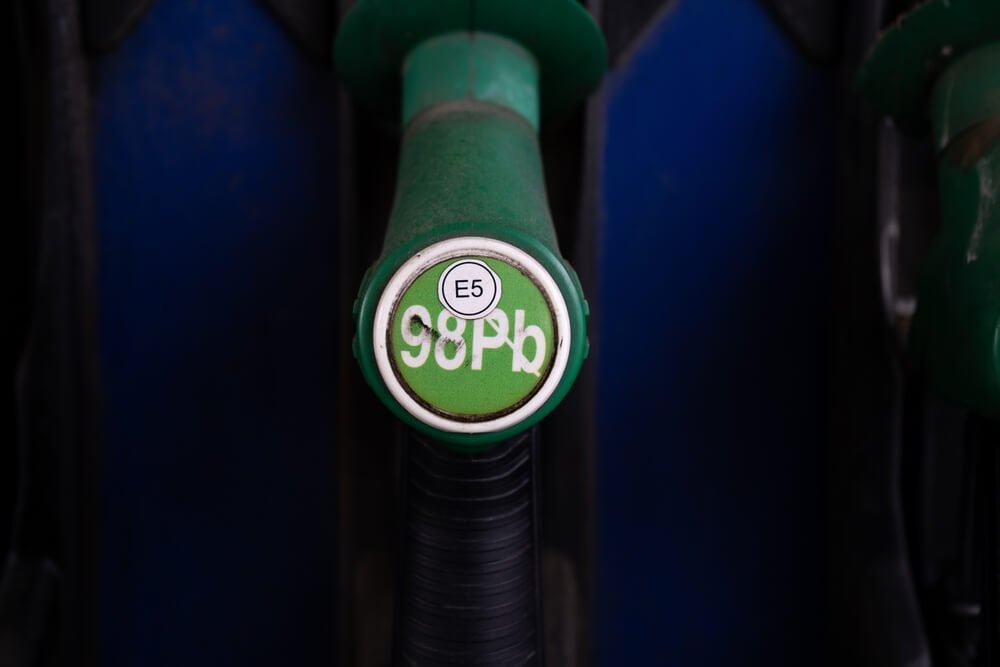
E5 gasoline differs from E10 primarily in its bioethanol content: in E5 its content is a maximum of 5% by volume, and in E10 – a maximum of 10%. This single difference leads to other differences: slightly higher theoretical fuel consumption for E10, different requirements for seals and fuel lines, and the fact that not every older car can run on E10. In Poland, E10 has been the standard 95-octane gasoline since January 1, 2024.
To sum it up
- E5 – up to 5% bioethanol, E10 – up to 10% bioethanol; the rest is gasoline.
- From January 1, 2024, regular 95 octane gasoline will be E10 at Polish gas stations, while E5 will continue to be predominantly 98-octane gasoline.
- Most gasoline vehicles are compatible with E10 fuel, but some older models are not. Please check your owner's manual or contact the manufacturer.
- You can mix E5 and E10 in the tank; using E10 may result in slightly higher fuel consumption.
What do the symbols E5 and E10 mean?
Letter E stands for ethanol, and the number next to it indicates the maximum percentage of bioethanol in the fuel. E5 gasoline contains up to 5%, E10 – up to 10%. The rest is petroleum-based gasoline with an additive package.
Bioethanol E10 is ethyl alcohol produced from biomass, such as cereals, corn, or sugar beets. It is added to gasoline to increase the share of renewable fuels in transport and reduce carbon dioxide emissions throughout the fuel's life cycle. Polish fuel dispenser labeling regulations define E10 fuel as gasoline containing between 5.0% and 10.0% of bioethanol (or an equivalent amount of ETBE or ETAE).
Gasoline E5 and E10 – comparison in the table.
| Characteristic | E5 gasoline | E10 gasoline |
|---|---|---|
| Bioethanol content | Up to 5% in volume | Up to 10% by volume |
| Typical octane number in Poland | Mostly 98 (premium gasoline) | 95 (standard gasoline) |
| Availability | Gasoline 98 and some premium fuels | Standard at stations from January 1, 2024. |
| Compatibility | Almost all cars have gasoline engines | Most cars, but not all, are older models. |
| Energy value | A little higher | A little lower (more ethanol) |
| water absorption | Less | The larger the pore size, the more hygroscopic the ethanol. |
| Price | Usually more expensive (premium fuel) | Usually lower |
Fuel consumption and engine performance on E10 fuel
Ethanol has a significantly lower calorific value than gasoline—a liter of ethanol contains less energy. Since E10 contains more alcohol, a liter of this fuel delivers minimally less energy to the engine than a liter of E5. In practice, this results in slightly higher fuel consumption , on the order of several percent, which in everyday driving is often lost due to fluctuations caused by driving style, weather and vehicle load.
The difference in composition usually does not have a noticeable effect on the performance of a vehicle adapted to E10 fuel. Octane number, The engine manufacturer's requirement is more important than the ethanol content - if the owner's manual recommends 98 octane fuel, it's worth sticking with it regardless of the E5/E10 designation.
The problem isn't the power itself, but the materials. Ethanol hygroscopic , which means it attracts water from the environment and also acts as a solvent. In vehicles with fuel systems not designed for high alcohol content, this can promote corrosion of metal components and accelerate wear of some seals, hoses, and plastic parts.
New gasoline vehicles are compatible with E10 fuel, and information published by automotive organizations indicates that this also applies to the vast majority of vehicles produced in the last decade. The risk primarily affects older cars , especially pre-2000 models and classic cars, although many models also accept E10. Therefore, compatibility should not be taken for granted; it must be verified.
E5 or E10 – which one to use and how to check your car?
- Check the user manual or a sticker near the fuel filler neck—manufacturers often indicate compatibility with E10 fuel there.
- Use the government's E10 vehicle compliance search engine (e10.klimat.gov.pl) or contact an authorized service center of the brand.
- Pay attention to the fuel dispenser – The place where E10 fuel can be used must be designated and, according to the regulations, a notice must be posted there informing the driver that his vehicle can use this fuel.
- If your vehicle is not suitable for E10 fuel , fill up with E5 fuel, which in practice is usually 98 octane gasoline.
- If the car is adapted , then from a technical point of view there is no reason to overpay for E5 fuel – the difference in consumption is insignificant.
- Lawn mowers, saws, scooters, motorcycles and boats should be processed separately: check the instructions for the specific device for compliance with the E10 standard.
When in doubt, the car manufacturer's opinion is decisive. For classic and rare models, it's worth consulting a mechanic or a car club.
Can you mix E5 and E10 gasoline?
Yes. E5 and E10 gasoline can be mixed in any proportion in the tank—in a vehicle designed for E10, this makes no difference. However, the owner of a vehicle not approved for E10 can dilute an accidentally filled tank with E10 by adding E5 and immediately return to using regular fuel. If the tank contains a large amount of E10 and the manufacturer specifically prohibits its use, the safest course of action is to contact a service center for clarification.
Frequently Asked Questions (FAQ)
Which gasoline is better: E5 or E10?
There's no single answer. For vehicles approved for use with E10 fuel, both options are suitable, with E10 generally being cheaper. For vehicles not approved for use with E10, E5 is a better and safer choice. The choice should be determined based on the owner's manual and the required octane rating.
Since when is E10 petrol sold in Poland?
Since January 1, 2024, the standard 95 octane gasoline at Polish gas stations has been E10. Gasoline with the maximum bioethanol content, 5%, remains available, primarily as 98 octane fuel.
Is gasoline 98 always E5?
In Poland, gasoline with an octane rating of 98 octane is commonly sold as E5, an alternative for vehicles not designed for E10 fuel. However, it's a good idea to check the label at the gas station before filling up, as the E symbol indicates the composition of the fuel, not the octane rating itself.
What happens if I fill my car with E10 gasoline and it is not compatible with E10 gasoline?
A single fill-up usually doesn't cause immediate damage, but prolonged use of E10 can accelerate wear on fuel system components. It's best to top up with E5 as soon as possible and continue using the correct fuel. If in doubt, contact a service center.
Does a car use more fuel on E10?
Theoretically, yes, because ethanol has a lower calorific value than gasoline. However, the difference is small—on the order of a few percent—and often difficult to notice in everyday driving.
See also
- What is the difference between 95 and 98 octane gasoline?
- What is the difference between gasoline and diesel fuel?
- What is the difference between 5w30 and 5w40 oils?
- What is the difference between 2T and 4T oil?