

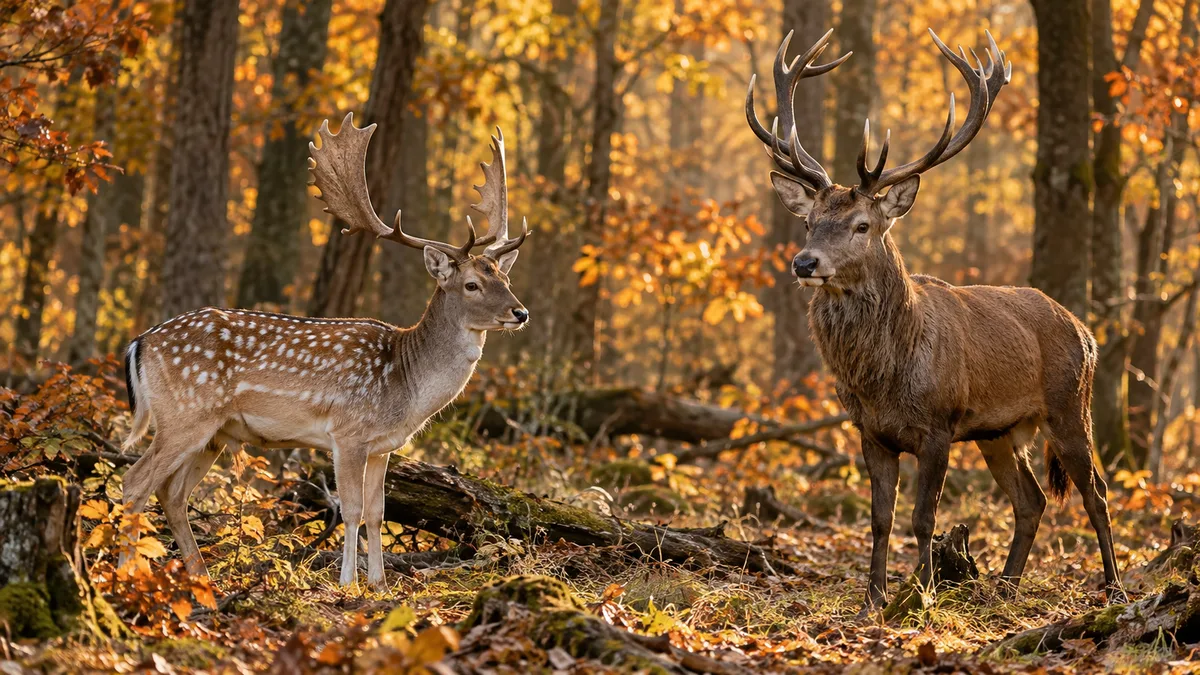
Fallow deer differ from red deer primarily in their antlers and size. A male fallow deer has flat, spade-shaped antlers and typically weighs 65–80 kg, while a male red deer has branched antlers and typically weighs around 150–160 kg. In summer, fallow deer are also easily recognized by the white spots on their backs, which are absent in adult deer.
To sum it up
- Horns: The fallow deer has spatulate (flat) processes, while the red deer has rods with many branches, often with a tip.
- Dimensions: A fallow deer buck weighs 65–80 kg, a red deer buck in Poland usually weighs 150–160 kg.
- Color: In summer, fallow deer have reddish-brown fur with white spots; in adult red deer, the fur is unspotted.
- Mating season: the fallow deer rut in October and November, the red deer rut from the second half of September.
What's the difference between a fallow deer and a red deer? A brief overview of both species.
Both animals belong to the family deer , so in a broad sense a doe can also be called a "deer." However, when we ask about the difference, we usually compare doe ( Dama dama ) With red deer ( Cervus elaphus ) is the largest representative of the deer family in Poland after the moose.
The red deer is a native species found in forests throughout the country. The fallow deer originates from the Mediterranean region (Asia Minor, Southern Europe). It was brought to Poland in the 13th century, to the Silesian Lowland, where it was subsequently released into the wild. Today, it is most numerous in the western part of the country.
Horns are the surest way to recognize horns.
У red deer Antlers consist of two long, round rods from which branches extend: the back, the back, the base, and finally the fork or tip. The number of branches and the weight of the antlers increase with age, usually until the male reaches 10–14 years of age. The antlers of an adult red deer weigh several kilograms, reaching 6–12 kg in the largest populations.
At the doe horns spade-shaped The lower part is a short shaft that widens toward the top, forming a flat "shovel" with a serrated edge. Among the deer species native to Poland, only the moose has antlers of a similar flat shape, but their spade-shaped parts are incomparably larger. In young fallow deer, the antlers are still straight and unbranched—the spade-shaped parts develop with age.
Both species shed their antlers annually and then regrow them. Red deer do this earlier—in older males, in February and March—while fallow deer typically do so in April and May. Females of both species are antlerless.
Size and silhouette
The average weight of a male fallow deer is 65-80 kg (in exceptional cases up to 120 kg) and reaches about a meter in height at the withers. A doe typically weighs 30-50 kg. A red deer stag in Poland typically weighs 150-160 kg and reaches 1.5 m in height at the withers. A red deer female weighs on average 70-80 kg, which is the same as an adult fallow deer stag.
Red deer have long legs and a proudly raised, long neck; in winter, males develop a noticeable mane around their necks. The doe is smaller and stockier, and its tail is relatively long, black on top and white underneath, and the animal often wags it.
Colouring: doe-like spots and solid red fur.
In summer The doe's back is reddish-brown, covered with white spots , a dark stripe along the spine, and a light underparts. A white, mirror-like spot bordered by a dark line can be seen on the croup. In winter, the coat turns grayish-brown, and the spots disappear or become barely noticeable. There are also dark (melanistic) and very light, almost white varieties.
In summer, the red deer has a reddish-brown coat without spots. , and in winter, it's grayish with a darker neck. The rump is light, fawn. Spots are present only on red deer fawns and disappear within the first months of life—so a spotted adult in the forest is almost certainly a doe.
Comparison chart: fallow deer and red deer
| Characteristic | Lani | red deer |
|---|---|---|
| Latin name | Lady Lady | Cervus elaphus |
| Weight of a bull | 65–80 kg (up to approximately 120 kg) | Usually 150–160 kg |
| Weight of the female | 30–50 kg | 70–80 kg |
| Horns | spatulate, flat | Branched, with branches and a crown. |
| Summer jacket | Reddish-brown with white spots | Reddish-brown, uniform |
| Shedding antlers | Usually from April to May. | February–April |
| Pairing | Rutting season: October–November | Rutting period: from the second half of September. |
| Origin: Poland | An alien species introduced in the 13th century. | Local species |
Behavior and mating season
Fallow deer live in herds, while adult males, outside the mating season, remain solitary or in small groups. This species tolerates human presence well, which is why it has been kept for centuries in game reserves and parks, as well as on farms.
The easiest way to distinguish between these two species is in autumn – by their calls. Gon The red deer season begins in the second half of September and lasts for several weeks; the males produce a loud, low roar. Gon Fallow deer mating occurs in October and November, and the males make hoarse, intermittent sounds resembling bleating—hence the name.
How to distinguish a fallow deer from a red deer in the field?
- Horns: flat, spade-shaped - in fallow deer; branched rods - in red deer.
- Stains: White spots on the body of an adult animal in summer – in a doe.
- Back: white with a black border and a moving black and white tail - a doe; a large fawn with a short tail - a red deer.
- Size: The animal is clearly larger than a roe deer, but the size of a doe – probably a fallow deer.
- Voice in autumn: A powerful roar in September means a red deer; a hoarse bleating in October means a doe.
Frequently Asked Questions (FAQ)
What is the difference between a fallow deer and a red deer?
The fallow deer has flat, spade-shaped antlers, white patches on its fur in summer, and is significantly smaller in size—males typically weigh 65–80 kg. Red deer have branched antlers, a uniform coat, and males typically weigh around 150–160 kg.
Is a doe a male deer?
Fallow deer are members of the deer family, but are a distinct species from the red deer. In colloquial speech, "jelen" usually refers to the red deer.
Do fallow deer really live in the wild in Poland?
Yes. It's not a native species—it was introduced in the 13th century—but it lives wild, primarily in western Poland, and is considered a game animal.
What is a track?
This is the fallow deer mating season, which occurs in October and November. The name comes from the hoarse, bleating-like sounds made by the males. In the case of red deer, the mating season is called the rut.
Does a young stag have spots like a doe?
Yes, red deer fawns are born with light spots, but these disappear within the first few months of life. Adult red deer have no spots, but adult fallow deer develop them in the summer.
See also
- What is the difference between a moose and a deer?
- What is the difference between a viper and a snake?
- What is the difference between a hare and a rabbit?
- What is the difference between a bee and a wasp?
- What is the difference between a marten and a weasel?