

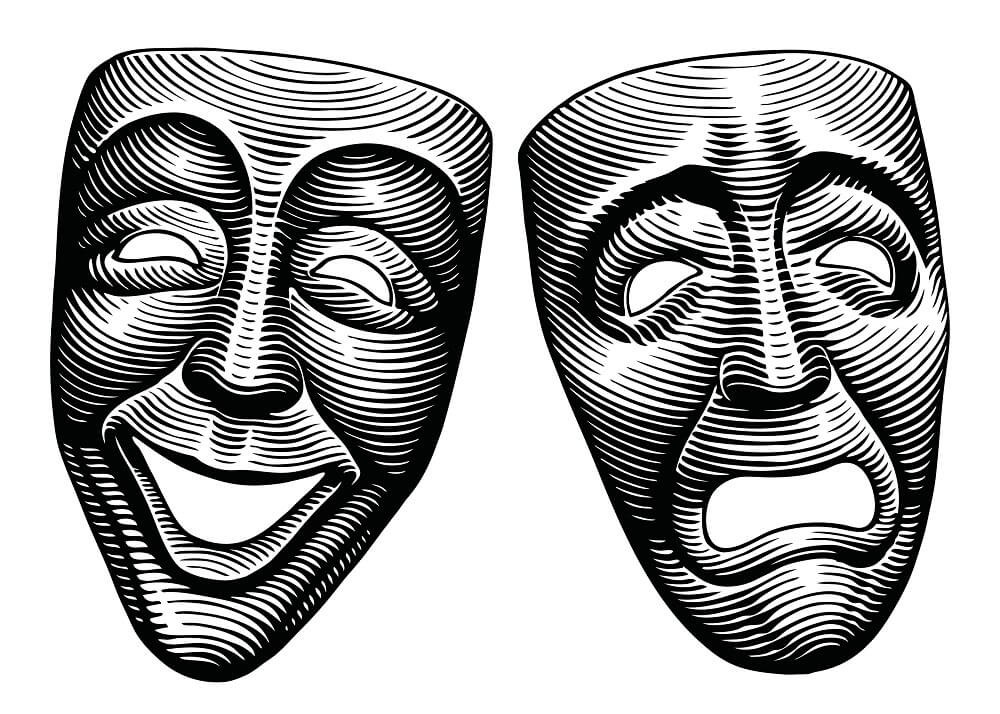
Comedy differs from tragedy primarily in its purpose and ending: tragedy depicts an insoluble conflict that leads the protagonist to defeat or death and is intended to evoke pity and fear in the audience, while comedy ridicules human foibles and usually ends happily. Both genres have their origins in ancient Greece, in rituals dedicated to Dionysus. They also differ in the types of characters, language, and mood.
To sum it up
- Ending: Tragedy is the defeat or death of the hero, comedy is usually a successful ending.
- Target: Tragedy is meant to lead to catharsis, comedy is meant to entertain and ridicule shortcomings.
- Heroes: According to Aristotle, tragedy presents people who are «better» than average, while comedy presents people who are «worse.».
- Style: sublime in tragedy, colloquial and humorous in comedy; the patroness of tragedy is Melpomene, of comedy – Thalia.
Where did comedy and tragedy come from?
Both genres originated in Ancient Greece from songs performed during festivals in honor of Dionysus . Tragedy grew out of serious and lofty songs, comedy out of playful and mocking ones. In Athens, plays were staged during Dionysian festivals in the form of playwright competitions.
Word «"tragedy"» usually comes from Greek words tragos (goat) and ode (song), meaning "goat song." Tradition attributes to Thespis the creation of an actor who conducted a dialogue with the chorus. The greatest Greek tragedians were Aeschylus, Sophocles, and Euripides.
Comedy (Greek: comodi ) literally means "song of the komos"—the komos was a merry procession of wine-drinking worshipers of Dionysus who sang obscene songs and ridiculed passersby. The most famous author of ancient Attic comedy was Aristophanes, and of the so-called New Comedy, Menander.
Tragedy – Definition and Characteristics
Tragedy — is a genre of drama that depicts a serious conflict from which the protagonist cannot emerge victorious. Every choice the protagonist makes leads to disaster—this is called tragic conflict . The most important concepts associated with ancient tragedy are the following:
- Fate – an inevitable fate from which the hero cannot escape.
- Hamartia - a tragic mistake or misdeed of a hero, often resulting from ignorance or overconfidence ( arrogance ).
- Catharsis – according to Aristotle’s Poetics, tragedy, by awakening compassion and fear, leads to the purification of these feelings.
- Choir comments on events and expresses the opinion of the community.
- The principle of three unities – the unity of time, place and action; its precise formula was deduced from the Poetics only by the theorists of the Renaissance and Classicism.
Examples of tragedies include Sophocles' Antigone and Oedipus Rex, as well as William Shakespeare's Hamlet and Macbeth. In Polish literature, the first humanistic tragedy is considered to be Jan Kochanowski's The Dismissal of the Greek Envoys, performed in 1578.
Comedy - Definition and Types of Comedy
Comedy — is a dramatic genre in which events and characters evoke laughter. Conflicts are resolvable, and the action usually leads to a successful conclusion—reconciliation, marriage, or the exposure of a con artist. Laughter often serves as a form of criticism: comedy points out character and moral flaws. Humor arises from three types of comedy:
- Situational comedy - funny coincidences, mistakes, disguises, changes of identity.
- Characteristic comedy - exaggerated character traits, such as stinginess, cowardice, vanity.
- Verbal comedy - wordplay, witty responses, linguistic misunderstandings.
Examples of comedies: "Clouds" and "Birds" by Aristophanes, "The Miser" and "Treasures" by Moliere, "A Midsummer Night's Dream" by Shakespeare, and also from Polish literature - "Revenge" and "Ladies and Hussars" by Aleksander Fredro.
Comedy vs. Tragedy - Comparison Chart
| Characteristic | Tragedy | Comedy |
|---|---|---|
| End | An accident is a defeat, the death of a hero | Usually everything ends well - reconciliation, marriage. |
| Target | It evokes pity and fear, catharsis | Entertainment, ridicule of shortcomings |
| Conflict | Tragic, insoluble | Solvable, often arises due to misunderstandings. |
| Heroes | Outstanding personalities: kings, heroes | Ordinary people with visible disabilities |
| Language | Sublime, pitiful | Conversational, humorous |
| Topics | Fate, guilt, duty, power, honor | Love, money, customs, human weaknesses |
| Muse-Protector | Melpomene | Waist |
| Ancient Creators | Aeschylus, Sophocles, Euripides | Aristophanes, Menander |
How can you tell if a piece is a comedy or a tragedy?
During a Polish lesson or when reviewing a book, it's worth asking yourself a few questions:
- How does the piece end? The death or fall of the protagonist indicates a tragedy, while a happy ending indicates a comedy.
- Could the hero have avoided the disaster? If every choice leads to disaster, then we are faced with a tragic conflict.
- What makes us laugh or what touches us? Comedy evokes laughter at shortcomings and situations, tragedy evokes compassion and fear.
- What language do the characters speak? Tragedy is characterized by a lofty, touching style, while comedy is conversational and witty.
The line isn't always sharp. Shakespeare already combined tragic and comic scenes in one work, and tragicomedy deliberately mixes them. In modern theater and cinema, pure genres are rare – even serious dramas contain elements of humor.
Frequently Asked Questions (FAQ)
What is catharsis?
Catharsis is a concept from Aristotle's Poetics. It describes the purification the audience experiences through tragedy: feeling compassion for the protagonist and fear for their fate, they are freed from these feelings.
Which muse is the patroness of comedy and which of tragedy?
Melpomene is the patroness of tragedy, and Thalia of comedy. Both are among the nine muses of Greek mythology. Their attributes are masks: tragic and comic.
What types of comedy are there?
There are three main types of comedy: situational (funny events and mistakes), characterological (exaggerated character traits), and verbal (puns, witty remarks).
What is tragicomedy?
Tragicomedy is a dramatic work that combines elements of tragedy and comedy: serious, even painful events are intertwined with comic scenes, and the ending does not necessarily have to be either clearly happy or tragic.
What was the first Polish tragedy?
Jan Kochanowski's tragedy "The Dismissal of the Greek Envoys" is considered the first Polish humanist tragedy. It was performed in 1578 during Jan Zamoyski's wedding.
See also
- What is the difference between opera and ballet?
- What is the difference between ancient and Shakespearean drama?
- What is the difference between prose and poetry?
- What is the difference between a novella and a short story?
- What is the difference between a legend and a fairy tale?