

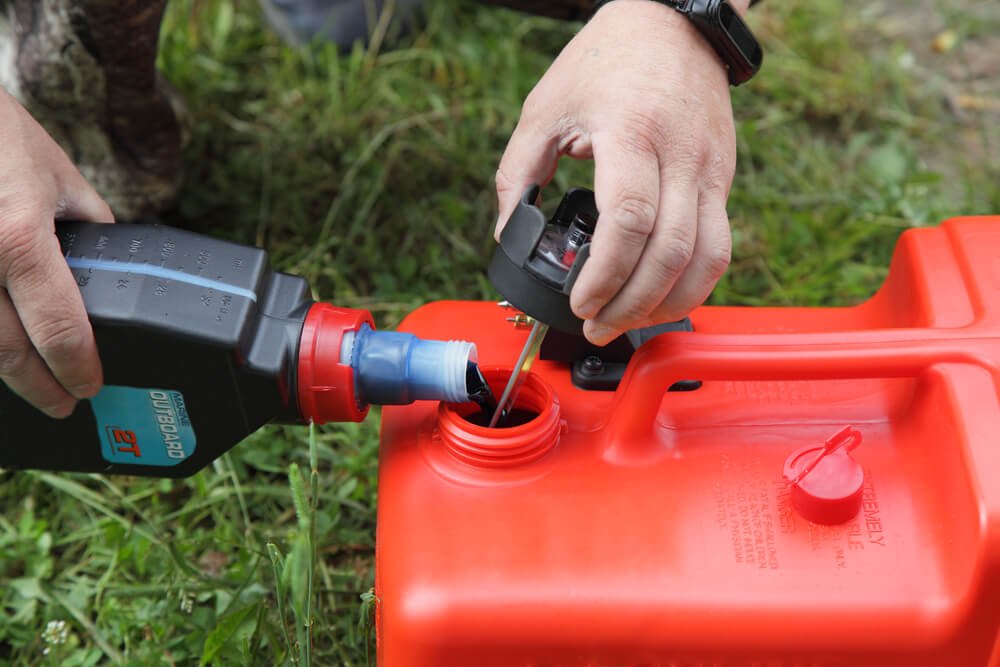
2T oil is designed for two-stroke engines: it is mixed with gasoline (or injected by a separate pump) and burns together with the fuel, while 4T oil works in a closed circuit of a four-stroke engine, circulating inside it until changed. This explains all the other differences: different compositions, different quality standards, and different functions. 2T and 4T oils are not interchangeable – using the wrong oil can damage the engine.
To sum it up
- 2T oil – for two-stroke engines (chainsaws, brush cutters, some scooters, mopeds, outboard motors); added to fuel and burned.
- 4T oil – for four-stroke engines (motorcycles, lawn mowers, generators); pour into the pan or tank, top up periodically.
- 2T oil should burn cleanly and with minimal smoke, while 4T oil should retain its lubricating properties for a long time at high temperatures.
- Standards: for 2-stroke engines, including JASO FB/FC/FD and ISO-L-EGB/EGC/EGD (and for outboard engines NMMA TC-W3), for 4-stroke engines, among others, SAE and JASO MA/MB (viscosity for motorcycles).
Two-stroke and four-stroke engines – why are there different oils?
В four-stroke (4T) engine The oil is stored in an oil pan or a separate reservoir. A pump delivers it to the bearings, camshaft, and cylinder walls, and then returns it to the engine. The same oil can last for thousands of kilometers or dozens of hours of operation before it needs to be changed.
In a typical two-stroke engine The crankcase is part of the intake system—the fuel-air mixture flows through it. There's no room for an oil bath, so oil enters the engine along with the fuel. It lubricates the bearings, piston, and cylinder, then burns in the combustion chamber and exits through the exhaust system. Thus, each dose of two-stroke oil is "disposable.".
How are 2T and 4T oils administered?
2T oil is supplied to the engine in two ways:
- In the mixture Oil is added to gasoline in the ratio specified by the equipment manufacturer (for example, a ratio of 1:50 means 20 ml of oil per liter of gasoline); this is how most chainsaws, brush cutters, and leaf blowers work.
- Oil supplied from a separate tank – the oil pump itself doses oil into the fuel; this system is used, in particular, in scooters and two-stroke motorcycles.
Four-stroke engine oil is poured directly into the engine—through the filler neck into the crankcase or tank—and checked with a dipstick. Nothing is added to four-stroke gasoline.
Always consult your specific engine manual for the correct fuel mixture ratio. Too little oil can cause overheating and seizure, while too much can cause excessive smoke and carbon deposits.
Composition and properties of 2T and 4T oils
Two-stroke oil is designed in such a way that mixes well with gasoline , protect the engine as quickly as possible as the fuel passes through it and burn as cleanly as possible — with minimal smoke, ash, and deposits on the piston, spark plug, and exhaust system. It has a lower ash content than conventional four-stroke oil.
4T oil must withstand high temperatures and loads over long periods of time without losing viscosity. It contains a complex of detergent, anti-wear, and antioxidant additives. In motorcycles, 4T oil is also often used to lubricate the gearbox and wet clutch , providing the necessary frictional properties.
Standards and labeling on bottles
2T oils They are primarily classified according to the Japanese standard JASO M345, with levels FA, FB, FC, and FD (FD being the highest level with the most stringent purity requirements). Levels FB, FC, and FD have equivalents in the ISO standard: EGB, EGC, and EGD . A separate specification is used for water-cooled outboard engines. NMMA TC-W3 . 2T oils do not typically have an SAE viscosity grade.
4T oils are classified by SAE viscosity grade (e.g. 10W-40) and quality standards such as API. For motorcycles, the standard is important. JASO T903 : oils MA (with subclasses MA1 and MA2) are intended for motorcycles with wet clutches, and oils MB — for designs in which oil does not lubricate the clutch (for example, scooter parts).
Comparison Chart: 2T Oil vs. 4T Oil
| Characteristic | 2T oil | 4T oil |
|---|---|---|
| Engine type | Two-stroke | Four-stroke |
| Directions for use | Mixed with gasoline or through a metering pump | To the oil pan/tank |
| The fate of oil | It burns along with the fuel. | It is in circulation for exchange. |
| Main characteristics | Fuel miscibility, clean combustion, low smoke and ash content. | Durability, stable viscosity, detergents and anti-wear additives. |
| Standards | JASO FA–FD, ISO-L-EGB/EGC/EGD, NMMA TC-W3 | SAE, API, JASO MA/MA1/MA2/MB |
| Exchange | It is not replaced, it is refueled. | Periodically, according to the instructions. |
| Application examples | Chainsaws, brush cutters, blowers, mopeds, two-stroke outboard motors | Motorcycles, lawn mowers, generators, 4-stroke outboard motors |
How do you determine which oil you need?
- Check the instructions or markings on the device. The manufacturer specifies the engine type, oil type and fuel mixture ratio.
- Please note that there is a separate oil filler neck and dipstick. If they are there and you don't need to add anything to the fuel, it is usually a 4-stroke engine.
- Pay attention to the fuel tank cap. On two-stroke engines, it often contains information about the mixture composition (for example, «Mixture 1:50»).
- Do not use car oil in a motorcycle with a wet clutch, Without checking compliance with standards, oils with friction-modifying additives can cause clutch slippage. Look for the JASO MA marking.
- For boats with two-stroke engines, If recommended by the engine manufacturer, choose oil marked NMMA TC-W3.
What happens if you mix up 2T and 4T oil?
Four-stroke engine oil added to gasoline in a two-stroke engine is not designed for combustion – it can cause smoking, piston and spark plug fouling, exhaust port clogging, and even seizure if insufficient lubrication occurs. Two-stroke engine oil added to the crankcase of a four-stroke engine will not provide adequate protection in a closed-loop system. In both cases, it's best not to start the engine, drain the unsuitable fluid, and contact a service center.
Frequently Asked Questions (FAQ)
What is the difference between 2T and 4T oil?
2T oil is designed for two-stroke engines—it's added to the fuel and burned with it. 4T oil is designed for four-stroke engines—it circulates in a closed circuit and is periodically replaced. They differ in composition, standards, and application.
Can I use 4 tablespoons of oil instead of 2 tablespoons for this mixture?
4T oil is not intended for use with fuel and may cause sludge formation, smoke, and engine damage. Use 2T oil in a blend according to the manufacturer's recommendations.
How much 2T oil should be added to a liter of gasoline?
It depends on the manufacturer's recommended ratio. For a 1:50 ratio, it's 20 ml of oil per liter of gasoline, while for a 1:25 ratio, it's 40 ml. Always check the device's instructions and the oil packaging.
What does the abbreviation JASO FD mean on two-stroke oil?
This is the highest quality level in the JASO M345 standard for two-stroke oils, placing the highest demands on engine cleanliness. Its ISO equivalent is EGD.
Does a lawn mower need 2T or 4T oil?
Most modern gasoline-powered lawn mowers are equipped with four-stroke engines and require four-stroke oil. Gasoline-powered brush cutters (trimmers) often have two-stroke engines. The engine type is determined in the owner's manual.
See also
- What is the difference between 75w80 and 75w90 oils?
- What is the difference between 5w40 and 10w40 oils?
- What is the difference between 5w30 and 5w40 oils?
- What is the difference between synthetic and semi-synthetic oil?