

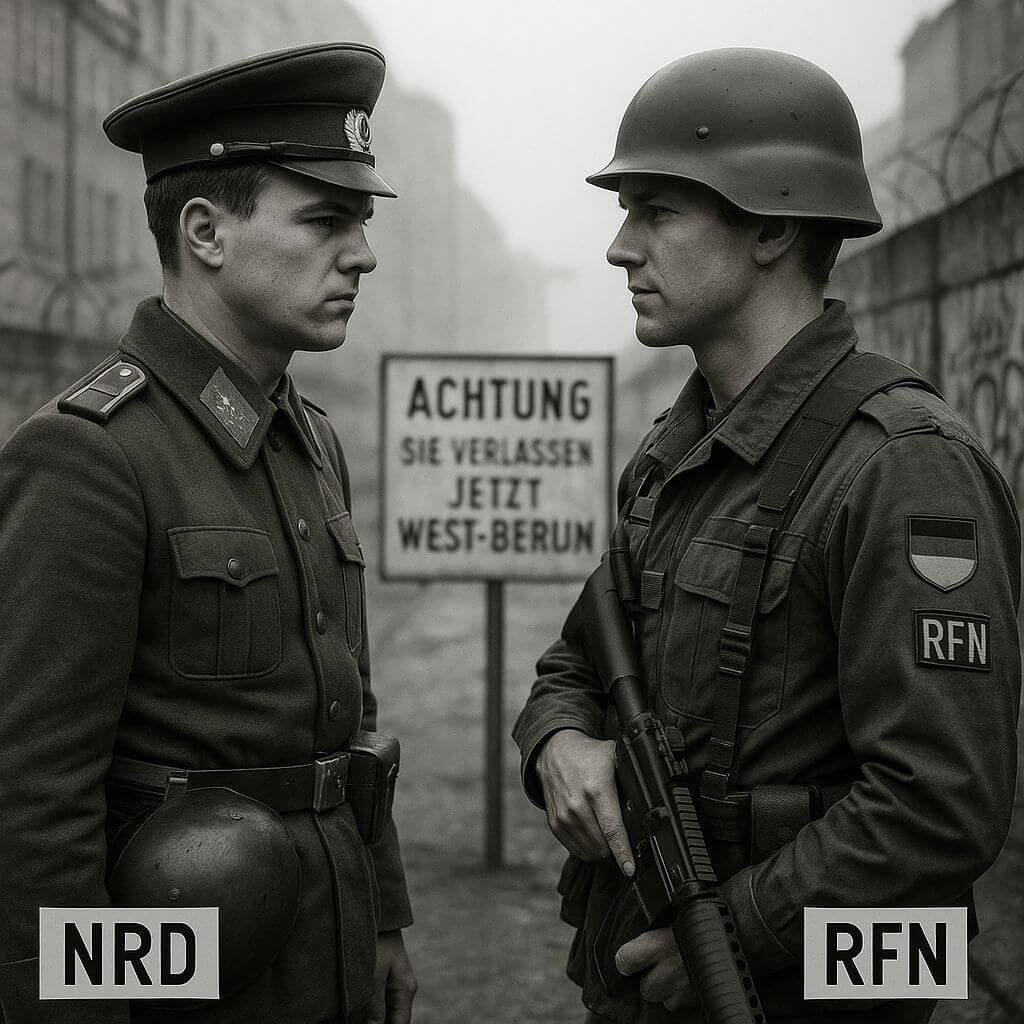
The GDR (German Democratic Republic) was a socialist one-party state dependent on the USSR, while the FRG (Federal Republic of Germany) was a federal parliamentary democracy with ties to the West. Both states were formed in 1949 from divided Germany and existed simultaneously until reunification on October 3, 1990. They differed in their political systems, economies, unions, currencies, and the daily lives of their citizens.
To sum it up
- System of government: East Germany was a dictatorship of the Socialist Unity Party (SED) with the Stasi political police; West Germany was a multi-party democracy based on the Basic Law.
- Economy: The GDR – centralized planning and state ownership; the FRG – social market economy.
- Allied unions: East Germany in the Warsaw Pact and Comecon; West Germany in NATO and the European Communities.
- Capitals: East Germany – East Berlin; West Germany – Bonn. After reunification, the GDR became part of the Federal Republic of Germany.
Where did the GDR and FRG come from?
After the defeat of the Third Reich in 1945, the victorious powers divided Germany into four occupation zones: American, British, French, and Soviet. Berlin was similarly divided into sectors, although it was entirely within the Soviet zone. The escalating conflict between the West and the USSR led to the creation of not one state, but two.
Federal Republic of Germany was formed from three western zones - its constitution, Basic Law , was adopted on May 23, 1949. German Democratic Republic was proclaimed on October 7, 1949, on the territory of the Soviet zone. The Federal Republic of Germany was significantly larger—both in area and population.
East and West Germany – differences in political system.
In the GDR, real power belonged to Socialist Unity Party of Germany (SED) . Formally, other parties existed, but they operated as a bloc subordinated to the SED, and elections offered no real choice. The opposition, churches, and ordinary citizens were monitored. Ministry for State Security, known as the Stasi . The media were censored.
The Federal Republic of Germany was federation of states (Länder) With free elections, competing parties, independent courts, and a Federal Constitutional Court. Parliament consisted of the Bundestag and the Bundesrat, the government was headed by the Chancellor, and the head of state was the Federal President. The Basic Law guaranteed civil rights and liberties—after 1990, it became the constitution of reunified Germany.
Economy and Currency: Planned vs. Market
In the GDR there was centrally planned economy Industrial enterprises were nationalized, and agriculture was largely collectivized. Production and prices were controlled by state plans. Shortages of consumer goods and long waits for certain items were commonplace—the Trabant, which appeared only years later, became a symbol of this phenomenon.
The Federal Republic of Germany adopted the model social market economy — a free market with an extensive social security system. The rapid economic growth of the 1950s was called the "economic miracle" (Wirtschaftswunder). The currency of the Federal Republic of Germany is German mark (Deutsche Mark) , while the GDR's currency was GDR stamp , not convertible on world markets. On July 1, 1990, in accordance with the Treaty on Economic, Monetary and Social Union, the Deutsche Mark replaced the currency of the GDR.
Unions and Foreign Policy
The two countries found themselves on opposite sides of the Cold War. The Federal Republic of Germany was a member NATO since 1955 and contributed to European integration by being a founding member of the European Coal and Steel Community and the EEC. The German Democratic Republic was part of Warsaw Pact и CMEA , and its foreign policy was subordinated to Moscow.
For many years, the Federal Republic of Germany did not recognize the GDR (the so-called Hallstein Doctrine). The situation changed with Chancellor Willy Brandt's "New Ostpolitik": December 21, 1972 An agreement was signed establishing the basis for relations between the two countries, and in 1973 both countries were admitted to the UN.
Comparison Chart: East Germany vs. West Germany
| Characteristic | GDR | Federal Republic of Germany |
|---|---|---|
| Full name | German Democratic Republic (GDR) | Federal Republic of Germany (FRG) |
| Height | October 7, 1949 | May 23, 1949. |
| Capital | East Berlin | Bonn |
| System | Socialist, de facto rule of the SED | Parliamentary democracy, federation of states |
| Economy | Centrally planned | Social market economy |
| Currency | GDR brand | German mark (DM) |
| Alliances | Warsaw Pact, CMEA | NATO, European Communities |
| End of existence | October 3, 1990 – accession to the Federal Republic of Germany. | It still exists as a united Germany. |
The Berlin Wall and German reunification
Hundreds of thousands of people, many of them young and educated, fled the GDR for the West. To stem this flow, the GDR authorities August 13, 1961 construction began Berlin Wall , cutting off West Berlin. The border between the two countries became one of the most heavily guarded in Europe.
In the autumn of 1989, mass protests and the flight of citizens through Hungary and Czechoslovakia weakened the power of the SED. November 9, 1989 passages through the Berlin Wall were opened. On March 18, 1990, the first free elections to the People's Chamber of the GDR took place, on July 1, the currency union came into force, and October 3, 1990 The GDR joined the Federal Republic of Germany. The former territories of the GDR became the so-called new federal states, and Berlin became the capital of the reunified Germany.
How to remember what is what?
- GDR = East Germany . The word "democratic" in the title is a propaganda term, not a description of a real system.
- FRG = West Germany – «federal» because it consisted of lands; this name is still used today.
- German abbreviations: DDR (Deutsche Demokratische Republik) - GDR, BRD (Bundesrepublik Deutschland) - Germany.
- On the map: the GDR bordered Poland and Czechoslovakia, the FRG – among others, with France, the Netherlands, Belgium and Austria.
Frequently Asked Questions (FAQ)
What is the Federal Republic of Germany today?
Yes. The official name of modern Germany remains the Federal Republic of Germany. In 1990, the GDR became part of the Federal Republic of Germany, so a new state was not created—the Federal Republic of Germany expanded to include the eastern states.
Why was Bonn the capital of Germany and not Berlin?
Berlin was located in the center of the Soviet zone and was divided. Bonn was chosen as the temporary seat of government until reunification. After 1990, Berlin became the capital, and parliament and the government gradually moved there.
When did the unification of the GDR and the FRG take place?
October 3, 1990 – this day is a public holiday in Germany (German Unity Day). Earlier, on November 9, 1989, the Berlin Wall was opened.
Was the GDR a democratic country?
Not in the Western sense of the word. Despite the word "democratic" in its name, the SED was in power, elections were not free, and the opposition was subject to surveillance and repression by the Stasi. The first free elections were held only in March 1990.
What do the abbreviations DDR and BRD mean?
These are the German names of both countries: East Germany (GDR) – Deutsche Demokratische Republik (GDR), West Germany – Bundesrepublik Deutschland (FRG). In Poland, the Polish abbreviations for East Germany and West Germany are used.
See also
- What is the difference between totalitarianism and authoritarianism?
- What is the difference between an enclave and an exclave?
- What is the difference between the executive and legislative branches?
- What is the difference between public administration and local government?
- How do the November uprisings differ from the January ones?