

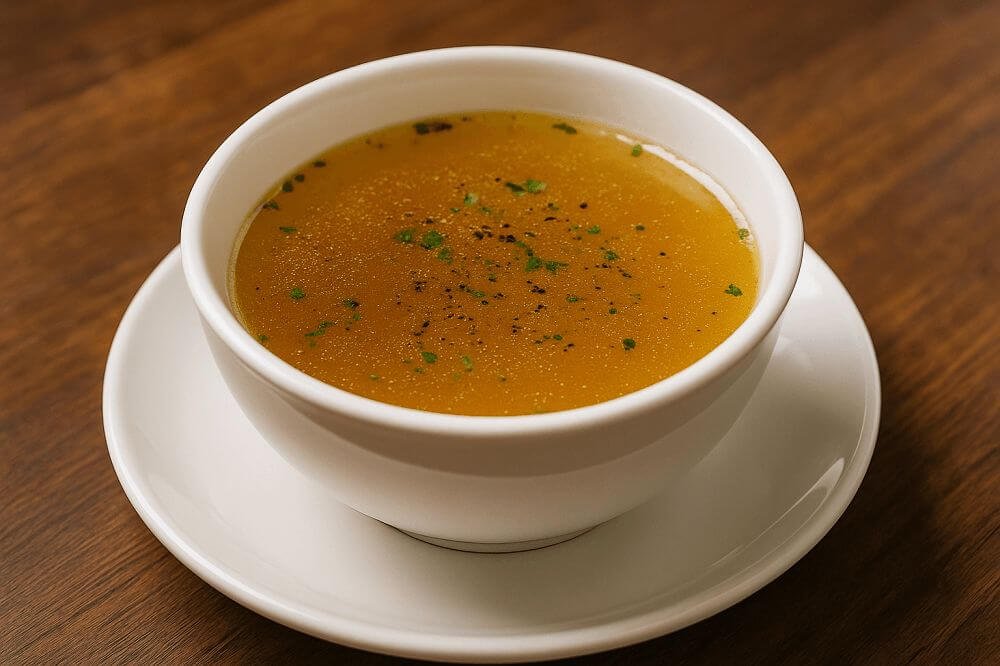
A broth is a prepared soup made from meat, bones, and vegetables, usually served with noodles, while a clear stock itself is used as a base for other dishes or served as a light drink in a cup; broth is also known as a concentrated cube of soup that can be dissolved in water. In home cooking, these two terms are often used interchangeably, as they are prepared very similarly. The difference lies primarily in their role in the dish and the method of serving.
To sum it up
- Bouillon – according to PWN, «a soup made from bone and meat broth with vegetables»; a separate dish.
- Bouillon – «meat broth with vegetables» or concentrate for dilution; the name comes from the French words bouillon .
- The broth is served with noodles, meat and vegetables ; broth - usually transparent , in a cup or as a base for sauces and soups.
- Bouillon cube is concentrate , and not a replacement for homemade broth.
Broth and decoction – definitions
The Polish dictionary PWN defines dew as "a soup made from bone and meat broth with vegetables." The key word here is "zupa"—rosol—a dish served in a bowl, usually with noodles or other toppings.
According to PWN, the word "broth"« has two meanings: 1) "meat broth with vegetables" and 2) "a concentrate used after dilution as a decoction." The word comes from the French bouillon , related to the verb bouillir , meaning "to cook." In French cuisine, bouillon is the basic stock used to make soups and sauces.
To put it simply: Any broth starts with a decoction, but a decoction doesn't always turn into a broth . It can be used as a base for a sauce, risotto, cream soup, or even served as a standalone dish.
What is the practical difference between broth and decoction?
Role in food
In Polish tradition, broth is a complete dish, often served on Sundays or holidays. Most often, broth is used in as a semi-finished product It's added to soups, drizzled over vegetables, used to brush roasts, and added to sauces and cereals. Restaurants also serve it as a clear, hot appetizer in a cup, for example, with pâté or croutons.
Ingredients and additives
The broth is made from bone-in meat—usually poultry, beef, or a combination of both—with vegetables (carrots, parsley, celery, leeks), onions, and spices such as black peppercorns, allspice, and bay leaves. It's then served on a plate with pasta, and often with chunks of meat and boiled carrots.
The broth can be made from the same ingredients, but you can also use only vegetables (vegetable broth) or bones. It is served strained, pure or with a few additions.
Transparency and taste
A good broth should be transparent . This is achieved by simmering slowly over low heat, not bringing to a boil, and skimming off any foam. Broths intended as a base for sauces are often simmered to enhance their flavor; the broth is seasoned to resemble soup.
Broth vs. Stock Comparison Chart
| Characteristic | Bouillon | Chicken broth |
|---|---|---|
| Definition (PWN) | Meat and vegetable broth; concentrate can also be used for dilution. | Bone broth and meat soup with vegetables. |
| Origin of the name | French bouillon | Name in native Polish |
| Role | A base for meals or a light snack | A standalone dish |
| Ingredients | Meat, bones or just vegetables | Meat with bones and vegetables |
| Directions for use | Pure, in a cup or as an ingredient. | On a plate with pasta, meat and vegetables. |
| The form is ready in the store. | Bouillon cube, paste or granules | There are no analogues to this dish - it is prepared exactly like this. |
Are bouillon cubes and broth the same thing?
No, a bouillon cube (or paste) is concentrate , another meaning of the word "broth," according to PWN. When dissolved in water, it forms a broth-flavored liquid, useful for quickly flavoring sauces or soups. The composition of concentrates varies depending on the manufacturer, so it's important to read the label carefully, especially for information on salt and flavor enhancers.
Homemade broth and decoction are made from natural ingredients, and their taste depends on the quality of the meat, bones, and vegetables, as well as the cooking time.
Broth or decoction – when to cook which?
- For Sunday lunch - chicken noodle soup; this is a separate dish in itself.
- For cream soup, risotto, sauce or cereal Use broth, preferably homemade; it will give the dish a richer flavor than just water.
- As a light snack - clear broth in a cup, for example with pate.
- For vegetarians — vegetable broth; classic broth by definition implies the presence of meat and bones.
- To prepare the broth – the cooked broth can be strained, cooled and divided into portions; it can be used later as a base.
Recently popular bone broth Collagen broth (also known as collagen broth) is a long-simmered broth made primarily from bones, joints, and cartilage. The collagen released from these bones forms a gelatinous mass when cooled. Claims regarding specific health benefits of this broth should be treated with caution.
Frequently Asked Questions (FAQ)
Are broth and decoction the same thing?
Not quite. Broth is a soup made from meat, bones, and vegetables, usually served with noodles. Broth is the broth itself, the base for dishes, or the clear liquid in a cup or concentrate in a cube. In colloquial speech, these words are sometimes used interchangeably.
Is it possible to make broth without meat?
Yes. Vegetable broth is made exclusively from vegetables and spices. A classic broth requires meat and bones, as defined by the PWN dictionary.
Is a bouillon cube a broth?
Yes, this cube is a bouillon concentrate that, when dissolved in water, forms a broth-flavored liquid. However, it's not a broth, but merely a quick substitute for seasoning dishes.
How is broth served?
It's most often served hot in a cup or soup pot, sometimes with pâté or croutons. It's rarely served on its own, but is used as a base for soups, sauces, and grain or rice dishes.
Where does the word "broth" come from?
The word bouillon comes from the French bouillon, related to the verb bouillir, meaning "to cook." In French cuisine, bouillon is the basic broth for soups and sauces.
See also
- What is the difference between pudding and jelly?
- What is the difference between jam and plum preserves?
- What is the difference between yellow and green zucchini?
- What is the difference between bacon and pork belly?