

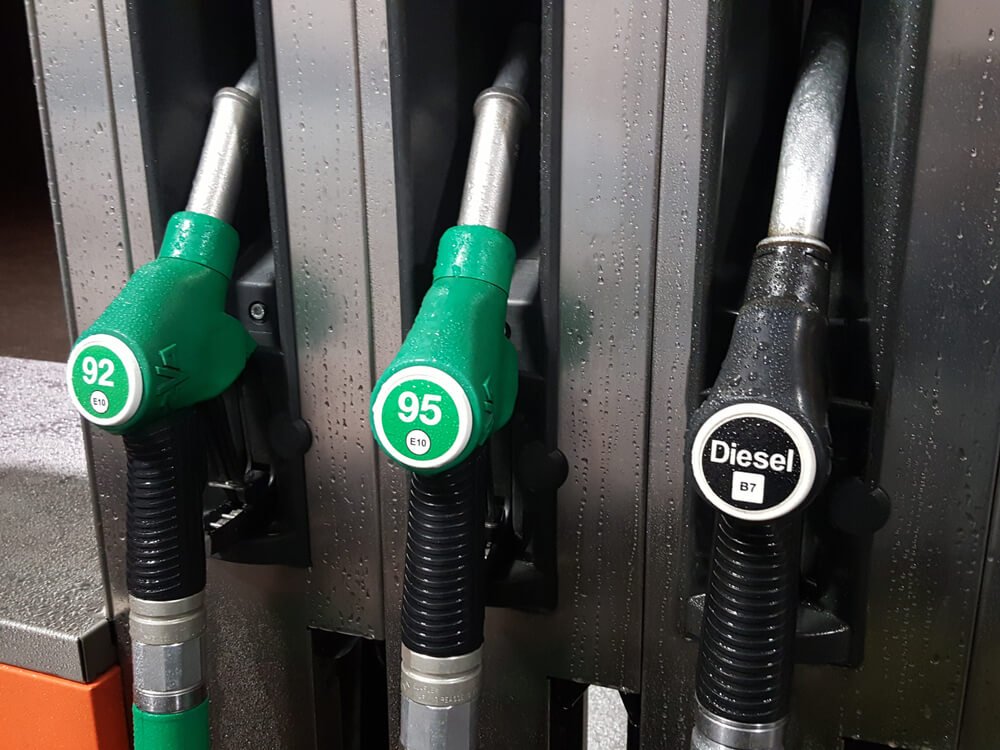
95 octane gasoline differs from 98 octane gasoline primarily in its octane rating, or resistance to detonation: 98 octane gasoline has a higher octane rating, so it can better withstand high pressure and temperatures in the combustion chamber. In Poland, they also differ in bioethanol content: gasoline with an octane rating of 95 is classified as E10 fuel (with up to 10% bio-components), while gasoline with an octane rating of 98 is sold as E5. The vehicle manufacturer, not price, determines which fuel to use.
To sum it up
- Octane number: Pb95 – min. 95 RON / 85 MON, Pb98 – min. 98 RON / 88 MON.
- Bioethanol: Since 2024, in Poland, Pb95 corresponds to E10 fuel, and Pb98 remains E5 fuel.
- A car designed for 95 octane gasoline, will not benefit significantly from running on 98 octane gasoline; a vehicle that requires 98 octane gasoline should not run on 95 octane gasoline.
- The operating instructions or the sticker on the fuel tank cap are decisive. .
Octane rating is the main difference between 95 octane and 98 octane gasoline.
Octane number measures the resistance of gasoline to detonation , Detonation is the uncontrolled spontaneous combustion of the fuel mixture before the spark plug flame reaches it. This combustion is sometimes heard as a metallic "pinging" sound. Prolonged detonation can seriously damage the engine, including the pistons and valves.
The higher the octane rating, the more resistant the fuel is to this phenomenon. This doesn't mean that 98-octane gasoline is "stronger" or contains more energy—it simply allows designers to use higher compression ratios, higher boost pressure, and more aggressive ignition timing. Only an engine specifically designed for this fuel can take advantage of this advantage.
Fuel with an octane rating of 98 is most often recommended for engines with high compression ratios and powerful boost (turbochargers, superchargers), as well as for sports cars. In such engines, the control electronics can adjust ignition timing to achieve the full power specified by the manufacturer when using fuel with a higher octane rating. A typical city car designed for 95 octane fuel does not have this reserve, so 98 octane fuel does not significantly affect its performance.
RON and MON – what do the rules say?
The fuel dispenser displays the octane number RON (Research Octane Number). Regulations also establish the motor octane number MON (Motor Octane Number), measured under more stringent conditions, at higher engine loads. According to the liquid fuel quality requirements regulation, based on the standard PN-EN 228 :
- Unleaded petrol 95: RON not less than 95.0 and MON not less than 85.0.
- Unleaded gasoline 98: octane number not less than 98.0, and MON not less than 88.0.
Both types of gasoline must meet the same quality requirements. Gas stations often sell 98 octane gasoline under their own brands as "premium" fuel with an additional additive package—their composition and stated characteristics vary by fuel manufacturer.
Comparison table: gasoline 95 or 98
| Characteristic | 95 gasoline | 98 gasoline |
|---|---|---|
| Scientific octane number (RON) | at least 95 | at least 98 |
| Motor octane number (MON) | at least 85 | min. 88 |
| Appointment in Poland | E10 (up to 10% biocomponents) | E5 (up to 5% biocomponents) |
| Standard | Mon-En 228 | Mon-En 228 |
| Price | Below | Higher |
| For whom? | Most vehicles, unless the manufacturer requires 98 | Engines for which the manufacturer recommends 98 octane petrol; older vehicles not suitable for use with E10 petrol. |
E10 and E5 is the second difference that few people remember.
From January 1, 2024, the standard 95-octane gasoline at Polish gas stations is E10 , which can contain up to 10% of biofuel. 98-octane gasoline is still sold as E5 (up to 5%). E5 and E10 markings are indicated on the filling pump and filling nozzle.
This is important for owners of older vehicles. If the vehicle is not compatible with E10 fuel—as indicated by the manufacturer, in the owner's manual, or on the fuel cap—98 E5 gasoline is a safer choice. Automakers and industry associations also publish compatibility lists.
Which gasoline should I use - 95 or 98?
- The manufacturer recommends gasoline with an octane rating of 95: Fill up with it. 98 octane gasoline won't provide a noticeable improvement in performance or fuel consumption in everyday driving, and it's also more expensive.
- The manufacturer recommends using gasoline with an octane rating of 98: Use it instead. 95 octane gasoline can impair engine performance, and in extreme cases, there's a risk of detonation.
- The manufacturer states «min. 95, recommended 98»: 95 is an acceptable value; 98 may allow the engine to operate at full power - this usually applies to cars with high-performance engines.
- For older vehicles that do not meet the E10 standard: select 98 E5.
Modern engines are equipped with knock sensor , which adjusts ignition timing when detonation is detected. This means that a one-time fill with lower-octane fuel usually won't cause damage, but the engine may run with reduced power. This shouldn't be considered a permanent fuel-saving measure if the manufacturer specifies a 98 octane rating.
If there's no 98-octane gas station on your route and your car requires it, fill up with enough 95-octane gasoline to reach the next station and drive more slowly—avoid sudden acceleration or high revs under heavy load. Next time you fill up, switch to the fuel recommended in your owner's manual.
The recommended octane rating can be found in operating manual or on a sticker on the fuel filler cap or door. If in doubt, contact an authorized service center.
Frequently Asked Questions (FAQ)
Can you mix 95 and 98 octane gasoline?
Yes, if the vehicle is suitable for both types of fuel. The mixture will have an intermediate octane rating, depending on the ratio. If the manufacturer requires 98 octane, such a mixture may not meet that minimum.
Does 98 octane gasoline reduce fuel consumption?
An engine designed for 95 octane gasoline shouldn't experience a noticeable reduction in fuel consumption or increase in power. The benefits of 98 octane gasoline are primarily evident in engines for which the manufacturer recommends this fuel.
What happens if I fill up with 95 octane gasoline instead of 98?
In modern cars, a knock sensor typically reduces the risk, but the engine may run at reduced power. Continuously using fuel with too low an octane rating increases the risk of detonation and damage. Next time you fill up, use the fuel recommended by the manufacturer.
What does the E10 marking on a pump mean?
E10 designates gasoline that may contain up to 10% of bio-based components (such as bioethanol). In Poland, standard 95-octane gasoline will be designated this way since 2024, while 98-octane gasoline will be sold as E5.
How do I know what kind of gasoline to use?
Check your vehicle's owner's manual or the sticker on the fuel filler cap. The manufacturer's instructions specify the minimum octane rating and compatibility with E10 fuel.
See also
- What is the difference between gasoline and diesel fuel?
- What is the difference between E5 and E10 gasoline?
- What is the difference between 5w30 and 5w40 oils?
- What is the difference between synthetic and semi-synthetic oil?