

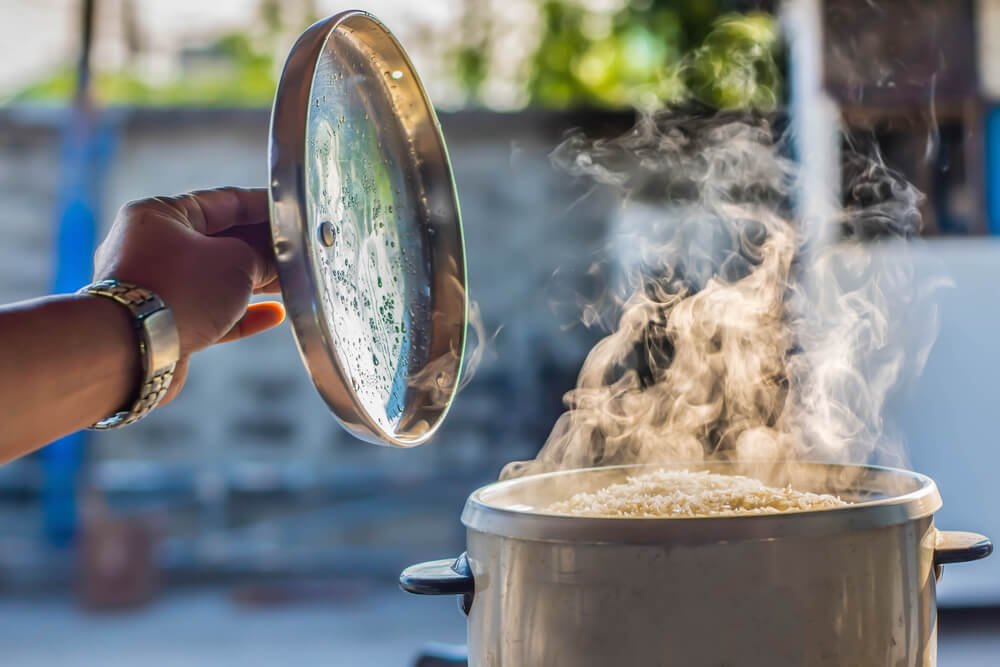
Evaporation occurs only on the surface of a liquid and at any temperature, whereas boiling occurs throughout the liquid and only at a certain temperature, called the boiling point. Both processes involve the transition of a liquid into a gaseous state, but boiling occurs violently and is accompanied by the formation of visible steam bubbles, while evaporation occurs quietly and unnoticeably.
To sum it up
- Evaporation location: Evaporation – only the surface of the liquid; boiling – the entire volume (steam bubbles are formed).
- Temperature: Evaporation occurs at any temperature; boiling occurs at the boiling point, which depends on the pressure.
- Process: During boiling, the temperature of the liquid does not change, even with the constant addition of heat; the evaporating substance may cool.
- Common features: Both processes involve a change in state of aggregation from liquid to gas and both require energy.
What is a paired connection?
Evaporation — is the transformation of a liquid into vapor from its free surface. Liquid molecules are constantly in motion, and their energy changes. The fastest molecules, located near the surface, can overcome the attraction of neighboring molecules and escape into the surrounding environment.
This is why evaporation occurs at any temperature – the laundry dries on the balcony, the puddles disappear, and the wet floor dries. As the particles with the highest energy evaporate, the average energy of the remaining particles decreases, and the liquid is cooled . This is the basis for cooling the body through sweat and the feeling of coolness after leaving the water.
What's boiling?
Boiling — is an intense evaporation that occurs throughout the entire volume of a liquid. Inside the liquid, usually near the heated bottom, steam bubbles . These bubbles grow, rise to the surface, and burst. This creates a characteristic gurgling sound.
Boiling begins when the saturated vapor pressure of a liquid is equal to the external pressure above its surface. Only then can a vapor bubble exist within the liquid without being destroyed. The temperature at which this occurs is called boiling point . For pure water at standard pressure (1013.25 hPa) it is 100 °C.
Boiling and evaporation are the most important differences.
Temperature and pressure
Evaporation has no temperature threshold—it happens even on a cold day, it's just slower. For boiling to occur, it needs to reach the boiling point, which depends on pressure . At lower pressures, such as high in the mountains, water boils at less than 100°C, so it takes longer to reach a boil. In a pressure cooker, the pressure is higher, and the boiling point exceeds 100°C, which reduces cooking time.
Constant temperature during boiling
When water boils, its temperature does not increase , even though the burner continues to heat up. All the heat supplied is used to convert the liquid into vapor (this is called the heat of vaporization). A stronger flame accelerates boiling, but at constant pressure, it does not increase the temperature of the water.
Process speed
The rate of evaporation depends on several factors: liquid temperature, surface size, air movement over the liquid, air humidity and liquid type . This is why laundry dries faster on a warm, windy, and dry day, and why tea cools faster on a flat plate than in a tall mug. Boiling speed depends primarily on how much heat we expend per unit of time.
Comparison chart: evaporation vs. boiling
| Characteristic | Evaporation | Boiling |
|---|---|---|
| Where does this happen? | Only on the surface of the liquid | Throughout the entire volume of liquid |
| Temperature | Any | Boiling point (depends on pressure) |
| State | There is no threshold - some particles always escape. | Saturated vapor pressure = external pressure |
| Visibility | Unnoticeable, silent | Steam bubbles, gurgling |
| Liquid temperature during | It may go down (the liquid will cool down). | Constant at constant pressure |
| Speed | Usually slow | Cruel |
| Examples | Drying clothes, drying a puddle, sweating | Boil water in a kettle, cook pasta |
What connects these two processes?
Evaporation and boiling are types evaporation in the broad sense , that is, the transition from a liquid to a gaseous state. In both cases, the liquid must absorb energy—the molecules must overcome their mutual attraction. The reverse process is condensation , during which steam releases heat and turns into liquid, for example on a cold window.
It is also worth distinguishing these two concepts from sublimation – transition from a solid state directly to a gaseous state, bypassing the liquid (for example, dry ice, that is, solidified carbon dioxide).
How can you tell if a liquid is evaporating or boiling?
- You see, how vapor bubbles form deep within a liquid , and you hear a gurgling sound - this is boiling.
- Liquid slowly disappears without any visible signs - this is evaporation.
- Single bubbles on the sides of the pan immediately after heating begins usually indicate the release of air dissolved in the water, and not boiling.
- The white "steam" above the pan is actually tiny droplets of condensed water—the steam itself is invisible.
Frequently Asked Questions (FAQ)
Does evaporation occur during boiling?
Yes. During boiling, the liquid continues to evaporate from the surface, but additional vapor forms within the liquid in the form of bubbles. Therefore, boiling can be considered a particularly intense form of evaporation.
Why does water boil at a lower temperature in the mountains?
At high altitudes, atmospheric pressure is lower. Boiling begins when the saturated vapor pressure equals the external pressure, so at lower pressure, a lower temperature is sufficient.
Why does evaporation cool the body?
The most energetic particles evaporate from the surface. The remaining particles have, on average, lower energy, meaning the liquid—and the skin in contact with it—has a lower temperature. Consequently, sweat cools the body.
Is it possible to boil water without heating it?
Yes, for example, by reducing the pressure above the water using a vacuum pump. When the pressure drops to the saturated vapor pressure at a given temperature, the water will begin to boil, even if it's not hot.
What is the difference between evaporation and condensation?
These are reverse processes: during evaporation, liquid turns into gas and absorbs heat, and during condensation, gas turns into liquid and releases heat.
See also
- What is the difference between a physical phenomenon and a chemical reaction?
- What is the difference between liquefied gas and propane-butane?
- What is the difference between calorific value and heat of combustion?
- What is the difference between fungus and mold?