

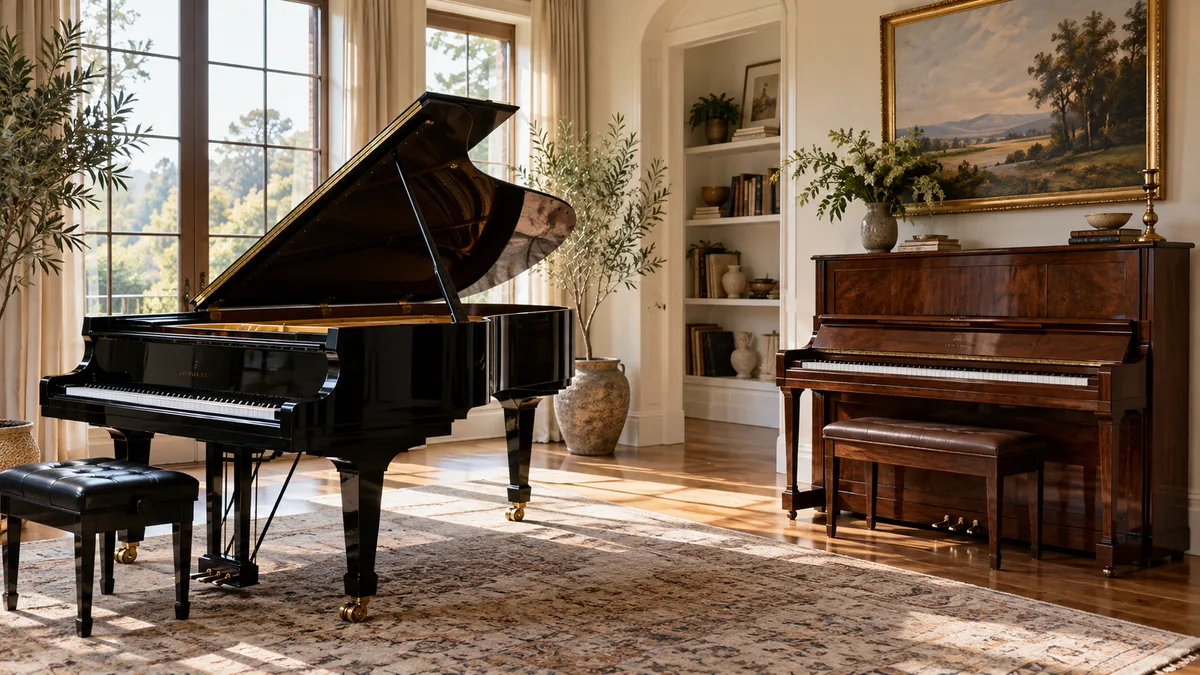
In a grand piano, the strings and soundboard are arranged horizontally, while in an upright piano, they are arranged vertically. This single difference determines everything else: the instrument's shape and size, hammer action, pedal control, sound, and price. However, both instruments are the same., piano , in two varieties: grand piano and upright piano.
To sum it up
- Piano – the strings are located horizontally, the hammers strike from below and fall under their own weight; piano - strings are arranged vertically, the hammers strike from the front and return to their original position thanks to springs.
- Mechanism double repeat on the piano allows you to repeat the same note faster.
- The pedals work differently: on a piano, the left pedal responds for sound production (una corda) , and the average — for sustain (sostenuto ); on a piano, the left pedal brings the hammers closer to the strings, while the middle pedal usually muffles the sound.
- An upright piano is smaller and less expensive, making it suitable for home use and learning; a grand piano offers greater sound potential and dominates the stage.
Construction: piano and grand piano.
Both instruments are percussion chordophones Pressing a key activates a mechanism that strikes the strings with a felt hammer, simultaneously moving a damper away from them. The string vibrations are transmitted to the soundboard, which amplifies the sound. The first such instrument was created in the early 18th century in Florence by Bartolomeo Cristofori; its shape resembled that of a modern piano.
В piano The strings are arranged horizontally along the winged body. This allows for the use of long strings and a large soundboard, resulting in a richer sound and longer decay. The piano has a raised lid, which directs the sound toward the listener.
В piano The strings and soundboard are arranged vertically in a perpendicular case that can be placed against a wall. This solution was designed for apartment-style instrument placement. The length of the strings limits the height of the piano, so they are usually shorter than those on a grand piano.
Mechanism and repetition
In a piano, a hammer strikes a string. from below , and then falls under the influence of gravity. Modern pianos use a mechanism double repeat , the principle of which was patented in 1821 by the Parisian company Érard. This mechanism allows a note to be repeated before the key returns to its top position, facilitating the creation of fast tremolos, trills, and repeats.
In a piano the hammer moves horizontally, to the vertical strings , and springs return it to its original position. To play the same note again, the key must return higher than on a grand piano, making it difficult to repeat quickly. Pianists also note that the grand piano keyboard provides greater control over dynamics and articulation.
Pedals on a grand piano and upright piano
Both instruments typically have three pedals, but only the right one works the same way - damper pedal Raises all dampers, allowing notes to sound when the keys are released.
- The left pedal on the piano (una corda) moves the entire mechanism sideways, so the hammers strike fewer strings. The sound becomes quieter and changes the timbre.
- Left pedal on a piano Brings the hammers closer to the strings—the hammer stroke is shorter, resulting in a quieter strike. This primarily affects volume, and to a lesser extent, timbre.
- The middle pedal on the piano (sostenuto) supports only those notes whose dampers were raised when the pedal was pressed.
- In a piano, the middle pedal It typically lowers a felt strip between the hammers and the strings (moderator), significantly dampening the sound—useful for block playing. Only some models are equipped with a true sostenuto pedal.
Comparison Chart: Piano vs. Upright
| Characteristic | piano | piano |
|---|---|---|
| String arrangement | Horizontal | Vertical |
| Form | Winged, with a lifting flap. | Perpendicular box to the wall |
| Hammer mechanism | From below, return by gravity. | The return is carried out from the front thanks to springs. |
| Repetition | Double - rapid repetition of sound | Slow down |
| Left pedal | Una corda – a shift in mechanism | Bringing the hammers closer to the strings |
| Middle pedal | Sostenuto | Mostly moderator (mute). |
| Place | Concert halls, studios, large spaces | Apartments, schools, gyms |
| Price | Higher in comparable class. | Below |
Size, sound and price
Grand pianos are classified by length, from the smallest used in offices, through living rooms, to concert grand pianos , which are approximately 2.7 meters or more in length. An upright piano takes up significantly less space because it is flush with the wall and has a low profile. However, both instruments are very heavy and require a company specializing in musical instrument transportation to move them.
The piano usually has richer timbre and wider dynamic range , and the sound spreads freely throughout the space. A grand piano placed against a wall creates a more intimate atmosphere. However, a large, well-made upright piano can sound better than a small, inexpensive grand piano—quality of workmanship is just as important as the type of instrument. A grand piano is also usually more expensive to purchase and requires a larger space, and both instruments require regular tuning.
Upright or grand piano – which to choose?
- For homeschooling A piano is a must. It fits in an apartment, is inexpensive, and a muffler pedal makes practicing easy without disturbing the neighbors.
- For advanced pianists and students The piano is a good option if space and budget allow. Better repetition and dynamic control are essential for performing complex repertoire.
- For a hall, church, recording studio - a piano that best fills a large room with sound.
- If space is limited or you move frequently , a piano or digital instrument with a weighted keyboard that doesn't require tuning will do.
Before purchasing a used instrument, it is recommended to consult a tuner or teacher to assess the condition of the action, soundboard, and tuning.
Frequently Asked Questions (FAQ)
Are piano and fortepiano the same thing?
These are two versions of the same instrument—the piano. They differ in the arrangement of the strings (the grand piano has horizontal strings, the upright piano has vertical strings), and therefore in their shape, mechanism, pedals, and sound. The playing method and key arrangement are the same.
How many keys does a grand piano have and how many does a piano have?
Modern grand and upright pianos typically have 88 keys—52 white and 36 black. Therefore, the number of keys isn't the only distinguishing feature.
Is it possible to learn to play the piano?
Yes. Most students start on the piano, and their key layout and playing technique are similar. Switching to the grand piano simply requires getting used to the different response of the keyboard and pedals.
What is better for a child – a piano or a grand piano?
For beginners, a good acoustic piano is usually sufficient. It's less expensive, smaller, and helps develop proper playing skills. A grand piano makes sense when a child enters higher education, such as a music school, and there's room for one at home.
What is the difference between a piano and a synthesizer?
A piano is an acoustic instrument with strings and hammers. A keyboard is an electronic instrument that produces sound digitally, typically with fewer keys and a lighter keyboard without a hammer action.
See also
- What is the difference between a keyboard and a piano?
- What is the difference between an acoustic guitar and a classical guitar?
- What is the difference between an accordion and other instruments?
- What is the difference between a dynamic and a condenser microphone?