

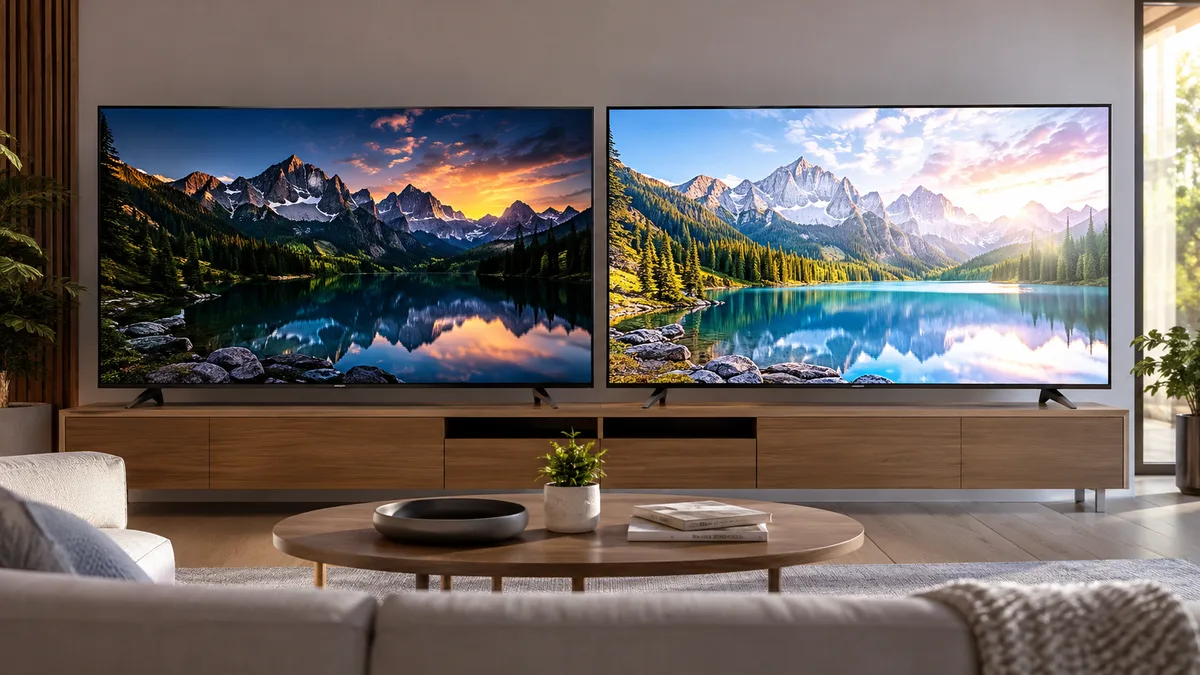
OLED differs from QLED in the way it generates light: in an OLED screen, each pixel is independently illuminated and can be completely turned off, whereas QLED is an LCD screen with an LED backlight and a layer of quantum dots that improve color reproduction. In practice, OLED delivers perfect blacks and unlimited contrast, while QLED typically delivers higher brightness and better results in bright rooms. Mini LED is a variant of LCD backlighting, often paired with QLED, which narrows the gap between OLED and QLED in terms of contrast ratio.
To sum it up
- OLED - self-emissive pixels, no backlighting, true black color, wide viewing angles.
- QLED – LCD matrix with LED backlight and quantum dot filter; typically provides a brighter image and eliminates the risk of pixel burn-in.
- Mini LED - dense backlight with thousands of small LEDs and multiple dimming zones; better contrast than conventional LCD displays, but still not at the level of OLED pixels.
- For a dark living room and watching movies, OLED TVs are often chosen, while for a bright room and long-term viewing of static content, QLED or Mini LED TVs are chosen.
How does an OLED screen work?
OLED ( organic light-emitting diode ) is a technology in which each pixel is made up of organic compounds that emit light when exposed to an electric current. Screen no backlight required - each pixel glows independently and can independently adjust brightness.
When a scene is about to fade, the pixels don't just dim, they turn off. This allows OLED displays to provide deep black color , very high contrast, and no halos around bright objects on dark backgrounds. The image maintains its quality even when viewed from the side, and pixels quickly change state, ensuring smooth motion and comfortable gaming.
There are two main types of OLED displays used in TVs: WOLED (with white subpixels and color filters) and QD-OLED , in which light from OLED pixels passes through a layer of quantum dots. Both types belong to the OLED family – self-emissive LEDs.
How does a QLED screen work?
Name QLED comes from the words "quantum dot LED"« , but in televisions sold in stores it means LCD matrix with LED backlight, enriched layer quantum dots — microscopic semiconductor crystals that convert backlight light into extremely pure colors. The result is a wide color gamut and high brightness.
Because light is generated by a common backlight, and liquid crystals only transmit or block it, QLEDs cannot completely turn off individual pixels. Therefore, black levels are typically shallower than OLEDs, and the image may lose contrast when viewed from an angle, depending on the type of matrix. Furthermore, the lack of organic pixels means that QLEDs not subject to fading static image elements.
OLED vs. QLED – Comparison of the Most Important Characteristics
| Characteristic | OLED | QLED |
|---|---|---|
| Light source | Each pixel is illuminated separately. | LED backlight + LCD matrix + quantum dots |
| Black and contrast | Perfect black color, very high contrast | Depends on the backlight and the number of dimming zones. |
| Brightness | Less for large, bright surfaces | Typically taller, works better in a bright room. |
| Viewing angles | Very wide | Depends on the matrix type, usually narrower. |
| Image burnout | Possibly using long-term static elements. | No risk of burnout |
| Response time | Very short | Longer than OLED |
| Thickness | Can be very thin (without backlight layer). | Usually thicker due to backlighting. |
Mini LED – where does it fit between OLED and QLED?
Mini LED - this is not a separate type of matrix, but type of LCD backlight . Instead of dozens or hundreds of LEDs, it uses many small LEDs grouped into zones that can independently adjust brightness (this is called local dimming). Many TVs marketed as QLED feature Mini LED backlighting.
The result is achieved significantly better contrast than a standard LCD display, while maintaining high brightness. However, there are still far fewer zones than pixels, so there may be some blurring around bright objects on a black background. flare . Mini LED occupies an intermediate position: brighter than OLED, but closer in contrast to classic QLED.
Which TV should you choose – OLED or QLED?
Choose OLED if:
- You mostly watch movies and TV series, often in the evening or in a darkened room.
- You want the best black levels and contrast.
- Several people are sitting in front of the TV at different angles.
- You play on a console and value fast image response.
Choose QLED or Mini LED if:
- The TV is located in a bright, sunlit room.
- You spend many hours watching channels with static logos, news tickers, or using the screen as a monitor.
- You will need a very large diagonal with a more reasonable budget.
- You need high brightness when working with HDR content.
Keep in mind that within each technology, there are better and worse models. A cheap QLED TV without local dimming may perform worse than a good LCD TV with Mini LED, and the brightness of different OLED TVs varies. Before purchasing, it's worth comparing the specifications of specific models, reading reviews, and familiarizing yourself with the manufacturer's warranty terms, especially regarding screen burn-in.
Frequently Asked Questions (FAQ)
What is the difference between OLED and QLED?
In OLED displays, each pixel emits its own light and can be completely dimmed, resulting in perfect black. QLED is an LCD display with an LED backlight and a quantum dot layer—it's typically brighter, but with less intense blacks.
Which is better: OLED or QLED?
It depends on the conditions. OLED works best in dark rooms and for watching movies, while QLED works best in bright rooms and for viewing static content for long periods of time. There's no one-size-fits-all technology.
Does OLED screen burn in?
Pixel burn-in (a permanent mark left by a static image) is possible on OLED screens, especially when displaying the same elements, such as a TV channel logo, for several hours straight. Manufacturers are implementing mechanisms to reduce this risk. QLED TVs are not susceptible to this risk.
Is QLED the same as Mini LED?
No. QLED refers to the use of a quantum dot layer, while Mini LED is a type of backlight consisting of many small diodes. Both technologies are often found together in a single LCD TV.
Is QD-OLED QLED?
No. QD-OLED is a type of OLED: the pixels themselves emit light, and quantum dots are used only to produce colors. In QLED, the light comes from an LED backlight.
See also
- What is the difference between LED and LCD screen?
- What is the difference between digital printing and offset printing?
- What is the difference between the Samsung S24 and S24FE?
- What is the difference between an emission spectrum and an absorption spectrum?