

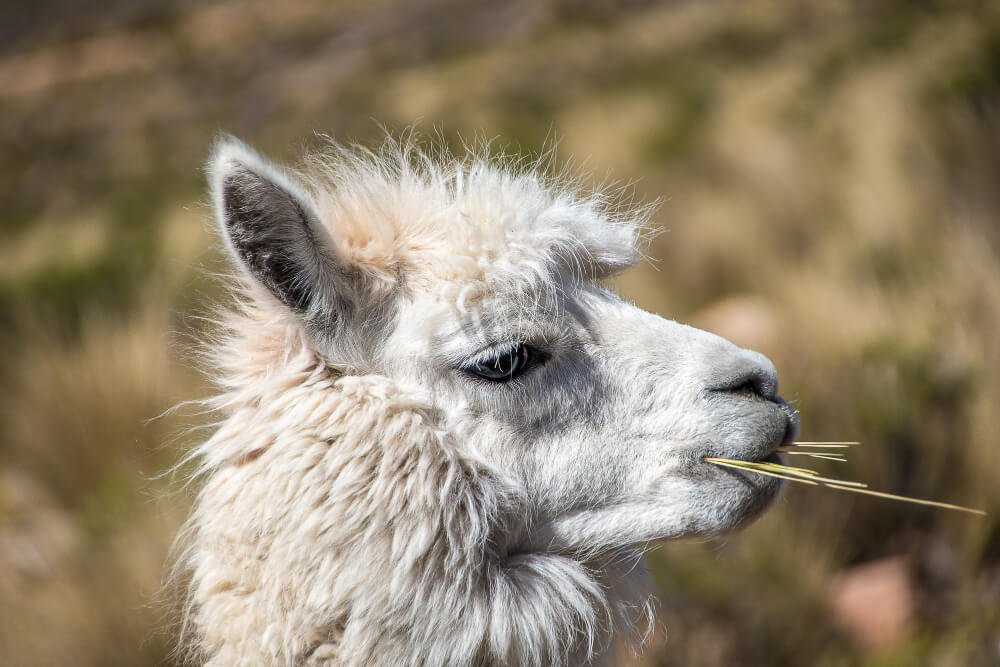
The llama is significantly larger than the alpaca, with long, banana-shaped ears and a long muzzle, while the alpaca is smaller, with short, pointed ears and a "fluffy" head. Llamas were bred primarily as pack animals, while alpacas were bred for their soft, valuable wool. Both species are native to South America and belong to the camelid family.
To sum it up
- Dimensions: The llama stands approximately 115 cm at the withers and weighs approximately 130–200 kg, while the alpaca stands approximately 90 cm at the withers and weighs approximately 45–80 kg.
- Ears and muzzle: The llama has long, curved ears and a longer muzzle, while the alpaca has short, pointed ears and a shorter, densely furred muzzle.
- Application: The llama is a pack animal and the "guardian" of the herd, while the alpaca is primarily a source of fine fiber.
- Ancestors: The llama descended from the wild guanaco, the alpaca from the vicuña.
Appearance: How to distinguish a llama from an alpaca?
The simplest criterion is size . According to Rutgers University, alpacas reach a height of approximately 90 cm at the withers and weigh approximately 45–80 kg. Llamas reach a height of approximately 115 cm at the withers and weigh approximately 130–200 kg. An adult llama is approximately twice as heavy as an alpaca, and with its head held high, it often reaches the height of an adult human.
The second distinguishing feature is ears . The llama has long, inward-curving ears, described as "banana-shaped." The alpaca has shorter, pointed ears, shaped like a pear or arrowhead. The head is also different: the llama has a longer muzzle with shorter hair, while the alpaca has a short muzzle surrounded by thick hair, giving its head a rounded, fluffy appearance.
The silhouette also differs. The llama has a straighter back and a more robust build, while the alpaca is more slender, with a back that curves slightly upward at the croup.
Wool: Alpaca or Llama?
Alpacas have been bred for centuries for their food their wool . It is thin, soft, lightweight, and does not contain lanolin (the fat found in sheep's wool). There are two distinct breeds of alpaca:
- Huacaya needles – dense, fluffy, wavy fur, making the animal look like a plush toy.
- Suri - long, silky hair, styled in flowing strands reminiscent of dreadlocks.
Llamas also produce fiber, but their wool is typically thicker and more varied, containing more coarse guard hairs. For this reason, llama wool is less valuable in the textile industry than alpaca wool.
Character and behavior
Both types - social animals and do not tolerate loneliness well, so they should not be kept alone. Both species also spit—a form of communication, most often directed at other group members (for example, when competing for food), rather than at people.
Alpacas are generally more timid and reserved. Llamas are more confident and can be a bit more assertive, which is why they are used as guard animals , warning flocks of sheep or alpacas about predators. In Poland, alpacas are often seen on agritourism farms and during animal-assisted activities (alpaca therapy).
Comparison table of llamas and alpacas.
| Characteristic | Lama | Alpaca |
|---|---|---|
| Height at withers | approximately 115 cm | approximately 90 cm |
| Body weight | approximately 130–200 kg | approximately 45–80 kg |
| Ears | Long, curved ("banana") | Short, pointed |
| Mouth | Long, short hair | Short, densely covered with hairs. |
| Fiber | Thicker, with more guard hairs. | Thin, soft, lanolin-free |
| Main purpose | Pack animal, guardian of the herd | Wool |
| Wild ancestor | Guanaco | Vicuna |
| life expectancy | approximately 15–30 years | approximately 15–25 years |
Origin and kinship
Llamas and alpacas were domesticated by Andean peoples thousands of years ago. Genetic studies show that The llama descended from the guanaco. , A alpaca - from vicuna , so the alpaca is now classified as Vicugna pacos , and the lama is like Lama glama . All four South American camelids are closely related and can interbreed; a hybrid of a llama and an alpaca is called Juarizo .
For centuries, the llama was the primary transport animal in the Andes. According to Rutgers University, it can carry 70 to 120 pounds (approximately 30 to 55 kg). The alpaca is too small for this task; its role was to produce fiber.
Frequently Asked Questions (FAQ)
How to quickly distinguish a llama from an alpaca?
Note the size and ears. The llama is large (with its head held high, it often reaches the height of a human) and has long, curved ears. The alpaca weighs about half as much, has short, pointed ears, and a round, fluffy head.
Are llamas and alpacas the same species?
No, they are two different species of camelid. The llama is descended from the guanaco, and the alpaca from the vicuña. However, they are closely related enough to produce offspring—a hybrid called a huarizo.
Do alpacas spit?
Yes, both alpacas and llamas spit. They most often do this at other animals in the herd, for example when competing for food. Humans are rarely targeted unless the animal feels threatened.
Which wool is better – alpaca or llama?
Alpaca wool is more highly valued: it is fine, soft, lightweight, and lanolin-free. Llama fiber is typically coarser and contains more of the stiff outer hairs, although soft yarn can also be produced from the wool of some animals.
Can I keep one alpaca?
This is not recommended. Alpacas and llamas are herd animals and cannot live alone. Breeders recommend housing at least a few individuals together.
See also
- What is the difference between wool and yarn?
- What is the difference between a hare and a rabbit?
- What is the difference between a moose and a deer?
- What is the difference between an alligator and a crocodile?