

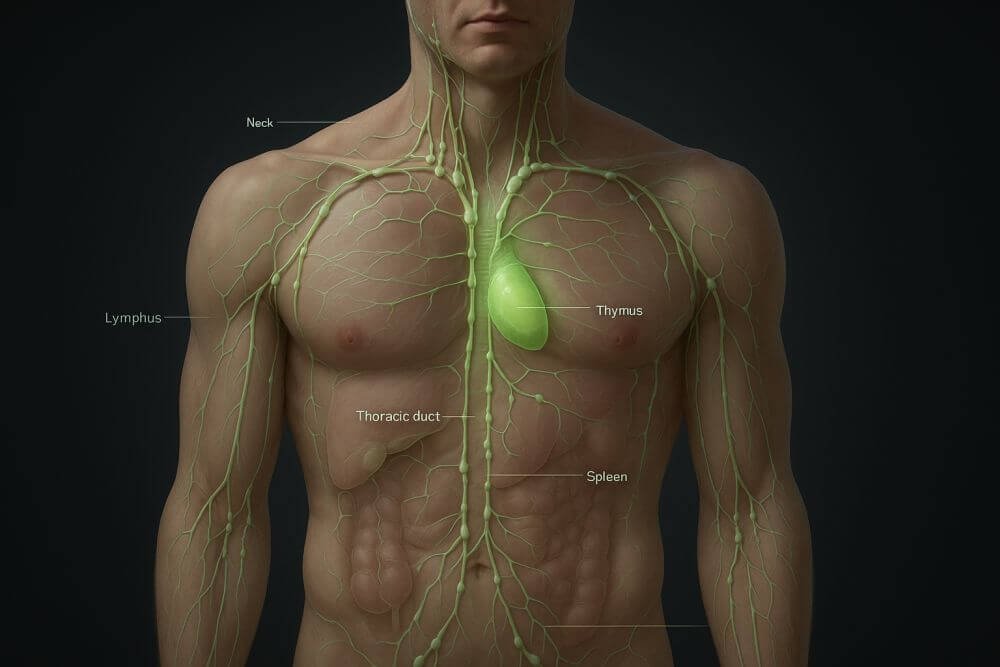
The circulatory system is a closed circuit, with the heart acting as a pump, distributing blood with oxygen and nutrients throughout the body. The lymphatic system is a one-way system of vessels without its own pump that collects excess fluid from the tissues and returns it to the blood. The system also performs an important protective function: lymph is filtered in the lymph nodes, and lymphocytes recognize microorganisms. These two systems are closely interconnected, and one could not function without the other.
To sum it up
- Movement: Blood is pumped by the heart, lymph is moved by contractions of skeletal muscles, respiratory movements and contractions of the walls of the lymphatic vessels.
- Direction of circulation: blood circulates in a closed circle, lymph flows only in one direction - from the tissues to the veins.
- Lymphatic fluid: Blood contains red blood cells and platelets, lymph is transparent or yellowish and contains mainly lymphocytes.
- Task: The circulatory system is responsible for transport, the lymphatic system is responsible for tissue drainage, fat absorption and immunity.
Structure: What does the circulatory system consist of and what does the lymphatic system consist of?
Circulatory system The heart consists of the heart and blood vessels: arteries (carrying blood away from the heart), veins (carrying blood to the heart), and capillaries, where gas and substance exchange between the blood and tissues occurs. Blood circulates through two circuits: the pulmonary and the systemic.
Lymphatic system consists of lymphatic vessels - from blind-ending lymphatic capillaries in the tissues, through increasingly larger vessels, to two main trunks: the thoracic duct and the right lymphatic duct. It also includes lymphatic organs : lymph nodes, spleen, thymus, tonsils, and lymphoid tissue in mucous membranes such as the intestinal wall.
Closed and one-way system
The blood doesn't leave the blood vessels—it returns to the heart and begins a new cycle. That's why we call it closed circulation . However, in the capillaries, some plasma leaks into the spaces between cells and turns into tissue fluid. Most of this fluid returns to the blood vessels, but the remainder remains in the tissues.
The lymphatic system takes on this "finishing" function. Tissue fluid enters the lymphatic capillaries and is then called lymph . It flows in only one direction: through successive lymph nodes to the lymphatic ducts, which empty into large veins at the base of the neck, at the so-called venous angles (the junction of the internal jugular vein and subclavian vein). Thus, the lymphatic system is not a separate circulatory system, but rather a "return route" for fluid that has left the blood.
What moves blood and what moves lymph?
Blood is pumped with heart , which creates enough pressure to push it through the entire vascular network. The lymphatic system lacks such a central pump. Lymph moves thanks to:
- Contraction of skeletal muscles, which compresses the lymphatic vessels (therefore, movement promotes lymphatic drainage).
- changes in pressure in the chest during breathing,
- rhythmic contractions of muscles in the walls of large lymphatic vessels.
Valves They play an important role in both systems. In veins and lymphatic vessels, they prevent the backflow of fluid, and they are especially abundant in the lymphatic system, since the flow occurs at low pressure.
Blood and lymph - composition and appearance
Blood It consists of plasma and formed elements: erythrocytes (red blood cells that carry oxygen thanks to hemoglobin), leukocytes (white blood cells), and platelets, which participate in blood clotting. Hemoglobin gives blood its red color.
Lymph Its composition is similar to interstitial fluid: water, electrolytes, proteins, and other substances, and its cells are primarily composed of lymphocytes. It does not contain red blood cells, so it has a clear or slightly yellowish color. An exception is the lymph draining from the small intestine after meals, which contains absorbed fats (in the form of chylomicrons) and has a milky appearance.
Functions: Conveyance, drainage and resistance.
The circulatory system is primarily responsible for transport : It supplies oxygen and nutrients, receives carbon dioxide and metabolic products, distributes hormones and heat, and transports immune system cells.
The lymphatic system performs three main functions:
- Lymphatic drainage – the return of excess tissue fluid and proteins into the blood; if lymphatic drainage is disrupted, lymphedema may develop.
- fat absorption from the digestive tract,
- The body's defense mechanism In the lymph nodes, lymph comes into contact with lymphocytes, which recognize bacteria, viruses, and other foreign particles. Therefore, during an infection, the lymph nodes may enlarge.
| Characteristic | circulatory system | Lymphatic system |
|---|---|---|
| System type | Closed circuit | One-way system, starts blindly in the tissues. |
| Pump | Heart | None – muscle, respiratory, vascular spasms. |
| Liquid | Blood (red) | Lymph (light or yellowish) |
| Red blood cells and platelets | Current | Flaw |
| Main organs | Heart, arteries, veins, capillaries | Lymphatic vessels, lymph nodes, spleen, thymus, tonsils |
| Main function | Transport of oxygen, nutrients, hormones. | Tissue drainage, fat absorption, immunity |
| Pressure in blood vessels | Higher levels, especially in the arteries. | Short |
How do the two systems interact with each other?
The easiest way to remember it is like this: The lymphatic system begins where the blood secretes fluid into the tissues and ends where it returns it to the veins. . Without it, fluid would accumulate in the tissues, and blood volume would gradually decrease. Lymphocytes, maturing in the lymphatic organs, circulate in both the lymph and the blood—these two systems form a unified immune network.
A simple diagram will help in biology lessons: heart → arteries → capillaries → interstitial fluid → (most returns to the veins, the rest enters the lymphatic vessels) → lymph nodes → lymphatic ducts → veins → heart. Persistent swelling, prolonged enlargement, or tenderness of the lymph nodes are symptoms that require a doctor's consultation.
Frequently Asked Questions (FAQ)
Is the lymphatic system part of the circulatory system?
It is often described as a separate system, although it is inextricably linked to the circulatory system—it is formed from fluid that leaves the blood and enters the veins. Due to its function, it is also considered part of the immune system.
Why is the lymphatic system called open?
Because it doesn't form a closed loop. Its capillaries begin blindly in the tissues and absorb fluid from the intercellular space, while lymph flows in only one direction—to the veins.
What is the difference between blood and lymph?
Blood contains red blood cells, platelets, and hemoglobin, which is why it is red. Lymph does not contain red blood cells or platelets, but consists primarily of lymphocytes and is clear or yellowish in color.
What provides lymph flow if there is no heart?
Skeletal muscle contraction, respiratory movements, and the contraction of lymphatic vessel walls and valves prevent lymphatic backflow. Consequently, prolonged immobility contributes to lymphatic stagnation.
Where does lymph enter the blood?
The thoracic duct and the right lymphatic duct drain into large veins at the base of the neck, where the internal jugular vein joins the subclavian vein (venous angles).
See also
- What is the difference between arteries and veins?
- What is the difference between smooth and striated muscle?
- What is the difference between an animal cell and a plant cell?
- What is the difference between a vaccine and a serum?