

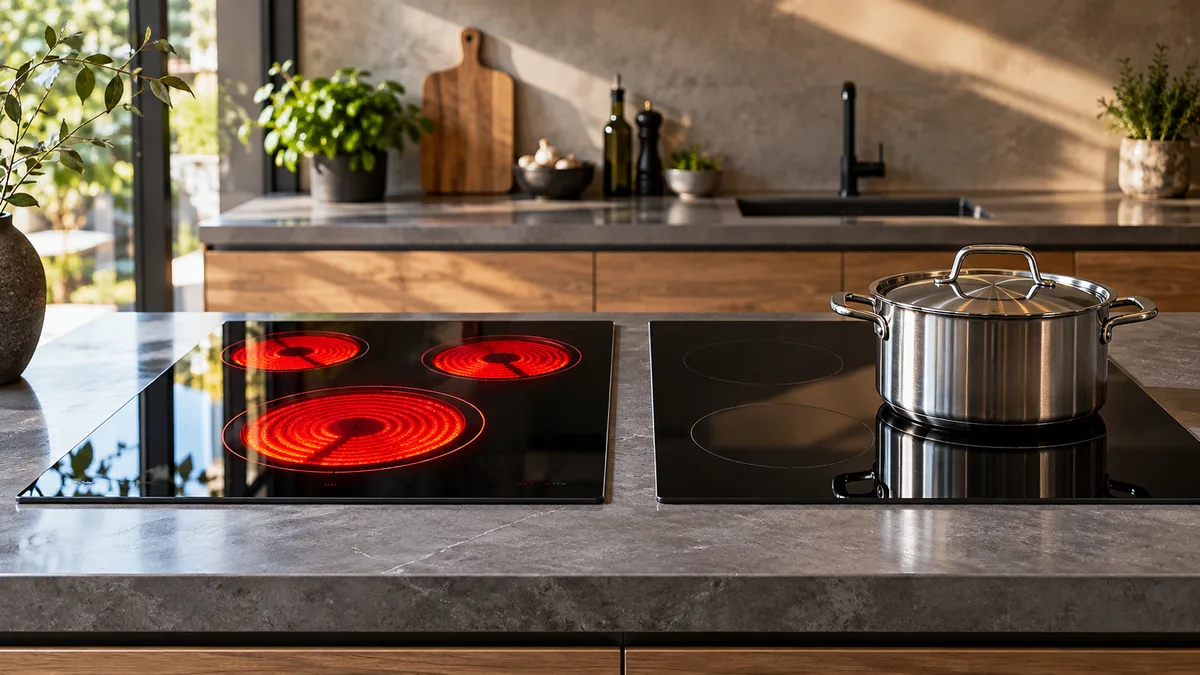
A ceramic cooktop heats the glass surface using heating elements or halogen emitters, which then transfer the heat to the pan. An induction cooktop creates an alternating magnetic field that directly heats the bottom of the pan. This single difference underlies everything else: an induction cooktop heats up faster and more efficiently, and its surface heats up cooler, but it requires pots with ferromagnetic bottoms. A ceramic cooktop is less expensive to purchase and is suitable for any flat cookware.
To sum it up
- Operating principle: ceramics heat the glass (heaters, halogens), induction – the very bottom of the pot (magnetic field, eddy currents).
- Pots: All flat-bottomed ceramic pots are suitable for induction cooking, but only those that stick to a magnet.
- Speed and current: Induction heating occurs faster and uses less energy to heat the environment.
- Price: Ceramic hobs are usually cheaper to buy, induction hobs are cheaper for everyday use.
Ceramic and induction cooktops – how do they work?
Both cooktops look similar: a smooth black ceramic surface and defined conical zones. The difference lies in the bottom.
Ceramic hob The glass contains heating elements—either coiled electric heaters or halogen lamps. These heat the glass, which in turn transfers heat to the bottom of the pan. It's simply a more modern version of an electric stove with cast-iron cooktops.
В induction cooker The coils are located under the glass. The alternating current flowing through them creates an alternating magnetic field, which induces eddy currents in the ferromagnetic base of the cookware. These currents are converted into heat— the pan heats up, not the stove . The glass is heated only a second time by the hot dishes.
Pots for induction cookers and ceramic
You can use it on a ceramic hob any pan with a flat, even bottom – steel, aluminum, copper, cast iron, or heat-resistant glass. The better the base adheres to the glass, the more efficient the heat transfer.
For an induction hob you need cookware with ferromagnetic bottom : cast iron, enameled steel, or stainless steel with a suitable base. The simplest test is to hold a magnet to the bottom of the pan, which will indicate that the pan is induction-ready. Manufacturers mark such pans with a spiral (coil) symbol. Regular aluminum, copper, glass, or ceramic without a ferromagnetic insert will not heat up—the stove simply won't detect them. Special adapters (induction discs) can be used, but this will deprive the stove of some of the advantages of an induction cooktop.
Cooking speed and energy consumption
Induction cooker heats up faster, Because it doesn't require heating elements and glass to heat up first, heat is generated immediately at the bottom of the pan, so less energy is lost to the surrounding environment. An induction cooktop also responds almost instantly to power changes—reducing the heat prevents the soup from boiling too quickly, similar to cooking on a gas stove.
A ceramic cooktop heats up and cools down more slowly. Some of the heat is lost to heating the glass and the air in the kitchen, so cooking the same dish typically requires more energy. Actual savings depend on the model, cookware, and cooking habits—manufacturers indicate the power of each zone in the instructions and on the label.
Safety and cleaning
Induction cooktops have a lower risk of burns: the burner is heated only by the pan, and the cooktop remains inactive without the pan. Most models turn off the burner when the pan is removed. However, the glass can remain warm after cooking, so cooktops have a residual heat indicator. Ceramic cooktops remain hot for a long time after switching off , which is especially important in homes with small children.
When boiling, food tends to stick to the ceramic surface because the glass is very hot, so cleaning should be done after it has cooled. On induction cooktops, sticking stains are less common and can usually be wiped off immediately. On both cooktops, care should be taken as the glass can be scratched by sand or the bottom of the pan.
Pacemakers and other implants: The induction cooktop generates an electromagnetic field. People with pacemakers or other active implants should read the manufacturer's warnings and consult their doctor before purchasing.
Comparison table of ceramic and induction hobs.
| Characteristic | Ceramic plate | Induction cooker |
|---|---|---|
| Heat source | Heaters or halogen lamps under glass | Coils – the magnetic field heats the bottom of the pan. |
| What is becoming popular? | Glass, and a pot made of it | Pot, glass for recycling only |
| Plates | Any with a flat bottom | Only with ferromagnetic bottom. |
| Heating speed | Slow down | Faster |
| Reaction to a change in the balance of power | Deferred | Almost instantly |
| Energy consumption | More | Less |
| Warm after turning off | The field remains hot for a long time. | The glass is only slightly warmed by the pan. |
| Purchase price | Usually lower | Usually higher |
Which CD should I choose?
- Choose an induction hob, If you cook every day and value speed, precise control, lower energy bills, and safety (for example, if you have children around), use a magnet to check how many pots you can fit.
- Choose ceramic cookware, If you're on a budget, don't cook often, or have favorite aluminum, copper, or glass cookware that you don't want to replace.
- Check the wiring. Electric cooktops have a high total power rating, and manufacturers specify the required connection method. Installation must be performed by a licensed electrician.
- Consider combination cooktops – there are models that combine induction and ceramic fields, as well as induction and gas fields.
- Look out for features like zone merging (useful for larger pots), booster function, child lock, and timer.
Frequently Asked Questions (FAQ)
How to distinguish an induction cooktop from a ceramic one?
It's difficult to tell for sure just by looking at it. Ceramic cooktops glow red when turned on, even without a pan. Induction cooktops don't heat up without a pan, often indicating its absence, and the cooking zones don't glow red. The cooktop type is also indicated on the rating plate and in the instructions.
Which is better – a ceramic or induction hob?
An induction cooktop is faster, more energy-efficient, and safer, but it's more expensive and requires the use of ferromagnetic cookware. A ceramic cooktop is less expensive and suitable for any flat pan. For everyday cooking, an induction cooktop is generally more energy-efficient.
Are induction cooktops suitable for ceramic cooktops?
Yes. Induction cookware has a flat bottom and is suitable for all electric cooktops, including ceramic ones. The opposite is not always true – not every ceramic cookware is suitable for an induction cooktop.
How to check if a pan is suitable for an induction hob?
Place a magnet on the bottom of the pan. If it's strongly attracted, the pan is induction-safe. You can also look for a spiral symbol on the packaging or the bottom of the pan, indicating it's induction-safe.
Is an induction cooktop safe for people with pacemakers?
Because cooktops generate electromagnetic fields, manufacturers include warnings in the operating instructions for people with pacemakers and other implants. It's important to read these warnings and consult a doctor before purchasing.
See also
- What is the difference between ceramic and porcelain?
- What is the difference between calorific value and heat of combustion?
- What is the difference between boiling and evaporation?
- What is the difference between a magnetic and a mechanical bike?