

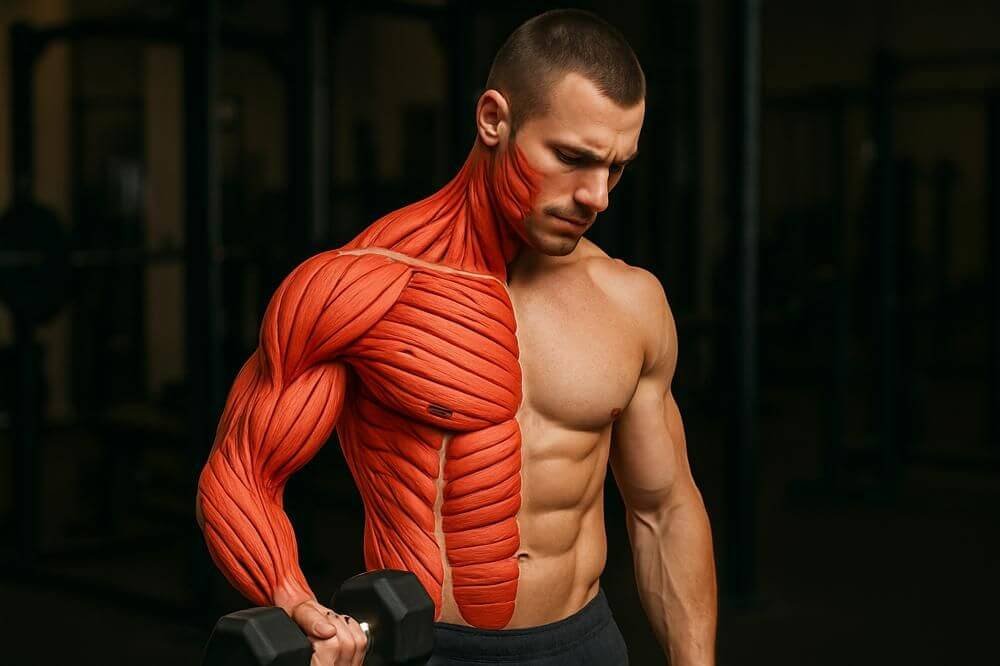
Smooth muscles differ from striated muscles primarily in their cellular structure and control mechanisms. Smooth muscles are composed of spindle-shaped, mononuclear cells without striations and contract independently of our will, whereas skeletal striated muscles are composed of long, multinucleated fibers with distinct striations, and we move them voluntarily. Cardiac muscle, which, although striated, also contracts involuntarily, is also classified as striated tissue.
To sum it up
- Structure: smooth - small spindle-shaped cells with one central nucleus; skeletal - long cylindrical fibers with multiple nuclei located under the cell membrane.
- Transverse striation: In skeletal muscle, contractile proteins form regular sarcomeres, visible as striations; in smooth muscle, they are irregularly arranged.
- Control: Smooth muscles are controlled by the autonomic nervous system and hormones (involuntary work), while skeletal muscles are controlled by the somatic nervous system (voluntary work).
- Job: Smooth muscles contract slowly, but for a long time and economically; skeletal muscles contract quickly and strongly, but tire more quickly.
Three types of muscle tissue – where is the line?
There are three types of muscle tissue in the human body: smooth , skeletal и cardiac . The question of "smooth muscle versus striated muscle" usually boils down to a comparison between smooth and skeletal muscle, as these are the most distinct types. Cardiac muscle combines characteristics of both groups: it has striations like skeletal muscle, but functions automatically like smooth muscle.
Cell structure: spindle cells vs. multinucleated fibers
The smooth muscle cell has spindle-shaped The shape is thicker in the middle and tapers toward the ends. It contains a single nucleus located in the center. The cells are arranged in layers and tightly connected to each other, allowing the entire layer to contract as a single unit.
Skeletal muscles consist of muscle fibers — very long cylindrical structures formed during embryonic development as a result of the fusion of multiple cells. Therefore, a single fiber contains from tens to hundreds of nuclei located at the periphery, directly beneath the cell membrane. Cardiac muscle cells are smaller in size, branched, have one or two central nuclei, and are connected to each other by interdigitation .
Where do transverse striations come from and why aren't they found in smooth muscles?
Both types of muscles contract using the same basic proteins – actin и myosin . The difference lies in their arrangement. In striated muscles, the filaments form repeating segments called sarcomeres . The alternation of lighter and darker bands creates a characteristic cross-striation pattern under a microscope.
Smooth muscle lacks sarcomeres. The filaments are angled and anchored in so-called dense bodies, which is why the cell appears uniform under a microscope—hence the name "smooth." The contraction signal is also different: in both cases, it is triggered by calcium ions, but in skeletal muscle, calcium binds to troponin , and in smooth muscle - with calmodulin .
Control: voluntary and involuntary muscles
Skeletal muscles are innervated somatic nervous system . Each fiber receives a signal from the motor neuron via the neuromuscular junction, so we can precisely control when and how hard they contract—when walking, talking, or blinking.
Smooth muscles obey autonomic nervous system , as well as hormones and locally acting substances. We cannot consciously tense or relax them. Therefore, they move food through the intestines, change the diameter of blood vessels and bronchi, and constrict the pupil without our intervention.
Contraction rate and fatigue
Skeletal muscles contract fast and strong , but they quickly tire during intense physical activity—hence the need for breaks during training. Smooth muscles respond more slowly but can maintain contraction (tension) for long periods with little energy expenditure. This energy conservation is important, for example, for the walls of blood vessels, which maintain a certain resting tension throughout life.
Where are smooth muscles and where are striated muscles?
Smooth muscles are found in the walls of internal organs: the digestive tract, blood vessels, respiratory tract, bladder, uterus and reproductive tract, as well as in the eye (the muscles of the iris) and in the skin (the columnar muscles responsible for "goosebumps").
Skeletal muscles They attach to bones and provide skeletal movement, but they also form the tongue, facial muscles, and diaphragm. An interesting example is the esophagus: its upper portion contains striated muscle, while the lower portion contains smooth muscle. Cardiac muscle is located exclusively in the heart.
Comparison chart: smooth and striated muscles
| Characteristic | Smooth muscles | Striated skeletal muscles | Cardiac muscle |
|---|---|---|---|
| Cell shape | fusiform | Long cylindrical fiber | Branched cell |
| Testicles | One, central | A lot, around the perimeter | One or two, central |
| Transverse striation | Flaw | Transparent (sarcomeres) | Transparent (sarcomeres) |
| Control | Involuntary (autonomic system, hormones) | Dependence on will (somatic system) | Involuntary |
| Calcium-binding protein | Calmodulin | Troponin | Troponin |
| Spasm | Free, durable, economical | Fast, strong, short | Rhythmic, continuous |
| Event | Walls of internal organs and blood vessels | Muscles attached to bones, tongue, diaphragm. | Heart |
How to determine muscle type on a microscopic specimen
In a biology lesson or a final exam, it is enough to check three things:
- Are the transverse stripes visible? The absence of transverse stripes indicates the presence of smooth muscle.
- How many nuclei are there in a cell and where are they located? Many nuclei at the edge of the fiber - in skeletal muscles; one or two in the center of the cell - in cardiac or smooth muscles.
- Do cells branch and connect with intercalated structures? Yes, it is the heart muscle.
Frequently Asked Questions (FAQ)
Is cardiac muscle smooth or striated?
Cardiac muscle is striated—it has sarcomeres, like skeletal muscle. It differs from skeletal muscle in that it works involuntarily, and its cells are branched, have one or two central nuclei, and are interconnected by interdigitations.
Why are there multiple nuclei in striated muscles?
Skeletal muscle fibers are formed during embryonic development through the fusion of multiple precursor cells. Each cell contributes a nucleus, so the mature fiber is multinucleated, with the nuclei located beneath the cell membrane.
Is it possible to consciously tense smooth muscles?
No. Smooth muscles are controlled by the autonomic nervous system and hormones, so their contraction is not dependent on our will. We only consciously control skeletal muscles.
Which muscles get tired faster?
Skeletal muscles tire more quickly, especially during intense physical activity. Smooth muscles contract more slowly but can maintain tension for long periods with minimal energy expenditure.
In which part of the body are both types of muscles found at the same time?
A good example is the esophagus: its upper wall is made of striated muscle, while the lower wall is smooth. In the eye, the muscles that move the eyeball are skeletal, while the muscles of the iris are smooth.
See also
- What is the difference between fast-twitch and slow-twitch muscles?
- What is the difference between the circulatory and lymphatic systems?
- What is the difference between an animal cell and a plant cell?
- What is the difference between arteries and veins?