

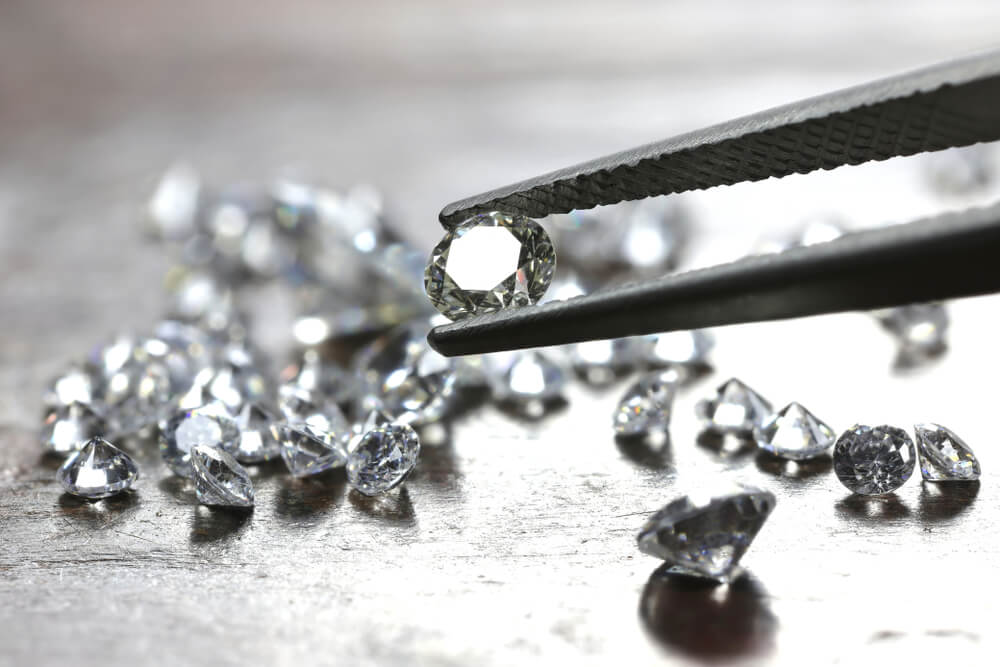
Diamond differs from cubic zirconia in composition and properties: diamond is crystalline carbon with a hardness of 10 on the Mohs scale, which is an excellent conductor of heat, whereas cubic zirconia is synthetic, stabilized zirconium oxide (ZrO2) with a hardness of approximately 8–8.5, is significantly heavier, and is a heat insulator. Cubic zirconia has been used for decades as a cheap diamond imitation. It may look very similar to the naked eye, but it boasts a higher brilliance and is significantly cheaper.
To sum it up
- Compound: Diamond is pure carbon (C), and zirconium dioxide is zirconium oxide ZrO2 stabilized in cubic form.
- Hardness: Diamond has a hardness of 10 on the Mohs scale, while cubic zirconia is around 8-8.5, so over time it will scratch and become dull at the edges.
- Shine: Diamond has a higher refractive index, while cubic zirconia has greater dispersion, so it creates more "rainbow" sparkles.
- Identification: The easiest way to tell them apart is to use a thermometer, since diamond is an excellent conductor of heat, while cubic zirconia is not.
Diamond and cubic zirconia – what are they?
Diamond — is a crystalline form of carbon. Natural diamonds are formed deep within the Earth and are mined. For decades, they have also been produced synthetic (laboratory-grown) diamonds , which have the same composition and physical properties as natural diamonds. These are also diamonds, not imitations.
Cubic zirconia ( Cubic zirconia (CZ) is a synthetic material. At room temperature, zirconium oxide has a different crystalline structure. The diamond-like cubic structure is maintained by the addition of stabilizing oxides such as yttrium oxide or calcium oxide. Cubic zirconia is imitation diamond, that is, it is a different material that is only similar in appearance.
Be careful with the names. Cubic zirconia is not zircon. Zircon (ZrSiO4) is a natural silicate mineral with a hardness of approximately 6.5–7.5 and is itself a gemstone. These two names are sometimes confused in stores.
Diamond and cubic zirconia - differences in properties.
Hardness and strength
Diamond is the hardest natural mineral: 10 on the Mohs scale. Cubic zirconia is hard enough to imitate (around 8–8.5), but with daily wear, its edges become scratched and lose their sharpness over time. A cubic zirconia ring worn for years will usually look worse than a similar diamond ring.
Radiance and "fire"«
Diamond has refractive index approximately 2.42, while cubic zirconia has a refractive index of approximately 2.15–2.18. Consequently, diamond reflects light more strongly and has a more intense, glassy shine. Cubic zirconia, on the other hand, has a higher dispersion (around 0.060 compared to 0.044 for diamond), meaning it scatters light more strongly into colors. A trained eye will notice that cubic zirconia's brilliance is more rainbow-like than that of diamond.
Mass and thermal conductivity
Cubic zirconia is significantly denser: a stone of the same size weighs approximately 1.7 times more Diamond. The second important difference is thermal conductivity. Diamond is one of the best conductors of heat, while cubic zirconia is an insulator. This difference underlies popular diamond quality testing instruments.
Comparison Chart: Diamond vs. Cubic Zirconia
| Characteristic | Diamond | Cubic zirconia |
|---|---|---|
| Composition | Carbon (C) | Zirconium oxide ZrO2 with stabilizer |
| Source | Natural or synthetic | Synthetic |
| Hardness (Mohs scale) | 10 | approximately 8–8.5 |
| Refractive index | approximately 2.42 | approx. 2.15–2.18 |
| Dispersion | 0,044 | approximately 0.060 (more rainbow flashes) |
| Mass at the same size | Lighter | About 1.7 times heavier |
| Thermal conductivity | Very good | Insulator |
| Price | High, depending on weight, color, clarity and cut. | Short |
How to distinguish a diamond from cubic zirconia?
- Thermometer A diamond tester (also known as a diamond tester) measures the rate at which a stone dissipates heat. It clearly distinguishes between diamond and cubic zirconia. However, it cannot distinguish between diamond and moissanite, which also conduct heat well, so jewelers use combination testers.
- Examine the shine under a magnifying glass. Bright, iridescent sparkles and rounded, scratched facet edges may indicate the presence of cubic zirconia. This is only a hint, not proof.
- Fogging test. Fogging on diamonds typically disappears faster than on cubic zirconia because diamonds dissipate heat more quickly. This is only an approximate result.
- Weighing A stone of known size can detect a much heavier cubic zirconia, but this requires removing the stone and using accurate scales.
- Certificate and gemologist. When purchasing a diamond, it's worth requesting a certificate from an independent gemological laboratory, and if in doubt, show the stone to an expert.
Don't try to test the stone by scratching it on glass or another stone, or by heating it with a flame. Such "home tests" don't provide definitive results and can damage the stone and the setting.
Diamond or cubic zirconia – which to choose?
Choose diamond, If the jewelry will last for decades, such as an engagement ring worn daily, where durability is paramount, or when you want a stone whose value is independent of the setting. A cheaper alternative with the same properties is a lab-grown diamond.
Cubic zirconia It's ideal for costume jewelry, special occasion jewelry, or earrings that won't be easily damaged. It's also a smart choice if you're looking to create a striking look on a budget. Just keep in mind that it may lose some of its luster over time due to heavy use.
Frequently Asked Questions (FAQ)
Is cubic zirconia a fake diamond?
No. Cubic zirconia is a different material (zirconium oxide) that only imitates the appearance of diamond. A synthetic diamond is a lab-grown diamond with the same composition and properties as a natural diamond.
Does cubic zirconia have any value?
Such jewelry is inexpensive to produce, so it's inexpensive and has virtually no resale value. The price of cubic zirconia jewelry is primarily determined by the setting (e.g., gold or silver) and the quality of craftsmanship.
Does cubic zirconia tarnish?
The stone itself doesn't change color, but it's less hard than diamond, so its edges and surface are susceptible to scratches over time. Furthermore, the stone collects oil and dirt, dulling its shine. Regular cleaning helps, but won't remove scratches.
What is the difference between cubic zirconia and zirconium?
Cubic zirconia is a synthetic oxide of zirconium (ZrO2), while zircon is a natural mineral, zirconium silicate (ZrSiO4). Although their names sound similar, they have different compositions, hardnesses, and origins.
Can a diamond tester detect cubic zirconia?
Yes. A heat tester can distinguish between diamond and cubic zirconia, as cubic zirconia is a poor conductor of heat. However, the same tester can also detect moissanite as a diamond, so gemological testing is recommended for gemstones.
See also
- What is the difference between a diamond and a brilliant cut diamond?
- What is the difference between a diamond and a brilliant cut diamond?
- What is the difference between a metal and a non-metal?
- What is the difference between geotextile and agrotextile?
- What is the difference between a perfume sample and an original perfume?