

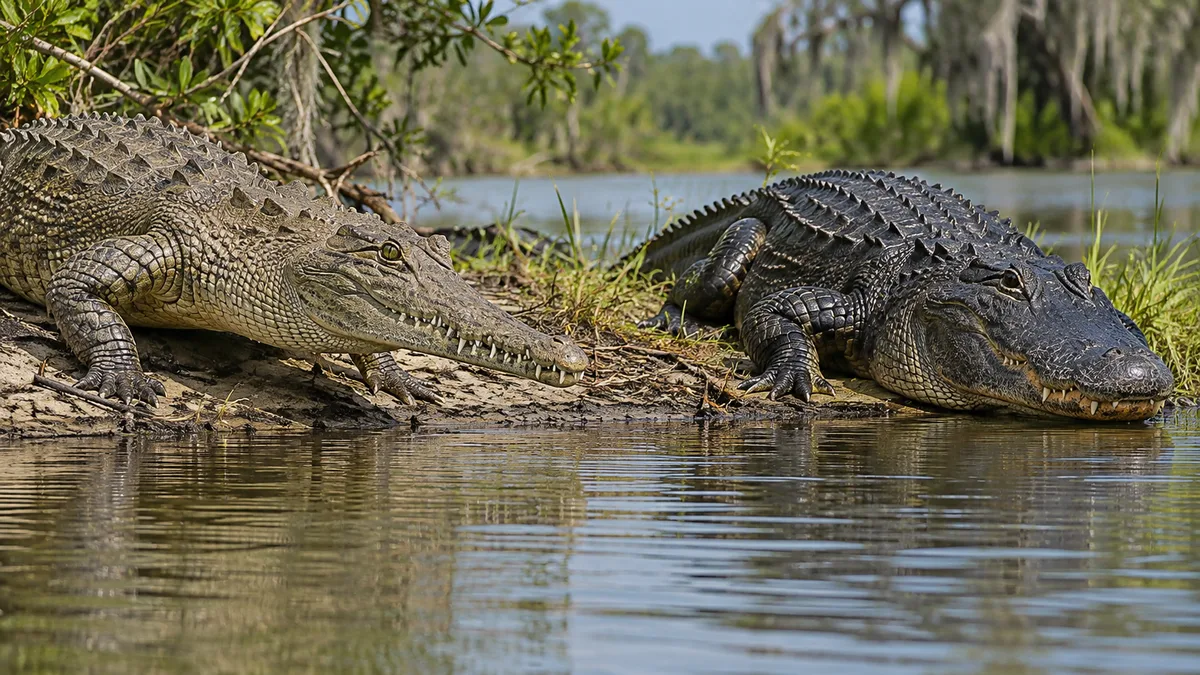
An alligator differs from a crocodile primarily in the shape of its snout and the visibility of its teeth. An alligator has a wide, U-shaped snout into which its lower teeth retract, while a crocodile has a narrower, V-shaped snout, the lower teeth of which are visible even when the mouth is closed. Crocodiles are also generally larger, tolerate salt water better, and inhabit a much larger territory.
To sum it up
- Muzzle: The alligator has a wide, rounded (U) neck, while the crocodile has a narrower, triangular (V) neck.
- Teeth: A crocodile's lower teeth are visible when its mouth is closed, while an alligator's are hidden.
- Dimensions: The largest crocodiles (saltwater, Nile) reach about 6 m in length, the American alligator is usually about 3.4 m.
- Distribution area: Alligators live only in the USA and China, crocodiles live in the tropics of Africa, Asia, Australia and America.
What's the difference between a crocodile and an alligator? Key characteristics.
Crocodiles and alligators belong to the same order – Crocodilia – but to different families. Alligators belong to the family Alligatoridae , and crocodiles - to family Crocodylidae . It's a bit like the difference between a fox and a wolf: similar body structure, but different developmental lines and many subtle differences.
Muzzle shape
This is the easiest way to distinguish these two reptiles from each other. When viewed from above, the alligator broad, rounded, U-shaped muzzle . The crocodile has a face narrower, more pointed, V-shaped . This rule is true in most cases, although some crocodiles (such as the mud crocodile) have a rather wide snout.
Teeth with mouth closed
The alligator's upper jaw is wider than the lower jaw, so when the mouth is closed the lower teeth are hidden in the recesses of the upper jaw. In a crocodile, both jaws are approximately the same width, and the teeth interlock externally – both upper and lower teeth are visible . The large fourth tooth of the lower jaw is particularly noticeable, protruding from the side of the mouth, creating a characteristic "smile".
Color and the senses
Adult American alligators are usually dark, grayish-black , while crocodiles are more common olive, brown or reddish in color . Crocodiles also have tiny sensory projections (pressure receptors) on scales across almost their entire body, whereas alligators have them mostly around their jaws—on crocodile skin, they appear as small dots on each scale.
Which is bigger - a crocodile or an alligator?
Crocodiles are larger. Saltwater crocodile ( Crocodylus porosus The Nile crocodile is the largest living reptile, with males reaching 6 meters in length and weighing over a ton. The Nile crocodile can also grow to approximately 6 meters.
The American alligator is smaller. According to the Smithsonian's National Zoo, the average length of adult males is about 3.4 meters, females about 2.6 meters, and exceptionally large males weigh almost half a ton. The longest reliably measured specimen, found in Alabama, was 4.5 meters. The Chinese alligator is significantly smaller than the American alligator. Therefore, the question "alligator vs. crocodile—which is bigger?" has a clear answer: record-holding crocodiles clearly outweigh record-holding alligators.
Comparison chart of crocodile and alligator
| Characteristic | Crocodile | Alligator |
|---|---|---|
| Family | Crocodiles (Crocodylidae) | Alligators |
| Muzzle shape | Narrower, V-shaped | Wide, U-shaped |
| Teeth with mouth closed | The top and bottom parts are visible. | Mostly visible from above. |
| Coloration of adults | Olive, brown, fawn | Dark, gray-black |
| Salt glands on the tongue | Active – tolerates salt water | There are no active ones - mostly freshwater bodies. |
| Maximum size | Approximately 6 m (Rosari, Nile) | Approximately 4.5 m (American alligator) |
| Reception | Africa, Asia, Australia, America | Southeastern United States and eastern China |
Where do crocodiles and alligators live?
Crocodiles live in tropical regions. Africa, Asia, Australia, Central and South America . They have active salt glands on their tongues that remove excess salt, so they thrive in estuaries and mangrove forests, and saltwater crocodiles even swim in the open sea.
Alligators live in only two places. American alligator ( Alligator mississippiensis ) inhabits the southeastern United States, including Florida and Louisiana. Chinese alligator ( Alligator sinensis ) is an endangered species found in the lower Yangtze River basin. Alligators primarily inhabit freshwater habitats: swamps, rivers, and lakes.
South Florida — is an amazing place. According to the National Park Service (NPS), it's the only place where American alligators and American crocodiles coexist in the wild. Alligators live in freshwater swamps, while the much rarer crocodiles inhabit brackish shores with mangroves.
What is more dangerous for humans?
Crocodiles , Crocodiles, especially Nile and saltwater crocodiles, are considered more dangerous—these species are responsible for the majority of crocodile attacks on humans. American alligators are generally less aggressive but are still large predators. The same rules apply to them: keep your distance, do not feed them, and do not approach the shore where they live.
How to Identify an Alligator and a Crocodile – A Quick Guide
- Look at the face from above: U = alligator, V = crocodile.
- Look at the closed mouth from the side: Visible teeth in the lower jaw indicate a crocodile.
- Rate the color: A very dark, almost black reptile is most often an alligator.
- Consider the location: Salt water, Africa or Australia – crocodile; freshwater swamps in the USA – most likely an alligator.
- Don't confuse it with the caiman and gharial: Caimans are relatives of alligators from Central and South America, while the gharial has a very long, thin snout and lives on the Indian subcontinent.
Frequently Asked Questions (FAQ)
What is the difference between a crocodile and an alligator?
A crocodile has a narrower, V-shaped snout and visible lower teeth when its mouth is closed, while an alligator has a wider, U-shaped snout and retracted lower teeth. Crocodiles are typically lighter in color, larger, and better able to tolerate salt water. They belong to a different family than alligators.
Which is bigger - a crocodile or an alligator?
Crocodile. The largest saltwater crocodile reaches about 6 m in length, while the American alligator averages about 3.4 m (males), and in exceptional cases, up to 4.5 m.
Do crocodiles and alligators coexist?
Only in one place in the world—south Florida. Alligators live in freshwater, while American crocodiles inhabit brackish waters.
Why can crocodiles live in salt water but alligators can't?
Crocodiles have active salt glands on their tongues that excrete excess salt. Alligators lack such glands, so they primarily live in freshwater and spend only short periods in saltwater.
Is a caiman an alligator?
Caimans belong to the same family as alligators (alligatorids), but are separate species. They live in Central and South America.
See also
- What is the difference between a viper and a snake?
- What is the difference between reptiles and amphibians?
- What is the difference between a fallow deer and a red deer?
- What is the difference between a moose and a deer?