


By 2027, the premium electric vehicle segment is no longer about "trying new things," but about mature technologies, business-class comfort, and genuine long-distance capability. By this time, the Mercedes EQS has firmly established itself as the brand's electric flagship. It's a large liftback built on an all-electric platform, with an emphasis on aerodynamics, cabin quietness, and intelligent driver assistance systems.
If EQS was previously perceived Whether it's an experiment or a bold step toward the future, the 2027 version is a refined product: with refined software, optimized energy systems, and more flexible powertrain configurations.
Exterior

The EQS's key feature is its aerodynamics. The domed roof and the smooth transition from the hood to the rear ensure a drag coefficient of approximately 0.20—one of the best among production cars. This is crucial for an electric vehicle: the lower the drag, the more consistent the driving range on the highway.
The front end appears low and wide. The huge curved windshield flows smoothly into the pillars, creating the effect of a single glass capsule. Between the headlights is a closed "Black Panel" panel with integrated sensors and a large brand logo. In 2027, the lighting system received updated graphics and more precise matrix system algorithms.
The lower section of the bumper is neatly designed: air vents direct airflow to key components, and the decorative elements are not excessive. Unlike traditional sedans, there's no hint of aggression here—the EQS conveys a calm, technologically advanced look.

In profile, the car appears very long, although its smooth roofline visually "pulls" it together. The door handles are recessed into the bodywork and automatically extend as the driver approaches. The wheels, up to 22 inches in diameter, are designed with aerodynamics in mind: even the spoke design is designed to reduce turbulence.
The mirrors are compact and the pillars are massive, creating a feeling of security inside. The shape of the sills and arches is also optimized to minimize air turbulence.

The rear end is designed in the same minimalist style. An LED strip connects the lights into a single line, visually widening the vehicle. The liftback design provides easy access to the trunk, and the sloping windshield improves aerodynamics and adds a finished look.
Interior

The 2027 EQS interior is no longer just luxury, but a technologically advanced environment. It combines genuine leather, wood and metal trim, soft surfaces, and sophisticated lighting. But the key feature is the digital architecture.
Hyperscreen and controls
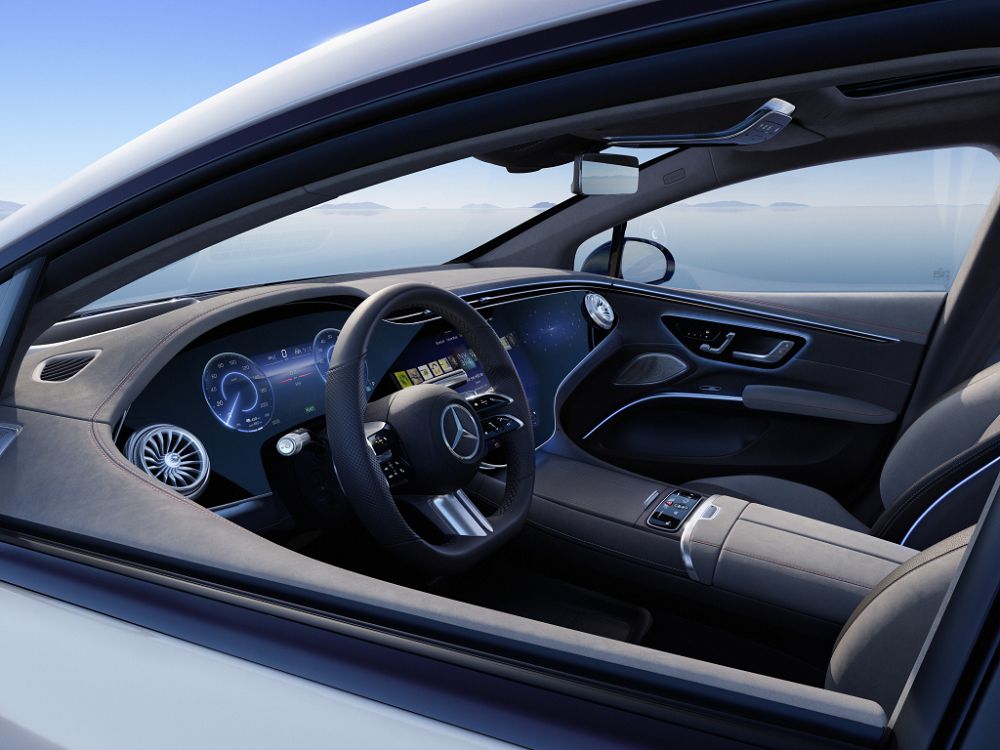
The entire width of the front panel can be occupied by a glass block called Hyperscreen, which combines three displays under a single glass:
- digital instrument panel in front of the driver;
- central screen of the multimedia system;
- separate display for the front passenger.
The system analyzes driver behavior and suggests features in advance, from navigation to seat massage settings. If there's no passenger present, the screen displays neutral graphics and avoids distraction.
The central tunnel is wide, with lockable storage compartments and wireless charging for devices. The armrest opens on both sides, revealing a deep compartment that can maintain a preset temperature.
Comfort and space
The five-seat layout is designed with long-distance travel in mind. The front seats feature multiple power adjustments, ventilation, heating, and several massage programs. The rear seats offer a high level of comfort, with ample legroom, a high-quality multimedia system, and separate climate control zones.
The panoramic roof adds a sense of airiness and light, while the sound insulation is tuned to ensure the cabin remains virtually silent, even at high speeds.
The luggage compartment, with a capacity of around 610 litres in the standard position, can be easily transformed by folding the second row, making the EQS practical for travelling.
Technical specifications

The 2027 Mercedes EQS is built on a dedicated electric platform with a flat battery pack at the base of the vehicle. This ensures a low center of gravity and improved handling.
Several powertrain versions are available:
- rear-wheel drive modification with a power of about 330–350 hp;
- all-wheel drive version with two electric motors with a total power of over 500 hp;
- High-performance designs with even more impressive output.
A battery with a capacity of approximately 108 kWh provides a range of over 600 kilometers under optimal conditions. In 2027, the energy management software was updated: the system more accurately predicts the remaining range, taking into account terrain, temperature, and driving style.
Acceleration to 100 km/h takes between 6 and approximately 4 seconds, depending on the version. Top speed is electronically limited, but even at higher speeds, the car remains stable and quiet.
Chassis and handling
The EQS comes standard with adaptive air suspension. All-wheel steering allows the rear wheels to turn up to 10 degrees, significantly simplifying maneuvers in the city and improving stability on the highway.
- reduced turning radius for a large body;
- stability at high speeds;
- comfortable filtering of uneven surfaces;
- several driving modes - from extremely soft to dynamic.
Assistants and security
The EQS is equipped with an extended package of electronic assistance systems:
- adaptive cruise control with traffic jam assist;
- lane keeping and active lane changes;
- collision avoidance system;
- 360-degree view and automatic parking;
- intelligent navigation taking into account charging infrastructure.
Software updates in 2027 will allow for improved functionality over the air, without requiring a visit to a service center.
Competing models
In the electric flagship segment, the EQS is traditionally compared to the Tesla Model S, Porsche Taycan, Audi e-tron GT, and Lucid Air. However, Mercedes' philosophy emphasizes not extreme performance but rather balance: quietness, comfort, advanced electronics, and a premium ambience.
Results
The 2027 Mercedes EQS is a mature electric flagship, where technology serves comfort and aerodynamics optimizes real-world range. It combines impressive dimensions, intelligent suspension, advanced digital architecture, and a level of quietness that's hard to find in traditional cars.
For those considering an electric vehicle as a full-fledged alternative to a luxury sedan, the EQS remains one of the most technologically advanced and sophisticated options in its class in 2027.