

It's time to once again take 10 famous people from the past and explore what everyone thinks they did, but actually didn't. In other words, 10 more myths about historical figures.
10. Ben Franklin and Daylight Saving Time

Benjamin Franklin was undoubtedly a pretty smart guy. In fact, there's a long list of useful things he either invented or helped improve, but because he was such a prolific inventor, he often gets credit for things he didn't even create. One such example is daylight saving time, which involves moving clocks forward one hour in the spring to take full advantage of sunlight, and then moving them back in the fall.
The idea's origin with the Founding Father dates back to 1784. At the time, the 78-year-old Franklin was living in Paris, where he served as the American envoy. He published an essay in the issue Journal de Paris from April 26 , in which he wrote that Parisians would save a fortune on candles if they got up at sunrise.
Here's the thing, though. Franklin's essay was clearly satirical. He wrote that he was the first person in Paris to discover that the sun rose so early after being accidentally awakened at six in the morning by a random noise and finding his room flooded with sunlight. He also wrote how he told his friends this, and they refused to believe it was possible.
Furthermore, Franklin made no mention of setting the clocks forward. Instead, his proposed solutions (again, intended as satire) included taxing windows with shutters that blocked out light, limiting candle sales to one pound per week per family, ringing church bells every morning at six, and, last but not least: shoot cannons on the street to wake everyone up.
9. Fidel Castro and baseball
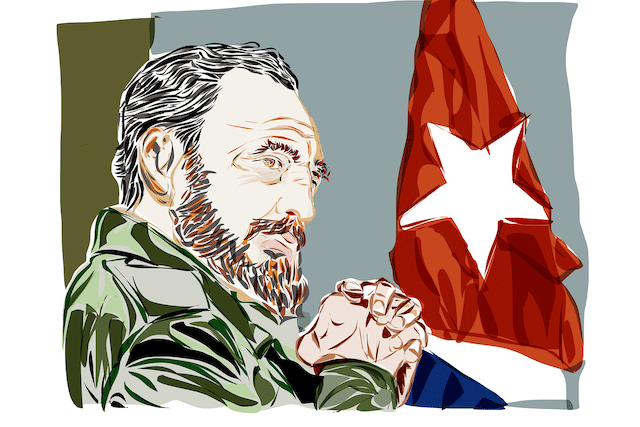
Fidel Castro wore many hats in his life: activist, revolutionary, political radical, guerrilla leader, ruthless dictator... And, according to one persistent myth, he almost wore another hat - that of a New Yorker. Yankees .
There's no denying that Fidel Castro was a big baseball fan. He was also quite good at it, having played the sport while attending college in Havana. However, there's a vast gulf between «decent» and «Yankee.» Castro was never good enough to turn pro, but popular history claims he was once a promising Yankee player in the 1950s, sometimes moving to the Senators. Washington .
Like many good myths, there may have been a grain of truth in this one that helped it take shape. It's possible, though not certain, that Castro may have participated in the mass screenings staged in Cuba. Joe Cambria , a famous baseball scout who brought numerous Cuban players to America. Even if this had happened, Castro would never have been taken seriously, but he liked the story and, of course, never made any effort to discourage it.
8. Charles Lindbergh and the transatlantic flight

Charles Lindbergh may be the most famous aviator in history, but if you asked people what made him so famous, many of them would probably give you the wrong answer. You could say that Lindbergh accomplished the first transatlantic flight back in May 1927, when he boarded the« Spirit of St. Louis» and flew from New York to Paris.
There's no denying that Lindbergh's flight was a landmark moment in aviation history, and even human history for that matter, but it came with two important caveats that people tend to overlook: it was the first solo, nonstop transatlantic flight. This meant Lindbergh flew directly from point A to point B without stopping along the way, and he did it completely alone. This remains a remarkable feat, but it diminishes the fact that dozens of others had crossed the Atlantic before him.
If we are looking for the first non-stop transatlantic flight, that honor belongs to To John Alcock and Arthur Brown, who successfully completed his journey in June 1919, eight years before Lindbergh. And if we're looking for the first transatlantic flight in history, we need to go back a few weeks earlier, to May 1919, when the crew of the Curtiss NC-4 flying boat, commanded by Rear Admiral Albert Cushing Reed, made the flight in 1919. year . days, after several stops for repairs.
7. Cass Elliott and the Ham Sandwich

No matter how grim it may be, celebrity deaths are always a rich source of myths and urban legends. For example, did you know that Cass Elliott, better known as Mama Cass for her work with Mamas & the Papas, choked a ham sandwich? Well, that's not true, but the story surfaced shortly after her untimely death in London on July 29, 1974, and hasn't gone away since.
Who exactly was responsible for this idea remains unclear. Some point the finger at a careless Met officer who opened the press's mouth. Others say the first doctor on the scene was to blame, as he, too, spoke to the media when he shouldn't have and mentioned that there was a half-eaten ham sandwich near the body, which could have been related to the cause of death. Since Cass Elliott's weight had long been the subject of media jokes, this was all it took for some unscrupulous journalists to craft a brutal yet convincing demise for the singer.
The third alternative source of the rumors was Elliott's manager, Allan Carr , who deliberately planted the story, even though he had more noble intentions. Besides her weight, Cass Elliott also had a rather serious drug addiction, so when Carr heard she had suddenly died, he assumed it was an overdose and thought the ham sandwich story was a less shameful route.
Finally, the British pathologist Keith Simpson He performed an autopsy and found the cause of death to be a heart attack. There were no drugs or ham sandwiches in Elliott's system, but by then the rumor had already become fact.
6. Ronald Reagan and Casablanca

Most people know that Ronald Reagan was an actor before he entered politics and eventually became President of the United States, but did you also know that during his film career, Reagan almost landed the lead role in Casablanca? » ?
This little piece of movie trivia is often presented as a fun «what if» from Hollywood history. What if Humphrey Bogart had missed out on his most iconic role? would Casablanca a hit without him? Will the film's success keep Ronald Reagan out of politics?
As before, the story of Reagan and Casablanca simply isn't true, but in this case, we know exactly how the myth arose. It was the result of a press release issued by Warner Bros. advertising in early 1942, which announced that the film would star Ronald Reagan and Ann Sheridan . But it was so early in pre-production that work on the script hadn't even begun, and casting decisions hadn't been made yet. These kinds of press releases, which contained no specific information, were quite common at the time and were simply intended to generate additional publicity for the studio's stars.
The person who had the final say in the casting was the producer. Hal Wallis , later stated that he never seriously considered anyone other than Bogie for the role, although it is true that he initially wanted Ann Sheridan instead of Ingrid Bergman.
5. Albert Einstein and school mathematics

The name «Einstein» became synonymous with «genius,» and given his extraordinary personality, it's no surprise that many myths arose about him. The most famous of all, of course, was that Einstein failed math in elementary school . This is a popular story because it helps us all feel better about our own mistakes and failures and gives us hope that one day we can turn things around.
While that last part is certainly possible, the bit about Einstein is not, although there is a grain of truth in it. Albert Einstein was gifted in geometry, physics, and algebra from a young age, and by age 11, he was already studying them at a college level. It is true that he failed the exam, although it was not a school exam, but an entrance exam to Zurich Polytechnic Institute . Einstein took the exam for the first time when he was just 16 years old and failed because the tests were in French, a subject the young Albert struggled with. However, he still answered all the math questions.
Another possible source of the myth was a change in the system ratings At his school. Anyone who looks at Einstein's academic records will notice that at some point he started getting a bunch of 6s, which should have been the lowest grade, while 1 was the highest. However, Einstein didn't suddenly go mute. The school simply reversed the order of grades, making 6s the highest. Sorry, but whatever you say, Einstein was always a prodigy.
4. Gene Simmons and cow tongue

KISS is known for a few things: rocking all night, partying every day, and staging outrageous and theatrical live shows. There are rockets, pyrotechnics, smoking guitars, fire-breathers, and, of course, makeup. To top it all off, bassist Gene Simmons became famous for his incredible tongue, which he proudly showed off at every opportunity. In fact, his tongue became so famous that people began to doubt its authenticity. Rumors soon surfaced that Simmons had enhanced his appearance by surgically replacing his own appendage with a cow's tongue. language .
This is, of course, absurd for many reasons. Aside from the fact that tongue transplants were medically impossible when KISS first achieved success in the early '70s, a cow's tongue is almost 20 times more , than a human's, so the difference would be quite noticeable. Also, while Simmons' tongue is large, it's not the largest ever or anything like that. It's just larger than average.
Finally, the myth was debunked by the man himself. He called the story his « favorite rumor about KISS », but confirmed that his language is 100 percent Gene Simmons'.
3. George Washington Carver and peanut butter

George Washington Carver was a scientist whose efforts were integral to the agricultural economy of the United States, particularly in the South, which depended entirely on cotton crops. Yet he is largely remembered as the «peanut butter guy,» which not only diminishes his accomplishments but is also untrue.
Born in slavery , Carver wanted to help black people. sharecroppers , who were constantly indebted to white plantation owners, increasing their farms' productivity. Cotton was by far the most profitable crop in America, but it was also extremely demanding on the soil. Since most Black farmers barely made ends meet, earning meager profits, they had no choice but to plant the most valuable crop. But growing cotton season after season depleted the soil of nutrients, so Carver wanted them to practice crop rotation and alternate crops to give the soil time to heal. But farmers were only willing to do this if they could profit from these other crops, so Carver began dreaming up hundreds upon hundreds of uses for soybeans, sweet potatoes, and, of course, peanuts.
Carver came up with more than 300 applications Peanuts alone have been used in everything from shaving cream to glue, shampoo, and all manner of food products. Yet peanut butter wasn't one of them, because it already existed. The Aztecs and Incas had made a paste from roasted peanuts centuries earlier, and in modern times, several people have filed patents related to peanut butter, including Dr. John Harvey Kellogg.
2. George Crum and potato chips

The story of how one of the world's most popular snacks came to be is one of malice and chance. One day in 1853, a man visited house by Lake Muna in Saratoga Springs, New York, and ordered fries. When his food arrived, he immediately sent it back, complaining that the fries were too thick and not salty or crispy enough.
The restaurant's chef was a native African American named George Crum, Aka George Speck, he didn't like fussy eaters. Were his potatoes too thick? Good, he sliced them as thin as possible. Were they not crispy or salty enough? Good, he cooked them until they were crispy and bathed them in salt. To his surprise, the patron loved them, and thus the potato chip, or Saratoga chip as Crum called it, was born.
To make the story even more fantastic, some versions claim that the patron was none other than a railroad magnate. Cornelius Vanderbilt . Unfortunately, there's nothing to suggest any part of this story is true. Crum was considered one of America's finest chefs of his time, yet no one in his lifetime hailed him as the inventor of the potato chip, not even Kram himself . This story spread after his death, and the true inventor remains a subject of debate.
1. Walt Disney and Frozen Head

Cryonics Cryonics is the practice of freezing a human body shortly after death in the hope that future medical advances will allow us to bring it back to life. Sometimes the entire body isn't even required; just the head. Of course, by the time medical science advances to the point where resurrection is possible, we'll have overcome our need for a body and be able to integrate our brains into computers, androids, smart toasters, or something similar. Many people pinned their hopes on the longevity of cryonics, including, if the myth is to be believed, its most famous patron, Walt Disney.
According to popular urban legend, the head of the Disney company is currently frozen in ice, waiting for science to figure out the whole «death» thing. Some even say it's stored in a freezer underneath the Disneyland attraction.« Pirates of the Caribbean ».
There is no evidence that Walt Disney was interested in cryonics, let alone that he froze himself. His own daughter debunked This myth, and records show that Disney cremated his body after his death. Some say the rumors were started by a few rogue Disney employees, while others blame a reporter from an old tabloid. The National Spotlite .