

The history of timekeeping dates back to ancient civilizations such as Sumer and Egypt. Egyptians were the first to divide the day into fixed units of time, which allowed them to develop more sophisticated methods of measuring time than ever before, such as sundials.
From there, civilizations such as China, India, Greece, Babylon, and others developed their own clocks and calendars, even if the earliest timekeeping devices were wildly inaccurate compared to modern clocks. It would take many scientific breakthroughs and fascinating attempts by various thinkers throughout history to achieve the common, universally accepted standard of time we all use today.
10. Sundial

The sundial cannon became popular in Europe in the 1600s, and old prototypes can still be found in museums and private collections around the world. It is essentially a timekeeping device based on a classic sundial, with vertically A magnifying lens and a cannon with a safety catch were positioned. Every day at noon or any other desired time of day, sunlight would pass through the lens and ignite the charge, causing the cannon to explode.
At that time, sun cannons were widely used throughout Europe to mark midday, although with the advent of modern clocks they gradually became obsolete. By the 19th century, they were built only as miniature new to collectors, although some of the larger ones still exist as tourist attractions, such as in Åtvidaberg, Sweden .
9. Candle clock
The first candle clock was described by the Chinese poet Yu Jiangu in 520 AD, although candles were likely used as a rudimentary measure of time for much longer due to their simplicity. Jiangu's clock was made from six candles of equal weight and thickness, enclosed in a glass frame to protect them from the flames. Each candle was left to burn for exactly four hours, with inch markers spaced at regular intervals to indicate twenty minutes.
Although the idea arose in China , candle clocks were soon adopted and improved by engineers around the world. They were a simple yet effective timekeeping device, though they had their limitations. First, these clocks were closer to modern alarm clocks or timers than to watches, as they could only be used to measure elapsed time. They were also likely quite inaccurate due to factors such as wind or wax quality. However, for common everyday tasks, they still provided a convenient way to keep track of time. Candle clocks were used until 18th century , before they were surpassed by modern clocks and watches.
8. Obelisk

First built in Ancient Egypt between 3500 and 2500 BC, the obelisk was one of the first timekeeping devices in history. It was made from a tapering rectangular stone slab, designed to accurately mark midday by the length of its shadow. Later were added marks to further divide the day into parts, as well as indicators to indicate the longest and shortest days of the year.
Although the earliest examples have been lost, obelisks were widely used and built by other civilizations, such as Babylon. In Egypt, they were often built at the entrance to temples and served a higher purpose than simply telling time. Egyptian obelisks were closely associated with the goddess Ra and sun worship, especially in era New Kingdom from 1570 to 1069 BC.
7. Merkhet
Over time, ancient Egyptian timekeeping devices and methods became more sophisticated, incorporating early designs like sundials in various ways to create even more sophisticated timepieces. The problem, however, was that they only worked during the day. A reliable method for measuring time at night wasn't developed until 600 BC. in the form of something called merkhet.
Merkhet, commonly used with aimed The device, called a bay, was essentially a tool for determining the north-south axis. By tracking the regular movement of the stars relative to this axis using devices such as water clocks, Egyptian scholars could use the merkhet to accurately determine the hour of the night. It also had other applications, such as in architecture—perhaps thanks to the merkhet, so many Egyptian buildings perfectly aligned along the north-south and east-west axes.
6. French decimal time
The French Revolution had a profound impact on all aspects of life in France, including timekeeping. In 1793, the newly convened National Convention decided that the old Gregorian time system was inconsistent with the spirit of the Revolution. It was too… asymmetrical compared to the simple decimal system, which could be understood in terms of factors from one to ten.
Near 17 months The French decimal time, also known as the Republican calendar, was adopted nationwide. All units of time, including weeks, were now divided into tens and hundreds. This was a novel idea, even if people didn't already have a time system they followed. More importantly, the weekly holiday now occurred every 10 days instead of seven, with a half-day added on the fifth day. Although the French government tried to make it work for a while, the idea failed to gain popular support and was officially abandoned. April 7, 1795 .
5. Incense clock
While the Egyptians were busy making timekeeping devices using the sun and stars, Chinese thinkers were developing a completely new way to sense time—through scent. Chinese incense clocks, dating back to at least the 6th century BCE, consisted of pieces of fragrant wood enclosed in a well-ventilated box. The incense, usually in the form of labyrinth , were burned at certain intervals, which made it possible to determine the time only by the smell in the room.
The design could be modified to serve more complex purposes, such as queuing different types of incense to tell the precise time of day. According to one historian, timers and incense clocks may have continued to be used in China for everyday tasks until 20th century .
4. Venetian ship

Navicula De Venetiis - or "« small Venetian ship »"—was a rare type of sundial, widely used in Europe during the Age of Exploration. We are not sure where it came from, although some evidence suggests that an earlier prototype was first designed and built by engineers in Baghdad in the ninth century. century .
Despite this, the navicula underwent many improvements and modifications in Europe. By the 14th century, it had become a useful tool for calculating time and latitude at sea. The device itself is shaped like a ship, with viewing holes at both ends of the deck for aligning with the correct latitude and a plumb bob indicating the time marked at the bottom. In most designs, the latitudes of famous European cities were inscribed on one side of the ship, depending on where it was made.
3. Time ball
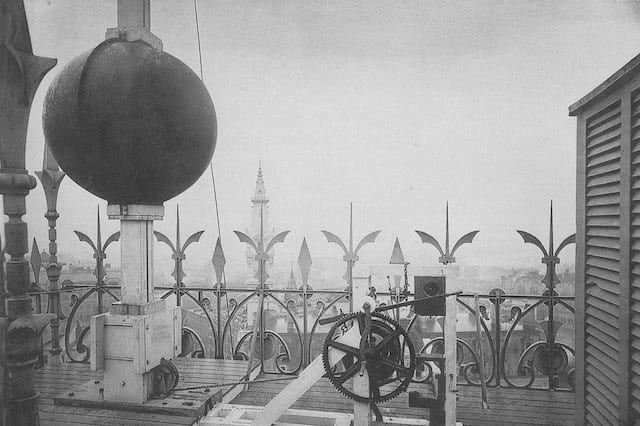
By the early 19th century, timekeeping devices such as pocket watches and clocks were commonplace. However, despite all the advances in mechanics and engineering, there was still no single standard to which these clocks could be compared. Local sundials—still the only accurate measure of solar time for most people worldwide—varied too widely to be reliable, even over short distances.
While the difference was barely noticeable previously with slower modes of transport like horse-drawn carriages, everything changed with the advent of trains, which required a standardized, universal time standard to operate. To resolve this, scientists and astronomers from around the world united and decided to divide the globe into 24 time zones.
Giant time balls were installed on top of famous observatories such as Greenwich to mark specific times of day, which were then used by ordinary people to synchronization of your watch. Thanks telegraph Time signals could now be transmitted instantly around the world, allowing train schedules to be synchronized and standardized no matter where you were. Although the system is now too obsolete to be of any real use, some of these balls continue to be used in for the purposes of novelty .
2. Congreve Rolling Ball Watch
Sir William Congreve was an artillery officer and engineer in the British Royal Army who is generally remembered for inventing the Congreve rocket in In 1808 . Although military rockets had existed before, Congreve's improvements made them more lethal and effective, allowing them to be used in large-scale conflicts such as the Napoleonic Wars. wars and the American War of Independence.
Congreve remained a prolific inventor of weapons and other military improvements throughout his career, though he also dabbled in other, less lethal inventions, such as his famous revolving clock. First built in 1808, it operated much like a pendulum—still a popular method of measuring time at the time. However, instead of a swinging pendulum, Congreve's clock used a steel ball on a horizontal zigzag track to track fifteen seconds, which was then used to move the clock's hands. over him.
1. Al-Jazari's Clock
Al-Jazari was a 13th-century polymath born in what is now southeastern Turkey. While we know little about his early life, we do know that he grew up to become one of the most important figures in early robotics—some even call him the "father" of robotics »" because of the greater influence of his inventions.
В treatise Al-Jazari «"The Book of Knowledge about Ingenious Mechanical Devices »"More than 100 of the earliest automata ever created are described in detail, along with instructions for their construction. Many of these were clocks of various types, including the famous elephant clock , which have since been reproduced by many engineers around the world. There are also Castle clock , which may have been one of the first programmable analog computers in history. Some of al-Jazari's designs were so complex that they inspired Renaissance engineers, including Leonardo da Vinci.