

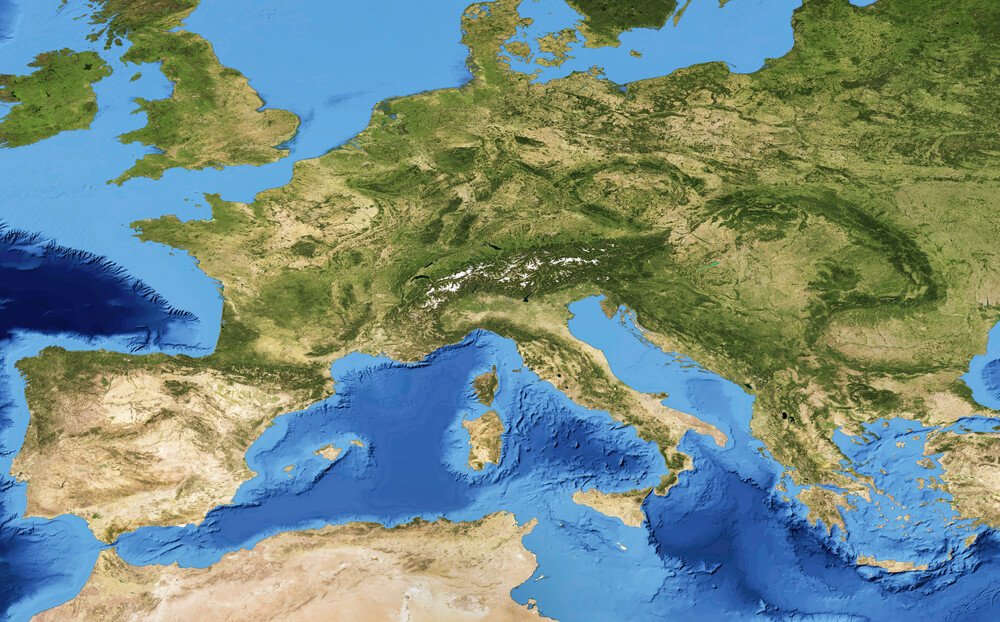
An ocean is a large body of salt water that separates the continents, while a sea is a smaller part of the ocean, more or less clearly separated from it by land—the coastlines of continents, peninsulas, or islands. Seas are typically shallower than oceans, and their salinity and temperature are more strongly influenced by the surrounding landmass. Each sea belongs to an ocean—the Baltic Sea, for example, is part of the Atlantic Ocean.
To sum it up
- Ocean — is a huge, enclosed body of salt water; traditionally, four oceans are distinguished, but increasingly, five (including the Southern Ocean).
- Sea — is a part of the ocean separated from it by land, islands, or, in exceptional cases, sea currents.
- The average depth of the oceans is about 3.7 km; many seas are much shallower (the average depth of the Baltic Sea is about 52 m).
- The average salinity of the oceans is about 35‰, while the salinity of the seas varies greatly – in the Baltic Sea it is on average only about 7‰.
What is the ocean?
Ocean — the largest of the world's oceans, consisting of interconnected saltwater bodies of water covering approximately 71% Earth's surface . Oceans are separated by continents, and their boundaries in open water are generally defined. They contain the vast majority of the planet's water—approximately 971 TP3T, according to NOAA.
Traditionally, four oceans are distinguished: Quiet (the biggest), Atlantic , Indian и Arctic . More and more often in atlases and educational materials Southern Ocean , surrounding Antarctica, is listed fifth. The average depth of the oceans is about 3.7 km , and the deepest point on Earth, the Mariana Trench, is located in the Pacific Ocean.
What is the sea?
Sea A sea is a part of the ocean, more or less clearly separated from it by continental coastlines, peninsulas, or islands. Seas have a smaller area and are often shallower—many are located on the continental shelf, the underwater edge of a continent. Limited water exchange with the ocean means that the salinity, temperature, and water movement in the seas can differ significantly from oceanic conditions.
An interesting exception is Sargasso Sea in the Atlantic Ocean. It doesn't have a single kilometer of coastline—its boundaries are determined by ocean currents, including the Gulf Stream and the Canary Current. Meanwhile, Caspian Sea , despite its name, is not associated with an ocean and is geographically considered a lake.
Types of seas
Depending on their location and distance from the ocean, they are divided into the following categories:
- Coastal (open) seas — located on the edge of the ocean, separated from it by islands or peninsulas and freely exchanging water with it, for example, the North Sea, the Norwegian Sea, the Sea of Japan.
- Inland seas connected to the ocean only by straits. They are divided into intercontinental seas , located between continents (e.g. the Mediterranean Sea, the Red Sea, the Caribbean Sea), and inland seas , surrounded by one continent and usually shallow (for example, the Baltic Sea, the White Sea).
- Interisland seas – their boundaries are determined by islands and archipelagos.
Depth and salinity – sea and ocean
On average, oceans are much deeper than seas. Inland seas, such as the Baltic Sea, are exceptionally shallow: The average depth of the Baltic Sea is about 52 m, and the greatest depth reaches 459 m in the Landsort Deep. However, some intercontinental seas, such as the Mediterranean Sea, have deep basins.
The average salinity of ocean waters is approximately 35‰ , or about 35 grams of salt per kilogram of water. These values vary greatly within the seas. In areas with a large influx of river water and limited exchange with the ocean, salinity decreases—in the Baltic Sea, it averages about 7‰ , while in the Gulf of Bothnia and Finland it's only a few parts per thousand. In warm seas with high evaporation, salinity is higher than in the ocean.
The Baltic Sea is an example of an inland sea.
The Baltic Sea clearly demonstrates the difference between a sea and an ocean. It is almost completely surrounded by European land and is connected to the Atlantic Ocean only through a narrow Denmark Strait and the North Sea. Therefore, it is classified as an inland sea.
The influence of this location is evident from the figures: the Baltic Sea is shallow (on average about 52 m) and has brackish , rather than salt water—on average, about 7‰, with the lowest salinity observed in the Gulf of Bothnia and the Gulf of Finland. For comparison, the salinity of open ocean waters is about 35‰. The boundaries of seas and oceans on maps are mostly arbitrary; international research on this issue is conducted by the International Hydrographic Organization (IHO).
Comparison chart: sea vs. ocean
| Characteristic | Ocean | Sea |
|---|---|---|
| Definition | The largest body of salt water between continents. | A part of the ocean separated by land or islands. |
| Number | 4 or 5, depending on the adopted division. | Many different sizes. |
| Surface | Huge - The Pacific Ocean is the largest. | Much less |
| Depth | On average, about 3.7 km | They are usually smaller in size, for example the Baltic Sea is on average about 52 m. |
| Salinity | Relatively constant, on average around 35‰ | It varies, for example, in the Baltic Sea it is approximately 7‰ |
| Influence of the earth | Small | Large rivers, climate, coastal features |
| Examples | Peaceful, Atlantic, Indian | Baltic, Mediterranean, Northern |
How can you tell if it's a sea or an ocean?
- Look at the map: If a body of water is clearly delimited by a coastline, peninsulas, or a chain of islands, then it is most likely a sea.
- Check which part each sea belongs to: Each sea is part of an ocean – for example, the Baltic and North Seas belong to the Atlantic Ocean.
- The title may be misleading: The Caspian Sea is actually a lake, and the Sargasso Sea has no coastline.
- In everyday speech the phrase «"We're going to the sea" simply means the coast - even the open ocean.
Frequently Asked Questions (FAQ)
How many oceans are there in the world?
Traditionally, four oceans are distinguished: the Pacific, Atlantic, Indian, and Arctic. The Southern Ocean around Antarctica is increasingly being added as a fifth.
To which ocean does the Baltic Sea belong?
To the Atlantic Ocean. The Baltic Sea is connected to it via the Denmark Strait and the North Sea.
Why is the Baltic Sea not very salty?
Numerous rivers flow into the Baltic Sea, and water exchange with the ocean through narrow straits is limited. Therefore, its average salinity is about 7‰, compared to approximately 35‰ in the ocean.
Is there a sea without shores?
Yes, the Sargasso Sea is in the Atlantic Ocean. Its boundaries are determined by ocean currents, not land.
Is the Caspian Sea a sea?
Despite its name, this is not the case. It has no connection to the ocean, so geographers consider it a lake—the largest in the world.
See also
- What is the difference between seasonal and episodic rivers?
- What is the difference between a glacier and an ice sheet?
- What is the difference between a plan and a map?
- What is the difference between an alligator and a crocodile?