

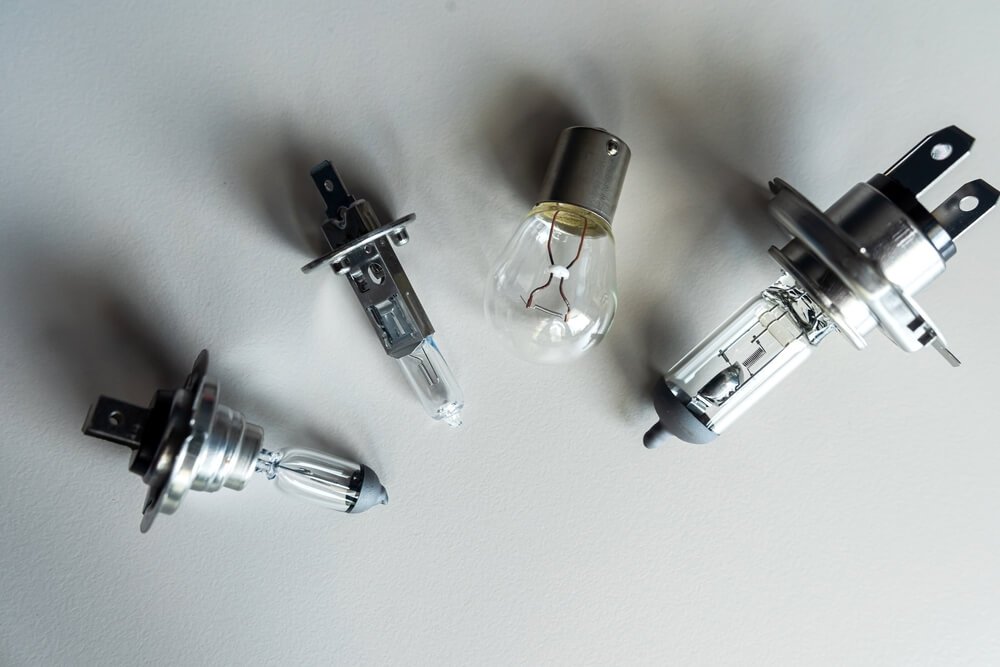
The H7 and H1 bulbs are 12V, 55W single-filament halogen bulbs that differ primarily in their bases: the H7 has a PX26d base with two pins, while the H1 has a P14.5s base with one pin, so they are not interchangeable. They also differ slightly in design, luminous flux, and typical application. The choice of bulb depends solely on the headlights of your vehicle.
To sum it up
- Base base: H7 – PX26d (two flat contacts), H1 – P14.5s (one contact, grounded through the housing).
- Parameters: Both parameters are 12V and 55W; the nominal luminous flux is approximately 1500lm for H7 and approximately 1550lm for H1.
- Application: H7 is a common choice for low and high beams in modern cars, H1 is used for high beams, fog lights and older headlights.
- Interchangeability: absent – it is impossible to install an H1 lamp in an H7 socket and vice versa, and any modifications do not meet the headlight certification requirements.
H1 and H7 bulbs – basic information
The letter "H" in the name indicates halogen The lamp, and the number designates the specific type described in UNECE Regulation No. 37, which specifies the dimensions, base, and electrical parameters. Types with different numbers indicate different designs, not "better" or "worse" versions of the same product.
What both H1 and H7 lamps have in common is the presence of one filament . This means that a single bulb performs only one lighting function—for example, only low beam or only high beam. This distinguishes them from the popular H4 bulb, which has two filaments and combines low beam and high beam in a single bulb.
Lamp H7 - diagram and design.
If you look at the H7 bulb from above, you will see: quartz flask with one horizontal filament (usually with a blackened tip), metal rim , which fixes it in the reflector, and PX26d base , from which they depart from below two flat contacts . The electrical connector (plug) is located above the contacts.
The compact design of the H7 filament matches well with modern free-form reflectors and lens headlights. This is why H7 is now one of the most common types of low-beam headlights, and even high-beam headlights in many vehicles.
H1 lamp – design and application
The H1 bulb is an older, classic design. It features a narrower bulb with a single filament running lengthwise, a metal rim, and P14.5s base . Power is supplied through one contact - a flat "blade" or wire - and grounding is carried out through the metal housing and the headlight housing.
H1 lamps have historically been used primarily for headlights high beam and fog headlights; in some older models, they were also used for low-beam headlights, especially lens-type headlights. They remain popular in auxiliary high-beam headlights and on equipment.
Comparison table: H7 and H1 bulbs
| Characteristic | H7 | H1 |
|---|---|---|
| Pen | PX26d | P14.5s |
| Contacts | Two flat contacts at the bottom | One contact, grounded through the living space |
| Number of threads | One | One |
| Voltage and power | 12 V, 55 W | 12 V, 55 W |
| Luminous flux (nominal) | approximately 1500 lm | approximately 1550 lm |
| Typical use | Low and high beam headlights in new cars | High beam, fog lights, old headlights |
| Interchangeability | Not suitable for H1 connector | Not suitable for H7 socket |
The wattage and luminous flux values shown are for standard 12V halogen bulbs. "Enhanced" versions (e.g. +100%, +150%) have the same bases and wattage, but differ in filament design and typically have a shorter lifespan.
H1 or H7 – how to determine which bulb to buy?
There's no "best" choice between them—you need to buy the headlight it was designed for. The easiest ways are:
- В car owner's manual , In the section on replacing light bulbs, you will find information about the types of light bulbs for each lighting function.
- Markings on an old light bulb – the H1 or H7 symbol is stamped on the base or plinth.
- Number of contacts – two flat contacts in a normal connector denote H7, one contact with one wire denotes H1.
- Catalog of a light bulb store or manufacturer – by make, model and year of manufacture of the car.
Replace halogen bulbs in pairs to ensure both headlights produce the same light, and avoid touching the bulbs with your fingers—skin oils can shorten the bulb's life. After replacing, check the headlight alignment. Also remember: replacing lamps with H7 LED permitted in Poland only if they are homologated and approved by the manufacturer for a specific car model - check the list of cars specified by the manufacturer.
The most common mistakes when replacing H7 and H1 bulbs.
- Buy by eye – H1 and H7 bulbs are similar in size, so they can be easily confused on store shelves. Always compare the markings and bases.
- The bulb is not tightened enough or the spring is not properly secured. – the filament does not fall into the focus of the reflector, and the beam shines too high or is blurred.
- Replacement of only one side – new and old bulbs differ in brightness and color, which reduces visibility.
- Lack of rubber casing on the back of the headlight allows moisture and dirt to get inside, causing the lamp to fog up.
- 24V light bulb in a passenger car or vice versa – the truck versions have the same base, but different parameters.
If you need to remove the bumper or wheel arch to access the headlight, and the owner's manual recommends replacement at a service center, do not use force - it is easy to damage the latches or the headlight housing.
Frequently Asked Questions (FAQ)
Will an H1 bulb fit instead of an H7?
No. H1 bulbs have a P14.5s base, while H7 bulbs have a PX26d base. They differ in mounting, contacts, and filament position, so they will not fit in a different base. Modifications (adapters, base changes) do not meet headlight homologation requirements and may dazzle other drivers.
Which bulb is brighter – H1 or H7?
Nominally, the H1 has a slightly higher luminous flux (approximately 1,550 lumens compared to approximately 1,500 lumens for the H7), but the difference is minor. How well you see the road depends primarily on the headlight design and its orientation, rather than the type of bulb itself.
Is H7 for low beam or high beam?
For both applications. In many vehicles, the H7 operates in low-beam mode, in others in high-beam mode, and sometimes in both modes in separate headlight sections. The vehicle manufacturer determines the intended use.
How to recognize an H7 bulb by its appearance?
The H7 bulb has a metal clamp and shaft, with two flat contacts protruding from the bottom and a quartz bulb with a single filament above them. The H1 bulb, on the other hand, has a single power contact, and the ground connection runs through the housing.
Do H1 and H7 have the same power?
Yes, both models have a standard 55W output in the 12-volt automotive version. There are also 24-volt truck versions with different outputs—these should not be confused with the passenger car versions.
See also
- What is the difference between gasoline and diesel fuel?
- What is the difference between 5W30 and 5W40 oils?
- What is the difference between a 16A outlet and a 32A outlet?
- What is the difference between the M32 and F40 gearboxes?