

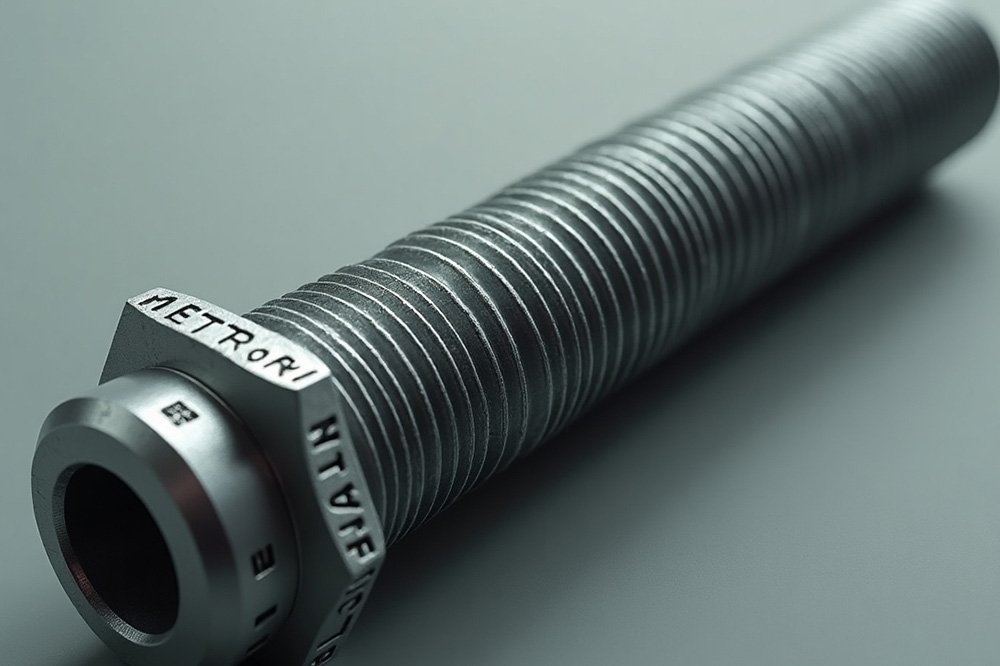
Metric threads differ from inch threads in their units of measurement and description: in metric threads, the diameter and pitch are specified in millimeters (e.g. M10×1.5), while in inch threads, the diameter is specified in inches and the pitch is the number of threads per inch (e.g. 1/4″-20 UNC). The thread angle can also vary—metric threads are always 60°, while imperial threads are either 60° (American UNC/UNF, NPT) or 55° (British Whitworth, including the popular G-thread for pipe). Therefore, screws and nuts from both systems are usually not compatible.
To sum it up
- Units of measurement: Metric – millimeters; Imperial – inches (1 inch = 25.4 mm).
- Thread pitch: In the metric system, the distance between threads in mm; in the inch system, the number of threads per inch (TPI).
- Profile angle: metric 60°; inch 60° (UNC, UNF, NPT) or 55° (Whitworth, G and R pipes).
- Plumbing: A 1/2" thread is actually approximately 21mm in diameter - the name doesn't match the size.
Metric threads – designations and construction
ISO metric thread — is the most common fastener thread in the world, used in screws, bolts and nuts. It has triangular profile with an angle of 60° , and all dimensions are given in millimeters.
The designation consists of a letter M and the nominal diameter in mm. For each diameter there is standard (coarse) thread pitch that drops down – for example, M10 is a thread with a diameter of 10 mm and a pitch of 1.5 mm. Small Threads are designated by their pitch, such as M10×1.25 or M10×1. Fine pitch is used when the connection requires higher pressure or when the wall is thin.
Inch threads - several different systems
«"Inch thread" is not a single standard, but a whole family. What they have in common is that dimensions are specified in inches, and the thread pitch is in threads per inch (TPI). The most important types are:
- UNC and UNF (Unified) – American fasteners with a 60° thread, produced in coarse (UNC) and fine (UNF) versions. The designation 1/4″-20 UNC means a diameter of 1/4 inch and 20 threads per inch.
- BSW (Whitworth) - a historical British fastener thread with a 55° angle and rounded ends.
- Whitworth carving - cylindrical G (ISO 228 standard) and conical R (ISO standard 7). It has a 55° angle and is an inch thread used in Polish water supply and heating systems.
- NPT – American tapered pipe thread with an angle of 60°.
Trap: In hydraulics, an inch is not 25.4 mm.
In threaded connections, the number in the designation indicates nominal pipe size , and not by thread diameter. For example, G 1/2 thread It has an outside diameter of 20.955 mm and 14 threads per inch, although half an inch is only 12.7 mm. Therefore, when measuring a fitting with a caliper, it is impossible to "convert" the result to inches—you must refer to a threaded connection table.
Comparison table of metric and inch threads.
| Characteristic | Metric thread | Inch thread |
|---|---|---|
| Unit | Millimeter | inch (25.4 mm) |
| Jump description | Distance between turns in mm (e.g. 1.5) | Number of threads per inch (e.g. 20 TPI) |
| Contour angle | 60° | 60° (UNC, UNF, NPT) or 55° (BSW, G, R) |
| Approximate markings | M8, M10×1.25 | 1/4″-20 UNC, G 1/2, 1/2″ NPT |
| Standards | ISO (in Poland PN-ISO) | ANSI/ASME (USA), BS, ISO 228 and ISO 7 (pipes) |
| Where will you meet? | Most of the screws, machines, cars and equipment in Europe and Asia | American equipment, old British machines, hydraulics, camera tripods. |
| Interchangeability | Usually no - even with a similar diameter, the pitch and angle are different. | |
Where can I find inch threads in Poland?
In everyday life, we almost always encounter metric threads. Imperial threads are found primarily in a few places:
- Plumbing, gas and heating systems – connectors, valves, taps and hoses have G or R threads, for example, 1/2″, 3/4″, 1″;
- Equipment from the USA – cars, motorcycles, automobiles and electronics designed in the inch system;
- Photography – the camera is attached to the tripod using a 1/4″-20 thread;
- Old British machine tools - with Whitworth thread.
How to determine whether a thread is metric or inch?
- Measure the outside diameter Vernier calipers. Readings near millimeters (6, 8, 10, 12 mm) indicate metric threads; values such as 6.35 mm (1/4 inch) or 9.5 mm (3/8 inch) indicate inch threads.
- Check the thread pitch with a thread gauge . It has separate metric (mm) and inch (TPI) blades. The blade that fits flush indicates the thread type.
- In plumbing Compare the result with the pipe thread table: a diameter of approximately 21 mm usually corresponds to G 1/2, approximately 26.4 mm – G 3/4.
- Don't apply excessive force. A bolt that only tightens two or three turns and then stops likely has a different thread. Tightening it with a wrench will damage both components.
- When working with gas and pressure equipment Use the manufacturer's documentation and entrust the work to an authorized installer.
Frequently Asked Questions (FAQ)
Can you screw an inch screw into a metric thread?
Generally speaking, no. Even with similar diameters, the thread pitch and often the thread angle vary. A screw may engage several threads, but tightening it too much will damage the threads, and the connection will not last.
What does M10×1.25 mean?
This is a metric thread with a nominal diameter of 10 mm and a fine pitch of 1.25 mm. The designation M10 itself denotes the same thread with a normal pitch of 1.5 mm.
Why is the thread diameter of 1/2 inch approximately 21 mm?
Because in pipe threads, 1/2" is the nominal pipe size, not the thread diameter. A G 1/2" thread according to ISO 228 has an outside diameter of 20.955 mm.
What is the difference between G and R threads?
Both threads are Whitworth-type and have a 55° thread angle. The G thread (ISO 228) is cylindrical and does not provide a thread seal—a gasket or O-ring seal is used. The R thread (ISO 7) is conical and provides a thread seal, typically with tape or paste.
What is the angle of a metric thread and what is the angle of an inch thread?
In the ISO metric system, the angle is 60°. In the US imperial system (UNC, UNF, NPT), the angle is also 60°, and in the British Whitworth system, including G and R tubulars, the angle is 55°.
See also
- What is the difference between alternating current and direct current?
- What is the difference between 95 and 98 octane gasoline?
- What is the difference between LR20 and R20 batteries?
- What is the difference between in-ear headphones and earbuds?