


Saturn isn't just a gas giant on the outskirts of the solar system, but a true planetary system full of mysteries, discoveries, and scientific opportunities. Its glittering rings, hundreds of satellites, and unique atmosphere have captivated astronomers for decades. Saturn's moons are particularly intriguing—some of them, such as Enceladus and Titan, are considered among the most promising sites in the search for extraterrestrial life. Over the past half-century, humanity has sent only four spacecraft to this planet—three flybys in the late 1970s and early 1980s, and the Cassini-Huygens mission entered Saturn's orbit in 2004 and remained there for 13 years, collecting invaluable data. In 2017, the spacecraft concluded its mission, diving into the planet's atmosphere.
Although no direct exploration of Saturn is currently underway, new missions are already on the way: for example, the apparatus Dragonfly, The Cassini probe, scheduled for launch in 2034, is scheduled to land on Titan, Saturn's largest moon. Meanwhile, scientists are analyzing the legacy of Cassini, which has yielded dozens of unexpected discoveries. Here are seven of the most surprising facts that have changed our understanding of Saturn and its surroundings.
1. Enceladus: A Subglacial Ocean and Hope for Extraterrestrial Life

Enceladus is one of Saturn's smallest moons, only about 500 kilometers in diameter (roughly the size of Colorado), yet it has become a leading candidate for habitability in the Solar System. In 2005, the Cassini spacecraft discovered powerful geysers near Enceladus's south pole, spewing water vapor and ice particles into space. Analysis revealed that beneath the kilometers-thick ice crust lies a global saltwater ocean, rich in organic compounds and hydrothermal activity at the bottom. These conditions make Enceladus not just potentially habitable—they create a real chance for microbial life.
2. Titan: the only satellite with an atmosphere and a hydrological cycle
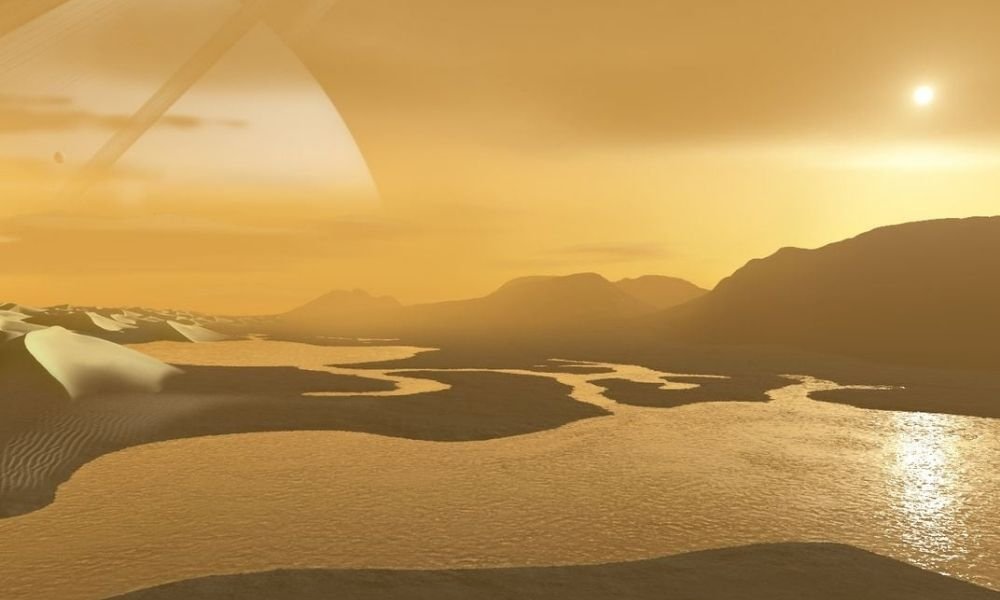
Titan is Saturn's largest moon and the second-largest in the Solar System (second only to Jupiter's moon Ganymede). But its most distinctive feature is its dense nitrogen atmosphere, 1.5 times denser than Earth's, and the only hydrological cycle known to us today that isn't based on water. Instead, it's made up of liquid methane and ethane, which form clouds, rain, rivers, and even lakes. All this makes Titan a kind of "laboratory of prehistoric Earth," but with a different chemical basis. That's why NASA is sending a mission there. Dragonfly — a nuclear-powered drone capable of flying from place to place and searching for signs of prebiotic chemistry or even exotic life forms.
3. Giant storms that last for months

On Saturn, giant storms—the so-called "Great White Spots"—occur once every 28–30 years (one Saturnian year). In 2010, Cassini recorded a record-breaking storm that spanned a 15,000-kilometer-wide band and stretched for nearly 300,000 kilometers—that's one and a half times the diameter of Earth! These storms originate deep in the atmosphere and rise outward, releasing accumulated thermal energy. Their effects can be felt for centuries: for example, they cause long-term changes in atmospheric composition and temperature anomalies. This phenomenon helps scientists better understand the atmospheric dynamics of gas giants—and even exoplanets beyond our solar system.
4. Hexagonal storm at the North Pole: a mystery that has persisted for decades

One of Saturn's most bizarre features is the giant hexagon at the planet's north pole. This atmospheric structure, each side twice the diameter of Earth (~20,000 km), was first spotted by the Voyagers in the 1980s and later studied in detail by Cassini. Winds within the hexagon reach speeds of up to 320 km/h. Scientists believe the shape is maintained by a standing wave resonant structure in the atmosphere—a phenomenon unique to Earth. There is still no consensus on why it is hexagonal rather than, say, circular or pentagonal, but one thing is clear: this system is incredibly stable and has existed since at least 1981.
5. How to measure a day on Saturn? It turns out it's not that simple.

For most planets, the length of a day is determined by radio signals associated with the rotation of the magnetic field. But Saturn's magnetic axis is perfectly aligned with its rotation axis—a unique feature in the Solar System. Because of this, the magnetic field rotates in sync with the planet, and the radio signals don't "blink" like those of Jupiter or Earth. As a result, even Cassini couldn't definitively determine the length of a day. Today, it's generally accepted that a day on Saturn lasts about 10 hours 33 minutes, but this value was obtained indirectly—through analysis of gravitational fluctuations and models of its internal structure. This makes Saturn the only planet for which we still don't know the exact length of a day.
6. Saturn's rings are the remains of a destroyed satellite.

Saturn's rings are among the most impressive objects in the Solar System. They extend 280,000 km from the planet, yet are only ~10-100 meters thick. They are composed almost entirely of ice—from microscopic dust grains to mountain-sized chunks. Current models suggest that the rings likely formed 100-200 million years ago from a disrupted moon that came closer to Saturn than the Roche limit—the boundary within which tidal forces tear bodies apart. But the rings are more than just decoration: fluctuations in their structure, caused by gravitational "echoes" from Saturn's interior, have allowed scientists to discover that the planet's core is fuzzy, and its gas layers can rotate at different speeds. This has revolutionized our understanding of the internal structure of gas giants.
7. Saturn's rings are disappearing—and faster than thought.

The beauty of Saturn's rings is temporary. During the final maneuvers of its mission, Cassini discovered what's known as "ring rain": icy particles from the rings, under the influence of the planet's gravity and magnetic field, are falling into the atmosphere at speeds of up to 10 tons per second. This process not only gradually strips Saturn of its ornaments, but also affects the planet's climate—for example, by creating dark bands in the mid-latitudes, first observed by Voyager in 1980. According to current estimates, at the current rate, the rings could disappear completely in just 300–400 million years. That is: we live in a unique era when we can observe this phenomenon with our own eyes—and our distant descendants may see Saturn without rings.
Saturn is not just a planet, but a living, dynamic system, full of mysteries and promise. Every discovery made in recent decades confirms that even in our own solar system, many secrets remain, waiting to be discovered. And future missions, such as Dragonfly, promise to reveal even more unexpected things – especially in the search for life beyond Earth.