

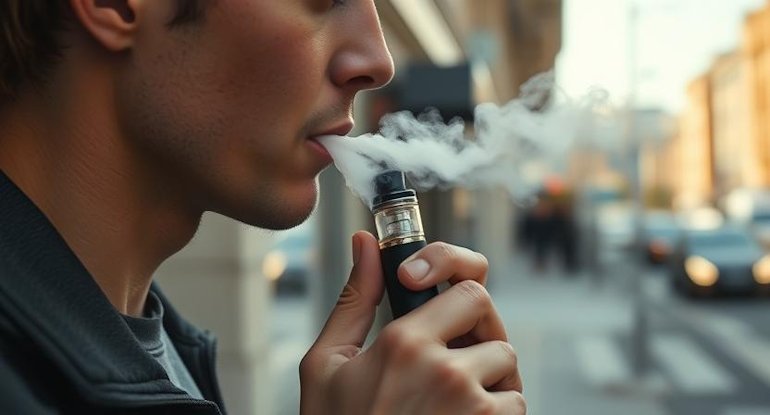
In recent years, the word “vape” has firmly entered into common usage, appearing not only in the speech of young people, but also in business, medical and legislative circles.
Description: We'll explore what vaping is, how it works, and how it can be more dangerous to human health than regular cigarettes.
It has become synonymous with a new approach to nicotine consumption, an alternative to traditional cigarettes. However, behind the apparent simplicity of this term lie many nuances and different interpretations that are important to understand in order to objectively assess the phenomenon of vaping.
At first glance, a vape is simply an electronic cigarette—a device that vaporizes liquid and produces a thick vapor that mimics smoke. But dig a little deeper, and it becomes clear: “vaping” is more than just the gadget itself. It's an entire culture, with its own rituals, styles, subcultures, and even vapor trick competitions.
It is interesting that in different sources the term “vape”" is used in various senses. Some authors use it to refer exclusively to the process of vapor inhalation, others to the devices, others to the general trend, and still others to a separate industry.
All interpretations of the word “vape”
To make sense of this chaos, let's take a closer look at each interpretation and understand how vaping differs from traditional smoking and why it may be even more dangerous than it first appears.
1. Vape as a device
The term “vape” (from the English word “vape” meaning to evaporate) originally appeared as an abbreviation of “vaporizer.” It's an electronic device consisting of a battery, an atomizer (the evaporating element), and a liquid reservoir. The operating principle is simple: the liquid is heated to the temperature of vaporization without combustion, producing a vapor that is then inhaled by the user.
Example: One of the first models, the eGo-T, which appeared in the early 2010s, was called a revolution in nicotine consumption.
The main components of a vape:
- Battery
- Cartridge/tank
- Evaporator (heating element)
- Liquid (nicotine, flavorings, propylene glycol, glycerin)
2. Vaping as a process
In everyday usage, “vaping” refers to the process of inhaling the vapor produced by the evaporation of a liquid. This process differs from smoking in that there are no combustion products, but nicotine and other chemicals still enter the body.
3. Vaping as a culture
Over time, vaping became a distinct phenomenon, developing its own culture. Vape shops, festivals, and competitions for “vape tricks”—the creation of complex vapor formations such as rings or dragon heads—emerged.
Example: “World Vape Championship” is an international competition where masters of the art of vapor demonstrate their skills in front of thousands of spectators.
4. Vaping as an industry
Today, vaping is a multi-billion dollar industry. Major manufacturers like Juul Labs and RELX invest hundreds of millions of dollars in the development of new device models, marketing, and research.
Why is vaping worse than tobacco cigarettes?
Despite the aggressive marketing of vaping as a “safe alternative,” the facts show a different picture. Numerous studies in recent years point to serious risks, many of which, in some respects, even exceed those of traditional smoking.
1. Liquid composition - a hidden threat
Most vaping devices use liquids containing propylene glycol, glycerin, flavorings, and nicotine. When heated, these substances can decompose into toxic compounds. For example, research conducted at Johns Hopkins University found that some liquids release formaldehyde, a known carcinogen.
2. Misperception of security
Vaping is often perceived as safe due to the lack of combustion. However, this perception comes with a twist: users inhale vapor much more frequently and for longer periods than cigarette smokers. This increases the overall dose of nicotine and toxins consumed.
For example, in 2020, an epidemic of vaping-associated lung illness (EVALI) broke out in the United States. More than 2,800 cases were recorded, including more than 60 deaths.
3. Nicotine addiction increases
Many vapes contain nicotine salts, a form of the substance that ensures faster absorption into the bloodstream. As a result, addiction develops more quickly, making quitting more difficult than with regular cigarettes.
Fun fact: One Juul cartridge has the nicotine content equivalent to about 20 cigarettes.
4. Impact on youth
Flavored e-liquids (“gum,” “mango,” “ice cream”) are a major draw for teenagers. This leads to widespread nicotine addiction among minors. In the US alone, more than 2 million high school students regularly vaped in 2022.
5. The long-term consequences are still unknown.
Vaping has been on the mass market for less than 20 years. A full analysis of its long-term impact on the body requires much more time. Cases of chronic lung disease are already known, but the scale of the problem cannot yet be predicted.
Table: Comparison of the harm from vaping and cigarettes
| Factor | Cigarettes | Vaping |
|---|---|---|
| Nicotine addiction | High | Very high (due to salts) |
| Cancer risk | Very tall | Not fully studied, but high |
| Effects on the lungs | Chronic diseases | Emerging diseases (EVALI) |
| Effect on the heart | Increased risk of heart attack | Possibly similar |
| Impact on youth | It's decreasing | It's growing |
Conclusion: Myths and Reality of Vaping
Today, it's impossible to definitively say that vaping is a safe alternative to cigarettes. Quite the contrary: accumulated data forces us to view it as a new form of addiction with unpredictable health consequences.
Can vaping help you quit smoking? In some cases, yes. However, often, it becomes not a bridge to nicotine freedom, but a new trap, especially insidious for young people.
When choosing between cigarettes and vaping, a person faces a false dilemma. A far more sensible choice is to completely abstain from all forms of nicotine use.