

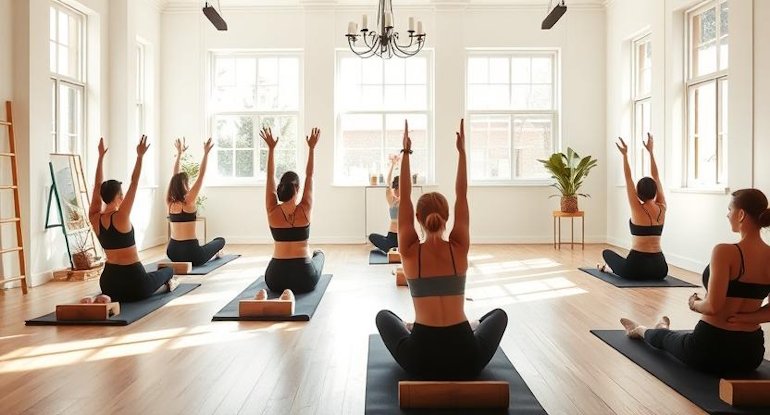
Pilates — a popular system of physical exercises that helps strengthen the body, improve posture, and achieve harmony between mind and body.
Description: Learn what Pilates is, how it came about, the principles behind it, and how this exercise system helps strengthen the body, improve posture, and reduce stress.
Named after its creator, Joseph Pilates, this method originated in the early 20th century and today attracts millions of people worldwide thanks to its versatility and effectiveness. It is suitable for people of all ages and fitness levels, including those recovering from injuries or those seeking overall wellness.
The core value of Pilates lies in developing core strength, flexibility, and coordination through smooth, deliberate movements with an emphasis on breathing and control. Unlike high-intensity workouts, Pilates doesn't put stress on joints, making it a safe choice for a wide audience. Let's explore what this system is, its interpretations, history, principles, and specific benefits, supported by research and practice.
Interpretations of the term “Pilates” in Russian boil down to its basic meaning—a system of physical exercises aimed at improving health and strengthening the body. However, in some contexts, the word can be used more broadly: for example, as a synonym for a healthy lifestyle or even as a cultural phenomenon associated with the “Pilates Princess” aesthetic popular among young people in 2023. In this article, we will focus on the basic meaning, exploring its history, principles, and effects.
The history of Pilates and its development
Joseph Pilates, the creator of the Pilates method, was born in 1883 in Mönchengladbach, Germany. As a child, he suffered from asthma, rickets, and rheumatic fever, which prompted him to search for ways to improve his health. By the age of 14, Joseph had improved his physical condition so much that he was invited to pose for an anatomical atlas. During World War I, while in an internment camp in Britain, he began developing exercises for the rehabilitation of the wounded, using improvised means such as bed springs.
In 1926, Pilates emigrated to the United States and opened a studio in New York City, where his method became popular among dancers, especially those from the New York City Ballet. Initially, Joseph called his system “Contrology,” emphasizing the importance of control over the body, mind, and spirit. Over time, the method bore his name and spread throughout the world. By 2023, the number of Pilates practitioners exceeded 12 million, particularly in countries such as the United States, Australia, and South Korea.
The method has evolved, branching into several styles. Classical Pilates is as close as possible to Joseph's original exercises, while modern Pilates incorporates elements of yoga, physical therapy, and even boxing. Despite these changes, the basic principles remain unchanged, allowing the system to retain its effectiveness and versatility for a variety of purposes—from general wellness to injury rehabilitation.
If you are a bodybuilder…
Pilates contraindicated in professional bodybuilding due to its low intensity and lack of emphasis on maximum muscle growth, which does not correspond to the goals of the sport.
Bodybuilders require high-intensity strength training with heavy weights for hypertrophy, whereas Pilates focuses on flexibility, balance, and core strength, which is not enough for competition level.
Additionally, over-stretching (see how stretching reduces your strength) in Pilates can reduce the muscle stiffness needed for heavy lifting.
However, Pilates is sometimes used as an adjunct practice for recovery during PCT or to improve posture.
The Basic Principles of Pilates and Their Importance
Pilates is based on six key principles that ensure its effectiveness. The first is concentration: during the exercises, you must fully focus on your body, sensing every muscle. For example, when performing the “Hundred” exercise, where you lie on your back and lift your head and shoulders, it's important to focus on contracting your abdominal muscles rather than moving your neck. The second principle is centering, which emphasizes the core (the abdominal, back, and pelvic muscles), which is considered the body's center of strength.
The third principle is control, which requires conscious execution of every movement. Joseph Pilates emphasized that even a simple movement, such as a leg lift, should be performed smoothly, maintaining spinal stability. The fourth is breathing: Pilates utilizes thoracic breathing, in which the inhalation fills the lower part of the lungs, and the exhalation helps activate the muscles. The fifth and sixth principles—precision and fluidity—ensure that movements are performed technically correctly and without sudden transitions, reducing the risk of injury.
These principles make Pilates unique. For example, a 2015 study conducted by the Australian Department of Health found that regular exercise improved muscle and tendon health in middle-aged adults, although the effect on coordination was less pronounced. It's important to note that Pilates is not recommended for pregnant women without consulting a doctor, and those with scoliosis or injuries should practice under the supervision of a specialist.
Benefits of Pilates and its impact on health
Regular Pilates practice offers numerous benefits, supported by both practical experience and scientific evidence. One of the most important is strengthening the core. Exercises like the “Bridge” (a pelvic lift from a supine position) actively engage the deep abdominal and back muscles, which helps reduce lower back pain. A 2020 study in the European Spine Journal found that 70% of participants with chronic back pain experienced significant improvement after 12 weeks of Pilates.
Pilates also improves posture and flexibility. The “Plank with Extension” exercise helps align the spine and increase joint mobility, which is especially beneficial for people with a sedentary lifestyle. Furthermore, the technique promotes stress relief: deep breathing and focused movement reduce cortisol levels. For example, in 2022, the Journal of Clinical Sleep Medicine noted that people who practice Pilates three times a week improved their sleep quality by 25%.
For those trying to lose weight, Pilates can also be beneficial, although not as quickly as cardio. Classes burn about 200-300 calories per hour but boost metabolism by strengthening muscles. Practitioners report that in a year of regular exercise (three times a week), you can lose up to 7 kg without changing your diet. Pilates is suitable for all ages and is especially beneficial for older adults, helping maintain mobility and reduce the risk of falls through improved balance.