

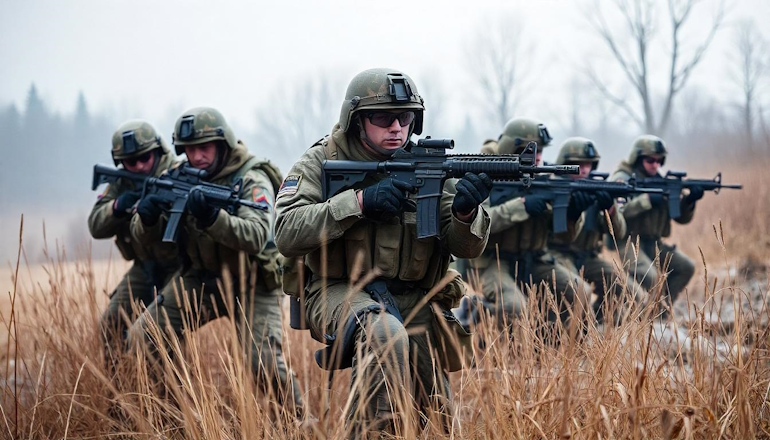
In Russia and many CIS countries, law enforcement agencies perform a wide range of tasks, from combating organized crime to maintaining public order.
Two key forces playing a significant role in these processes are SOBR (Special Rapid Response Unit) and OMON (Obrazovatel'nye Mobil'noye Otdel'noye Squad). Although both operate within the Ministry of Internal Affairs (MVD), their functions, tasks, and structures differ significantly.
To better understand the differences between these units, one needs to study their history, goals, composition, and tactical features.
History of the formation of SOBR and OMON
SOBR SOBR was created in 1992 in response to the rise of organized crime in post-Soviet Russia. This unit quickly found its niche in combating organized crime groups, hostage situations, and other extreme situations. SOBR is primarily focused on high-risk operations, such as eliminating terrorists or apprehending dangerous criminals. Its primary mission is a rapid and accurate response to complex criminal situations.
riot police The OMON (Special Purpose Police Unit) emerged earlier, in 1988, as a law enforcement unit within the police. Initially, it was created to maintain public order at public events, but over time, its functions expanded. Today, OMON participates in counter-extremism operations, accompanies special operations to suppress mass riots, and participates in counter-terrorism operations, particularly in regions with a heightened terrorist threat, such as the North Caucasus.
Main tasks
The tasks of SOBR and OMON differ in the level of danger and the specifics of the operations.
SOBR specializes in:
- Elimination of armed criminals and terrorists.
- Conducting hostage rescue operations.
- Counteracting organized crime groups.
- Participation in complex special operations requiring rapid response and precise coordination.
riot police, on the contrary, performs a wider range of tasks related to public safety:
- Maintaining law and order during mass events such as rallies, concerts and sporting events.
- Dispersal and suppression of mass riots.
- Participation in crime-fighting operations where police support is required.
- Anti-terrorist activities and protection of public facilities in high-risk areas.
Tactical features and preparation
Both units undergo rigorous training, but the nature of this training varies depending on the mission.
SOBR SOBR is an elite unit whose members undergo rigorous physical and psychological training. They are trained in tactics for capturing dangerous criminals, rescuing hostages, operating in dense urban environments, and conducting special operations using weapons and specialized equipment. SOBR operates in situations requiring high concentration and precision, and often carries out missions jointly with other special forces units, such as the FSB and the Airborne Forces.
riot police, On the other hand, it focuses on maintaining public order and mass operations. OMON members undergo training in crowd dispersal techniques, negotiation, and the use of special riot control equipment (stun grenades, rubber bullets, water cannons). Although their duties also include counterterrorism activities, their primary focus is maintaining order in large crowds.
Composition and structure of divisions
SOBR A group of highly trained personnel is comprised of a limited number of highly skilled fighters who perform highly complex missions. These teams typically consist of 5-15 individuals, each with specialized skills, including sniping, mine handling, negotiations, and medical assistance.
riot police — a much larger unit operating in various regions of Russia. It comprises hundreds of soldiers who can be mobilized to maintain order during mass events or sent to suppress unrest in hotspots. OMON operates throughout the country, performing functions both in peacetime and during crises.
Examples of application in real operations
SOBR The SOBR unit is often called upon for complex and dangerous special operations. For example, SOBR units participated in the elimination of terrorists at Nord-Ost in 2002 and in other counter-terrorism operations in the North Caucasus. This unit operates quickly and covertly, minimizing risks to civilians.
riot police The OMON was also involved in suppressing riots on the streets of Moscow and St. Petersburg, where its fighters used special means to disperse crowds and prevent pogroms. In the 1990s, OMON was actively deployed in the Chechen Republic to maintain order during military operations.
Conclusion
The SOBR and OMON units play a key role in maintaining law and order and ensuring security in Russia, but differ in their goals and objectives. SOBR focuses on high-risk operations and combating organized crime, while OMON specializes in mass events and maintaining order. Both units are an important part of the country's security system and are active both in peacetime and during emergencies.