

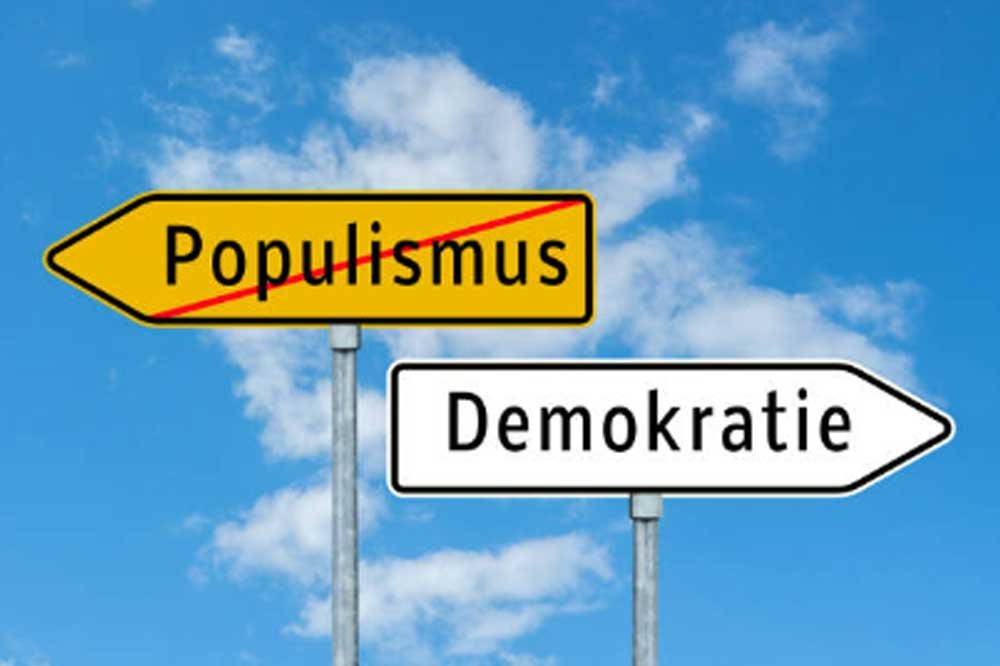
Demagoguery is a way of speaking and gaining support (playing on emotions, unrealistic promises), while populism is a political position or tendency that divides society into «ordinary people» and «corrupt elite». Simply put: demagoguery is a tool, while populism is a program and a way of looking at politics. Populists often resort to demagoguery, but a politician from any side of the political spectrum can be a demagogue.
To sum it up
- Demagogy — this is a technique: appealing to the emotions, expectations and fears of interlocutors and empty promises.
- Populism — is a position or «weak» ideology according to which politics should express the will of the «people» and not the «elite».
- Demagoguery is viewed unambiguously negatively, and populism sometimes becomes a subject of debate – some researchers also see it as a sign of problems with democracy.
- The concept of demagoguery dates back to Ancient Greece, and populism as a name for political movements appeared in the 19th century.
Demagoguery – definition and origin of the word.
The Polish dictionary PWN defines demagogy as «"a method of attracting supporters by appealing to their emotions, expectations, and making unrealistic promises.". The word comes from Greek dēmagōgía , which means "to lead the people" ( dēmos - people, agō - I'm leading).
In ancient Athens, the word "demagogue" originally meant simply a popular leader, but quickly acquired a negative connotation. A classic example is Cleon , a politician during the Peloponnesian War, portrayed by Thucydides and Aristophanes as a crowd-pleasing orator. Aristotle, even then, described demagogues as a threat to democracy, potentially leading to tyranny.
Demagogy is not an ideology, but set of rhetorical devices . The most common of them are:
- appeal to emotions (fear, anger, pride) instead of arguments.
- simple solutions to complex problems and promises without specifying costs,
- looking for a scapegoat and seeing the world in black and white.
- an attack on a person rather than on his arguments (argumentum ad personam).
- selective provision of data and taking facts out of context.
What is populism?
According to the PWN dictionary, populism is «"support or promotion of ideas and intentions, primarily political and economic, that correspond to the expectations of the majority of society.". The term comes from Latin populus , meaning "the people." The second, less common meaning relates to literature: a movement that prioritizes the interests of ordinary people.
In political science, the most frequently cited definition is by Dutch scholar Cas Mudde (2004). He describes populism as «"subtle" ideology , which divides society into two homogeneous and hostile groups—the "pure people" and the "corrupt elites"—and asserts that politics should be an expression of the will of the people. It is "subtle" because it does not determine the economic or social system itself and, therefore, is compatible with other ideologies.
For this reason, populism can be either left-wing radical (criticism of the financial elite, demands for redistribution), and right-wing radical (criticism of the cultural elite and international institutions, emphasis on national identity). The first movements that began to be called populist were Russian populists in the 19th century and American People's Party , founded in 1892 by peasants and workers.
Demagoguery and populism are the most important differences.
The two terms are sometimes used interchangeably, especially in journalism, but they answer different questions. Demagogy describes, How The politician convinces his audience. Populism describes that , What They preach and understand politics as a conflict between the people and the elite.
The academic literature also highlights direction: populism is sometimes described as a bottom-up phenomenon, arising from social sentiment, while demagoguery is described as a top-down action – the leader shapes the crowd's emotions for his own purposes.
| Characteristic | Demagogy | Populism |
|---|---|---|
| What's happened | Persuasive techniques, rhetorical style | Attitude, tendency or «subtle» ideology |
| Existence | Playing on emotions, unrealistic promises | The division: "the people" versus "the elite"« |
| Source | Greece, Greek: dēmagōgía - leading the people | Latin populus - people; movements of the 19th century |
| Who uses it? | Politicians of all stripes, including those outside of politics (media). | Parties and leaders with an anti-elite program |
| Bid | Clearly negative | A Controversial Issue – From Threat to Corrector of Democracy |
| Historical examples | Cleon in Athens | Narodniks in Russia, People's Party in the USA |
| Can this happen without the other? | Yes - in every campaign | Yes, although he usually resorts to demagoguery. |
What is the relationship between demagoguery and populism?
The simplest way to describe this relationship is as follows: populism is the essence, demagogy is the form . Populist movements seeking to appeal to broad swathes of voters often employ simplifications and emotional language. However, this doesn't mean that everyone who speaks of "ordinary people" is a demagogue.
This also works the other way. A politician with moderate, non-anti-elitist views may make empty promises during an election campaign or threaten their opponents—in this case, they are engaging in demagoguery, even if they are not a populist. Therefore, both words should be used accurately, and not as a general insult to opponents.
How to recognize demagoguery and populism in practice?
When evaluating a politician's statement, advertisement, or social media post, simple questions can help:
- Are there any arguments and data? If instead there are only emotions and slogans, this is a sign of demagoguery.
- Were the costs and methods of fulfilling the promise disclosed? The lack of response is a typical demagogic tactic.
- Is the world divided into "us" and "them"? If "them" is a single, evil elite, and "us" is the entire nation, then it is a populist concept.
- Is the opponent being criticized for his views or for who he is? Attacking a person is a classic demagogic technique.
- Is there any context to these numbers? Check the source, period, and reference point for statistical data.
Fact-checking services are also useful because they corroborate public statements and show where facts end and manipulation begins.
Frequently Asked Questions (FAQ)
What is demagoguery in simple terms?
It's about winning support by playing on people's emotions and promising unrealistic things instead of presenting compelling arguments. A demagogue says what the audience wants to hear, not what can be done.
Are populism and demagoguery synonyms?
No. Demagoguery is a method of persuasion, while populism is a political position based on the opposition between "the people" and "the elite." Populists often use demagoguery, but demagoguery also occurs outside of populism.
Is populism always bad?
This assessment is controversial. Critics point out that populism undermines institutions and pluralism. Other researchers note that it can signal real problems that are ignored by the political elite. Demagoguery, on the other hand, is almost unanimously viewed negatively.
Where does the word "demagogy" come from?
Word «"demagogy »" comes from Greek and means "leader of the people." In ancient Athens, a demagogue was the name given to a popular leader, and later to a politician who manipulated the crowd.
Populism: Left or Right?
It can be both. Populism itself does not define an economic program or worldview, so it is associated with various ideologies – from leftist demands for redistribution to right-wing nationalism.
See also
- What is the difference between government and parliament?
- What is the difference between a president and a prime minister?
- What is the difference between direct and indirect democracy?
- What is the difference between a dictatorship and an absolute monarchy?