

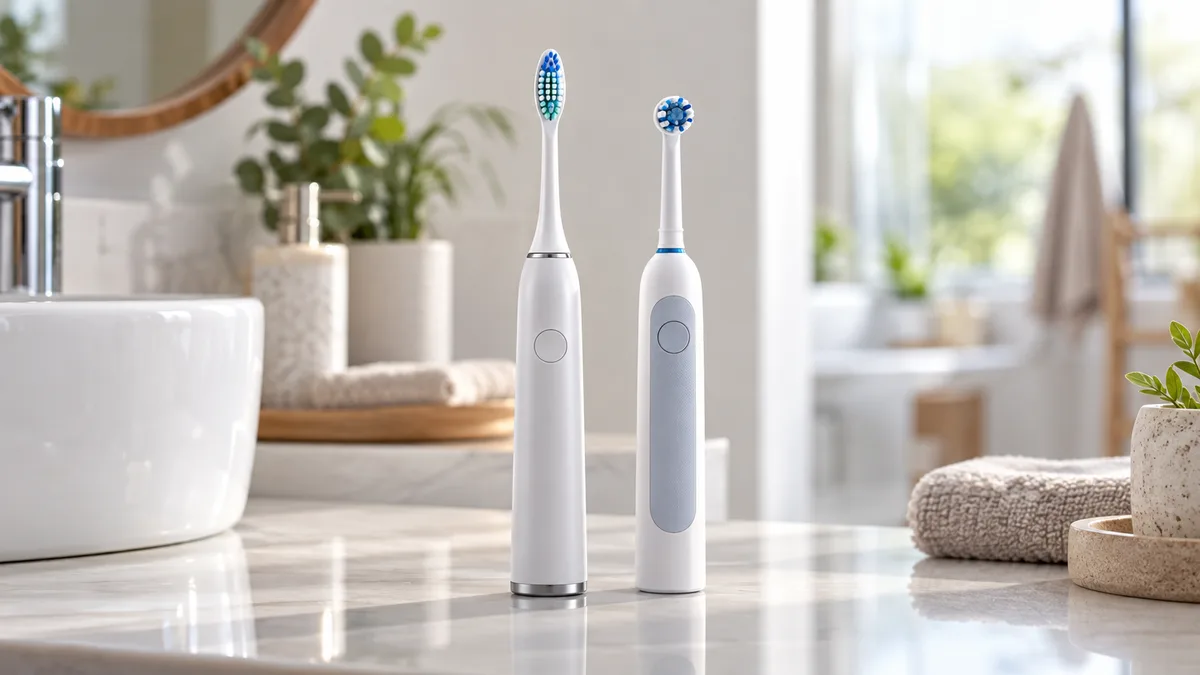
A sonic toothbrush differs from a "regular" electric (rotating) toothbrush primarily in the type of movement: a sonic head vibrates very quickly from side to side, making smooth movements, while a rotating head is circular and rotates back and forth. Strictly speaking, a sonic toothbrush is also an electric toothbrush—it has a motor and a battery. When someone asks "sonic or electric," they're usually comparing two technologies: sonic and rotary (oscillating-rotating).
To sum it up
- All sonic toothbrushes are electric , but not all electric toothbrushes are sonic – in practice, sonic technology is compared to rotary technology.
- Sound waves : elongated head, very fast lateral vibrations (usually tens of thousands of movements per minute), sweeping movements.
- Rotary : A small round head that rotates alternately in both directions, making much fewer movements, and cleans each tooth individually.
- Both toothbrushes remove plaque more effectively than a manual toothbrush – regular use and proper brushing technique are more important than the type of brush.
Sonic vs. Electric Toothbrush – Why the Confusion?
The term "electric toothbrush" covers all toothbrushes with an electric motor. However, in stores and in conversations, "electric" means rotating A sonic toothbrush is a model with a round head, while a sonic toothbrush is a model with an elongated vibrating head. Therefore, the question "what is the difference between a sonic and an electric toothbrush?" in practice refers to the difference between the two drive technologies.
Both models are battery-powered, have replaceable brush heads, and often share similar features: a timer, pressure sensor, and multiple modes. They differ in the way the bristles move across the teeth, the shape of the head, and, consequently, the cleaning technique.
How does a sonic toothbrush work?
In a sonic toothbrush, the motor forces the brush head vibrate very quickly from side to side . The bristles vibrate rapidly, typically exceeding 30,000 per minute—depending on the model, manufacturers specify values in the tens of thousands. The frequency of these vibrations is in the audible range, hence the name "sonic" (from the Latin sonus - sound).
The rapid movement of the bristles mixes saliva and toothpaste, creating a foam with small bubbles that extends beyond the area of direct contact of the bristles with the tooth. The brush head has an elongated shape , similar to a regular manual toothbrush, so many people quickly get used to it.
Don't confuse a sonic toothbrush with ultrasonic . Ultrasound has a frequency above the audible range and operates on a different principle – it is a separate, less common group of devices.
How does a rotating electric toothbrush work?
A rotating toothbrush (also called an oscillating-rotating toothbrush) has small round head , which rotates slightly in one direction and then in the other. Some models also feature a pulsation function, which produces small movements toward the tooth. The number of movements per minute is significantly lower than with sonic models, but the operating principle is different—mechanically "polishing" each tooth.
The round brush head covers one tooth at a time, so you clean tooth by tooth , briefly pressing the head against each surface. This technology has the longest history of research: in a 2014 Cochrane review comparing electric and manual toothbrushes, the largest number of studies were devoted to toothbrushes with oscillating and rotating movements.
Chart: Sonic or Rotating Toothbrush
| Characteristic | Sonic toothbrush | Rotating toothbrush |
|---|---|---|
| Movement of bristles | Rapid side-to-side oscillations (pivoting motion) | Rotation alternates in both directions, sometimes with pulsation. |
| Head shape | Oblong, like a regular toothbrush. | Small, round |
| Number of moves | Typically tens of thousands per minute | Much less – usually several thousand oscillatory movements per minute. |
| washing technique | Move your head slowly over your teeth, without rubbing them. | Tooth by tooth, with a short pause after each. |
| Feelings | A more gentle, tickling sensation and a slight "buzzing" sound. | More precise mechanical polishing |
| Replacing the tip | Every 3-4 months or when the bristles become deformed. | Every 3-4 months or when the bristles become deformed. |
Which is better: a sonic or an electric toothbrush?
There is no clear answer to the question of which is better. The Cochrane review mentioned above found that Electric toothbrushes reduce plaque and gingivitis more than manual toothbrushes. — both in the short and long term. The greatest amount of evidence was collected for oscillating-rotating toothbrushes, but this does not mean that sonic toothbrushes are bad; there are simply fewer comparative studies, and the authors emphasized that the clinical significance of the differences remains unclear.
In everyday use, the most important factors determining the result are: brushing your teeth for two minutes twice a day , thoroughly cleaning all surfaces, avoiding excessive pressure, and regularly replacing the brush head. The best toothbrush is one you use correctly and enjoy.
Which toothbrush should you choose? Practical advice.
Consider Sonic, If:
- You are switching from a regular toothbrush and want to maintain the familiar head shape,
- If you have sensitive gums or wear orthodontic braces, sonic toothbrushes are often recommended (it's best to check with your dentist about the choice).
- You prefer a more gentle washing experience.
Consider the possibility rotational mode , If:
- Do you enjoy the distinct feeling of polished teeth?
- It will be easier for you to brush your teeth methodically, one tooth at a time.
- You need a technology that has the largest amount of comparative research.
If you have braces, implants, bridges, gum recession, or tooth sensitivity, consult with your dentist or hygienist about which type and attachment to choose. Beneficial features of both types include: pressure sensor and a timer signaling quadrant change. Before purchasing, also check the availability and price of the original attachments, as they have a fixed price.
How to brush your teeth with each of them?
By using sound There's no need to scrub with a toothbrush. You angle the bristles toward your gum line and slowly move the head along your dental arch, letting the vibrations do the work. rotating With a toothbrush, you apply it to each tooth individually, hold it there for a moment, and then move on to the next one, treating the outer, inner, and chewing surfaces. In both cases, it's best to follow the manufacturer's instructions for your specific model.
Frequently Asked Questions (FAQ)
Can a sonic toothbrush be called an electric toothbrush?
Yes. A sonic toothbrush has a motor and a battery, making it a type of electric toothbrush. However, in common parlance, an "electric" toothbrush refers to a rotating model with a round head, hence the comparison between "sonic" and "electric.".
Which is better: a sonic or a rotating toothbrush?
Both toothbrushes remove plaque more effectively than a regular manual toothbrush. Most studies focus on oscillating and rotating toothbrushes, but for the average user, brushing frequency, timing, and technique are more important than the type of toothbrush itself.
Is a sonic toothbrush safe for your gums?
When used correctly, yes. Too much pressure and intense friction usually cause problems, so it's best to choose a model with a pressure sensor and a soft tip. If you have gum disease, it's a good idea to consult your dentist about choosing a toothbrush.
How often should I change my electric toothbrush head?
It's recommended to replace them approximately every 3-4 months, or more often if the bristles become weak or deformed. Worn bristles are less effective at removing plaque.
What is the difference between a sonic and ultrasonic toothbrush?
A sonic toothbrush vibrates at a frequency within the audible range and cleans teeth primarily through the movement of its bristles. An ultrasonic toothbrush operates at frequencies above the audible range—it's a different technology and a different group of devices.
See also
- What is the difference between grinding and sandblasting?
- What is the difference between a trimmer and a razor?
- What is the difference between a laser printer and an inkjet printer?
- What is the difference between a dynamic and a condenser microphone?