

Popular culture and detective series have firmly merged the images of specialists working with crime scenes and the bodies of the dead, merging them into a single profession.
Because of this, in everyday thinking, a pathologist, a forensic scientist, and a criminologist are all doing the same job.
In reality, these are three completely different specialties, which differ in their basic education, research objects, and ultimate goals.
- Main border Between them there is a line of «medicine and law»: the first two are doctors with different specializations, while the third represents investigative bodies and works exclusively with material evidence.
Pathologist — is primarily a clinical physician whose main task is to study diseases at the tissue level.
Contrary to popular belief, this specialist devotes the lion's share of their time to living people, not the dead. They examine biopsy specimens, organs, and tissue fragments removed during surgery. It is the pathologist who makes the final diagnosis when cancer is suspected, determining the tumor type and its degree of malignancy, which allows the treating physician to prescribe the appropriate treatment.
When a pathologist performs an autopsy, they work strictly within the hospital system on people who died from natural causes—severe or chronic illnesses. Their goal in the autopsy room is not to search for evidence, but to confirm or refute the clinical diagnosis made during their lifetime. The specialist evaluates the appropriateness of the prescribed treatment, identifies medical errors, and studies the mechanisms of development of a specific pathology to help medicine prevent similar fatal outcomes in the future.
Forensic expert also has a higher medical education, but his jurisdiction begins where there is a suspicion of violent or unnatural death.
This doctor is called upon by an official order from the investigator if a person has died in a traffic accident, was murdered, committed suicide, or died suddenly outside a medical facility. The forensic expert's job is to determine the exact cause of death, establish the time of death, determine the parameters of the crime weapon, the trajectory of the projectile, or the presence of toxins in the tissue, translating biological data into legal evidence.
An important and often hidden part of a forensic medical examiner's work is examining living people. In cases of physical violence, domestic conflicts, workplace injuries, or sexual assault, it is this specialist who documents the assault and determines the severity of the injury. Without an official medical report confirming the nature, location, and age of the injuries, law enforcement agencies cannot correctly classify the crime and refer the criminal case to court.
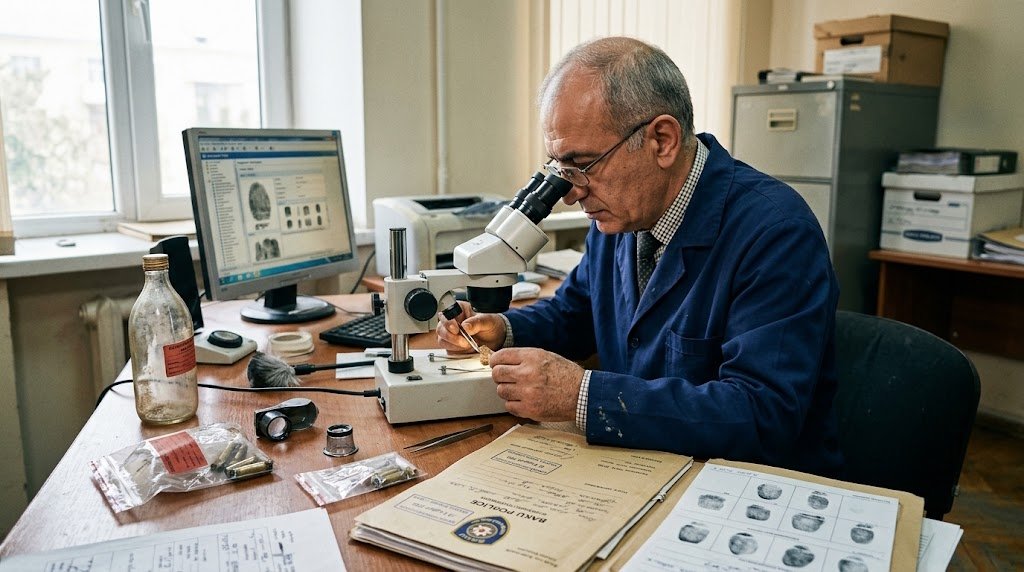
Forensic scientist is fundamentally different from both doctors, since he is a law enforcement officer with a legal or specialized technical education.
They do not perform autopsies, diagnose illnesses, or assess the severity of injuries, as their focus is not on the human body, but on the physical environment at the crime scene. This specialist searches for, records, and recovers invisible traces left by the perpetrator, victim, or crime weapon on any surface.
A forensic scientist's work is divided into many subspecialties: fingerprinting examines fingerprints, ballistics examines firearms and shell casings, trace evidence examines shoe prints or tire treads, and handwriting analysis examines forged documents. While a forensic expert explains to investigators what exactly happened to a victim's body, a forensic scientist explains what object was used to do it, who held the object, and how the participants moved around the scene. This data merges into a coherent picture, allowing the investigator to reconstruct the chronology of events and prove the suspect's guilt.
In the USA The basic division of functions remains, but the structure and names differ:
- Pathologists are responsible for clinical diagnosis and natural deaths in hospitals.
- The investigation of violent or suspicious deaths is the responsibility of a Forensic Pathologist within the Medical Examiner's office or the Coroner system (where the position may be an elected position).
- Forensic Scientists (CSIs), who are not physicians and work in polygraph or forensic laboratories, collect and analyze physical evidence.