

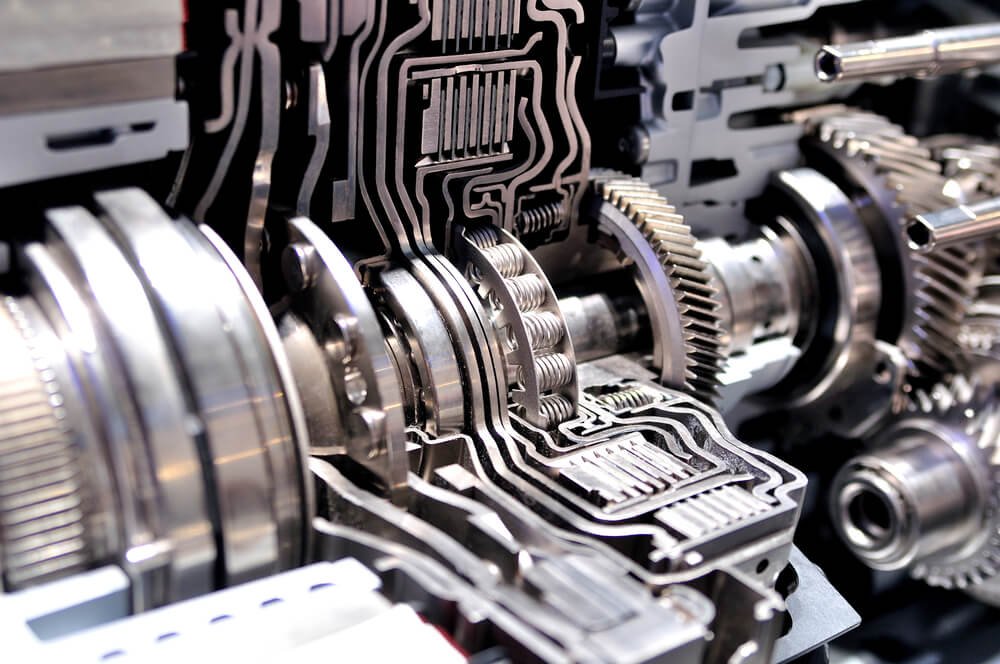
The M32 transmission differs from the F40 primarily in its durability: both are GM's 6-speed manual transmissions for front-wheel drive vehicles, but the M32 is smaller and can handle up to 320 Nm of torque, while the F40 is a larger design rated for up to 400 Nm of torque. The M32 was used in many popular Opel models (as well as Fiat, Alfa Romeo, and Lancia), while the F40 was primarily used in larger and more powerful models, including the Opel Vectra C, Signum, Insignia, and Saab. The M32 transmission is also known for bearing wear.
To sum it up
- Torque : M32 – up to 320 Nm, F40 – up to 400 Nm.
- Origin : The M32 was produced by GM Powertrain in Vienna-Aspern; the F40 was developed for GM Europe by Saab Powertrain, produced in Gothenburg and, from 2004, in Rüsselsheim.
- Application : M32 – including Astra H/J, Corsa D, Meriva, Zafira B, some Vectra C and Insignia; F40 – more powerful versions of Vectra C, Signum, Insignia, Saab 9-3 and 9-5.
- Typical M32 problem : Shaft bearings - symptoms include a whistling noise in 5th and 6th gears and play in the gear shift lever.
M32 and F40 Gearboxes – Basic Information
Both transmissions are 6-speed manual transmissions with integrated differentials (so-called dual-shaft transmissions) are designed for vehicles with transversely mounted engines and front-wheel drive. They feature a three-shaft design with synchronized gears, a hydraulically controlled clutch, and a cable-operated gear selector. At first glance, they perform the same function—they differ in size, durability, and the engine types for which they were designed.
M32 box
The M32 transmission (like its sister M20) is manufactured by GM Powertrain in Vienna-Aspern . It features a compact design and relatively low weight, and is designed for torque up to 320 Nm . It was installed in Opel vehicles such as the Astra H and J, Corsa D, Meriva, Zafira B, as well as some versions of the Vectra C, Signum, and Insignia, and worked with 1.7 and 1.9 CDTI diesel engines and 1.4 and 1.6 turbocharged petrol engines, among others. The same transmission was installed in Fiat, Alfa Romeo, and Lancia vehicles.
Gearbox F40
The F40 transmission was developed for GM Europe by Saab Powertrain . It was originally produced in Gothenburg (2002–2003) and in Rüsselsheim since 2004. It has an aluminum body, weighs approximately 56 kg, and is torque-certified. up to 400 Nm . First and second gears are equipped with triple-cone synchronizers, while third, fourth, and reverse are equipped with double-cone synchronizers. The transmission was used in mid- and large-class cars of the group: the Opel Vectra C, Signum, Insignia, Saab 9-3 and 9-5, as well as Chevrolet and Buick models, among others.
Table: M32 or F40 – comparison
| Characteristic | M32 | F40 |
|---|---|---|
| Type | 6-speed manual transmission, front-wheel drive | 6-speed manual transmission, front-wheel drive |
| Maximum torque | 320 Nm | 400 Nm |
| Manufacturer / factory | GM Powertrain, Vienna-Aspern | Developed by Saab Powertrain; Gothenburg, Rüsselsheim, since 2004. |
| Dimensions | Compact, lightweight | Larger and longer, approximately 56 kg. |
| Examples of cars | Astra H/J, Corsa D, Meriva, Zafira B, some Vectr C and Insignia; Fiat, Alfa Romeo, Lancia | More powerful Vectra C, Signum, Insignia; Saab 9-3, 9-5 |
| A known weakness | Roller bearings howl in 5th/6th gear. | There is no such widely reported serial defect. |
| Amount of oil | Approximately 2.2–2.4 liters (according to sources in the workshop). | About 2.8 liters |
Common M32 Transmission Problems
The M32 gearbox is considered faulty, primarily due to their own roller bearings . Repair shops specializing in this type of transmission report that the tapered roller bearings used are too weak for the torque being transmitted, and their wear is accelerated by the use of inappropriate or worn-out oil. The most commonly reported symptoms include:
- Howling or squealing in 5th and 6th gears , for example, on the highway, when changing gears during acceleration or releasing the gas pedal.
- Play or "floating" of the lever after releasing the clutch - a sign of bearing wear.
- Difficulty engaging 3rd and 4th gears (synchronizers, gears).
- Problems with engaging first gear (slider).
A quick response is the key to success: timely repairs (replacing bearings with reinforced ones and selecting the correct washers) are significantly cheaper than rebuilding the transmission if play has already damaged the gears or housing. Regular oil changes according to the manufacturer's specifications also contribute to maintenance; many auto repair shops recommend changing the M32 transmission oil more frequently than the standard maintenance schedule.
Is F40 better than M32?
As for durability, yes. The F40 gearbox has higher torque and a more robust design, which is why it was used in more powerful engine versions. Furthermore, it's not susceptible to the same common failures as the bearings in the M32. However, this doesn't mean it's indestructible—like any gearbox, it can wear out, especially in higher-powered vehicles and if maintenance is neglected.
Owners of cars with an M32 engine sometimes ask if they can swap it for an F40. While technically possible, the F40 is larger and longer, so swapping it out would require, among other things, different driveshafts, a transmission mount, shift cables, and a matching clutch and flywheel. In practice, it's usually more cost-effective to rebuild an M32 with reinforced bearings. It's a good idea to consult a specialist workshop about any transmission modifications.
How to determine the type of car transmission and what should you pay attention to when buying?
- Marking on the body – the gearbox type (for example, F40) is cast in the form of a convex inscription on the upper part of the housing.
- Technical characteristics of the car – The gearbox version can be determined by the VIN number at an authorized service center or in the parts catalog; the same model (e.g. Insignia, Vectra C) may have both gearboxes depending on the engine.
- Test drive – On a car with an M32 engine, accelerate to highway speed in 5th and 6th gear and listen for a whistling sound when accelerating and releasing the accelerator pedal; make sure the gearshift lever does not rotate too freely.
- Service history – clarify information about changing the oil in the gearbox and possible repair of bearings.
Frequently Asked Questions (FAQ)
Which gearbox is stronger: M32 or F40?
The F40 engine is rated for torque of up to 400 Nm, while the M32 engine is rated for torque of up to 320 Nm. Furthermore, the F40 is larger and heavier.
Which cars are equipped with the M32 gearbox?
In particular, in the Opel Astra H and J, Corsa D, Meriva, Zafira B models, as well as in some versions of the Vectra C, Signum and Insignia, and in Fiat, Alfa Romeo and Lancia vehicles.
What are the symptoms of a damaged M32 transmission?
The most common symptoms include a whistling or squealing sound in 5th and 6th gears that changes with acceleration, play when releasing the clutch, and subsequent difficulty shifting. This is usually a sign of worn shaft bearings.
Is it possible to replace the M32 engine with an F40?
This is possible, but it will require replacing many components (shafts, bearings, cables, clutch, and flywheel) due to the F40's larger dimensions. Repairing the M32 is usually cheaper with reinforced bearings.
What oil is suitable for M32 and F40 gearboxes?
Always use the vehicle manufacturer's recommended transmission oil with the correct specifications and viscosity. The F40 transmission specifies 75W-85 GL-4 synthetic oil, but check your vehicle's owner's manual or parts catalog before purchasing.
See also
- What is the difference between 75w80 and 75w90 oils?
- What is the difference between 2T and 4T oil?
- What is the difference between 5w30 and 5w40 oils?
- What is the difference between twin turbo and biturbo?