

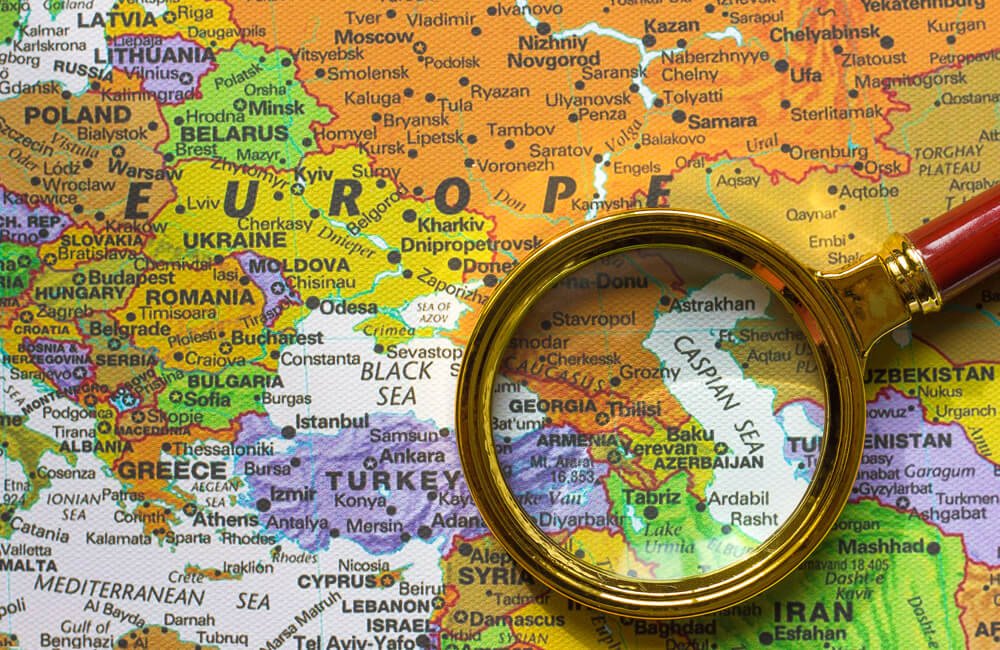
A state is a political organization—the power, laws, and institutions that exercise control over a given territory and population—while a country is, first and foremost, a territory: a populated area considered from a geographical, economic, and cultural point of view. In everyday speech, these two words are often synonymous ("to leave the country," "state borders"). The difference becomes clear in context: we speak of the state when we think of power, and of the country when we think of space.
To sum it up
- State = authority: government, law, sovereignty, recognized boundaries.
- Country = space: territory, landscape, economy, culture, population.
- The word "country" has several meanings – it can mean a region, an administrative unit (for example, in the Czech Republic or Russia), or a border.
- Any state can be called a country, but not every "country" is a sovereign state (e.g. Scotland, Bavaria, Basque Country).
State - Definition and Elements
Dictionaries describe a state as a politically organized, large group of people possessing independent power and occupying a territory with clearly defined boundaries. Political science and law emphasize that a state is organization : it has a state apparatus, a legal system and the ability to use coercion.
Classically, three elements of the state are mentioned:
- territory – an area limited by borders (land, internal and territorial waters, airspace).
- Population – permanent residents, including citizens.
- Sovereign power – independence from other states in internal and external affairs.
In international law, a fourth condition is often added: the ability to maintain relations with other states . These criteria were set out in the Montevideo Convention of 1933. Examples include Poland, France, Japan, and the very small Vatican and Monaco.
The United Nations has 193 member states. There are also territories that consider themselves states but are not universally recognized by the international community—examples include Kosovo and Taiwan. This demonstrates that statehood is a matter not only of geography but also of politics and law.
Country – what does this word mean?
The Polish dictionary PWN lists several meanings of the word «"country"» :
- A populated area that constitutes a political and economic entity (this meaning is the same as the word "state").
- A region distinguished by certain characteristics, such as "the land of childhood," or "the Mediterranean countries.".
- an administrative-territorial unit in the Czech Republic, Slovakia and Russia (for example, Krasnodar Krai).
- edge, border – a meaning that is used less frequently today.
Linguists, including Professor Katarzyna Kłosińska, note that "state" and "country" are synonyms with slightly different uses. We choose "state" when we think about politics—borders, power, laws. "Country"—when we think about geography, economics, landscape, and travel: agricultural country , mountainous country or to explore the country .
The same difference can be observed in adjectives. «"State"» refers to authorities and institutions: government body , government audit , government holiday . «"Interior"» usually means "within the country, not abroad": domestic market , domestic flight , domestic production . Nobody would say "state flight" when they mean a flight from Gdansk to Krakow.
Comparison Chart: Country vs. State
| Characteristic | Country | Country |
|---|---|---|
| The essence of the concept | Political organization | Territory, region |
| Accent | Authority, law, institutions | Geography, economics, culture |
| Sovereignty | Always (condition of existence) | There is no need for this. |
| Borders | Strictly defined by law | They can be traditional (for example, regional). |
| Values | Mostly political | State, region, administrative unit, boundary |
| Typical phrases | State authorities, state border, raison d'état | Home country, coastal country, leaving the country |
| Examples | Poland, Germany, Vatican | Poland, as well as Scotland, Bavaria and the Basque Country |
Country that is not a state - examples
The difference is best seen in the examples of territories called countries that are not sovereign states:
- Scotland, England, Wales and Northern Ireland are parts of the United Kingdom that are often referred to as countries; the country is called the United Kingdom.
- Federal states of Germany and Austria (e.g. Bavaria, Tyrol) are units of a federal state, possessing their own authority, but not sovereignty.
- Basque Country — is a region in Spain that has autonomy but is not a separate state.
- Greenland – an autonomous territory within the Kingdom of Denmark.
In reverse, the rule is simpler: any state can be called a "country." Therefore, the sentences "Poland is a country in Central Europe" and "Poland is a country in Central Europe" are both correct, although the former sounds more geographical and the latter more political.
When should I use the word "country" and when should I use the word "state"?
- Are you talking about power, law, citizenship, borders? Use the word "state": state budget , head of state , rule of law .
- Are you talking about place, landscape, travel, economics? Use the word "country": flat country , country vacation , developing countries .
- Are you talking about homeland in an emotional sense? The word "country" sounds more natural: homesick .
- Are you writing a legal text or a social studies paper? When referring to the subject of international law, use the precise term "state".
It is also important to distinguish between these two concepts concept of nation . A nation is a community of people united by language, culture, history, and a sense of identity. A nation can exist without its own state, and a single state can encompass several nations.
In school practice, the most frequently asked question is: on a political map, do we mark countries or states? The political map shows states and their borders. On a physical or economic map, the word "country" is more often used because it describes the terrain, climate, or industry of a given territory.
Frequently Asked Questions (FAQ)
What is the difference, in short, between a country and a state?
A state is a political organization possessing authority, laws, and sovereignty. A country is a territory defined geographically, economically, and culturally. In everyday speech, these words are often used interchangeably.
Are country and state synonyms?
Partially yes. In the sense of "political and economic entity," they are synonymous, but "country" also has other meanings—region, administrative unit, or border—that "state" does not.
What elements does a state consist of?
Territory, population, and sovereign power. International law often adds the ability to maintain relations with other states.
Is Scotland a country?
Scotland is called a country, but it is not a sovereign state – it is part of the United Kingdom of Great Britain and Northern Ireland.
What is the difference between a state and a nation?
A state is a political organization possessing power and territory. A nation is a cultural and historical community. A nation may not have its own state, while a state may be multinational.
See also
- What is the difference between a state and a nation?
- What is the difference between the executive and legislative branches?
- What is the difference between an enclave and an exclave?
- What is the difference between a community and a society?