

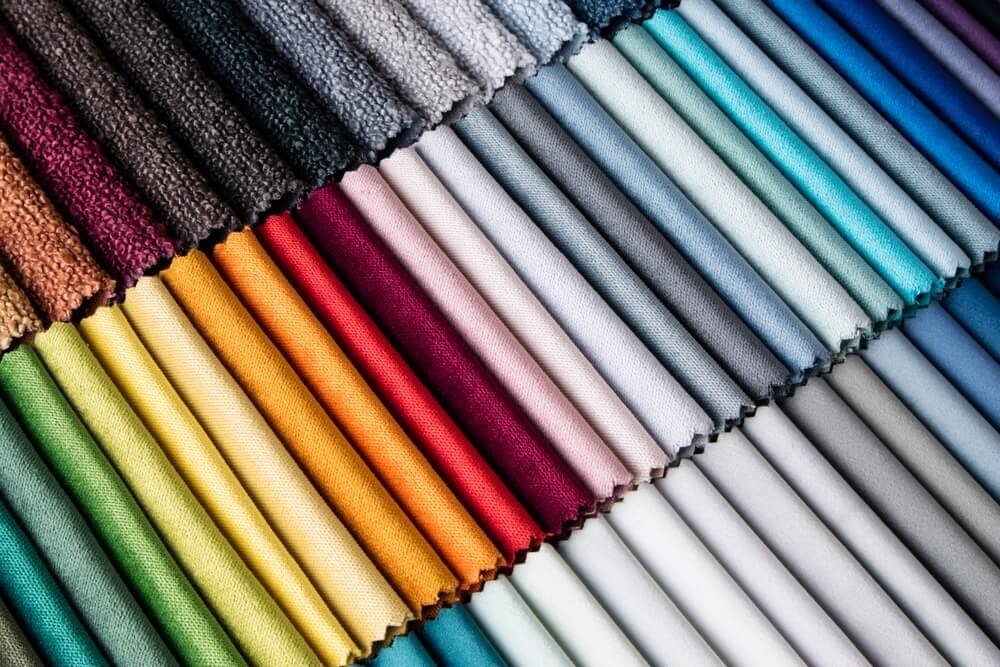
Knitwear differs from woven fabrics in its construction: woven fabric is made from two pairs of threads—warp and weft—interlaced at right angles, whereas knitwear is made from threads that form interlocking loops. This difference underlies everything else: knitwear is stretchy and clings to the body, while woven fabric is more stable, stretches less, and holds its shape better. That's why T-shirts, leggings, and sweaters are typically made of knitwear, while shirts, jeans, and coats are made of woven fabrics.
To sum it up
- Textile = an interweaving of warp threads (longitudinal threads) and weft threads (cross threads) produced on a loom.
- Knitwear = a network of stitches arranged in rows and columns, created by knitting machines or needles.
- Knitwear is smaller stretches and wrinkles; the fabric is more rigid and has greater dimensional stability .
- You'll recognize them by their edges: fabric crumbles , knitwear can blossom ("free stitches") and twist.
What is fabric?
Textile — is a flat textile product made from two pairs of threads interwoven at right angles. The threads running lengthwise are called basis , and the threads running across are - duck . Fabrics are produced on looms, and the method of weaving the threads is called weaving .
There are three main methods of weaving:
- Flax – the simplest material, the threads are intertwined alternately one above the other (for example, linen, poplin, chintz);
- twill weave – gives the surface characteristic diagonal stripes (for example, denim);
- Satin – creates a smooth, shiny surface (eg satin, satin).
Because the threads of the fabric are "anchored" in the mesh, the material stretches only slightly—usually just slightly diagonally. The exception is fabrics with added elastic fibers (such as elastane), which gain some stretch while still remaining fabric.
What is knitwear?
Knitwear consists of loops, or threads, passing through each other. Loops located next to each other form row , and the loops located one above the other form column . A hand-knitted sweater looks the same – industrial knitwear is created using the same principle, only on knitting machines.
There are two main types:
- Cross-knitted fabrics – stitches are created from a thread running across the fabric (even a single thread is sufficient); they are made on crochet and wave knitting machines. They unravel easily – if the thread breaks, the stitches will «fly away»;
- Knitted fabrics , Warp-knitted fabrics are made from multiple yarns running lengthwise across the fabric on machines called warp knitting machines. They are more stable and less prone to unraveling.
Popular knitted fabrics include: Jersey (for example, for T-shirts), interlock , elastic (used for cuffs and stand-up collars), as well as sweatshirt fabric and fleece.
Knitwear vs. Fabric – Difference Chart
| Characteristic | Knitwear | Textile |
|---|---|---|
| Construction | stitches (loops) in rows and columns | warp and weft interlacing at right angles |
| Production | knitting machines, knitting needles, crochet hooks | loom |
| Extensibility | large, often in both directions | small (unless with elastane) |
| Flatten | usually smaller in size | usually larger in size (depending on the type of fiber) |
| Edges after cutting | they can become untangled and twisted | they wear out |
| Cutting stability | Soft, elastic. | holds its shape well |
| Examples | knitwear, interlock, ribbed, sweatshirt, fleece | poplin, denim, satin, flannel, linen |
| Typical clothing | T-shirts, sweatshirts, sweaters, leggings, underwear | shirts, jeans, suits, coats, bedding |
It is worth remembering that the type of fabric - knitted or woven - is determined production method, not raw materials . Cotton, wool, viscose, or polyester can be used to make both knitted and woven fabrics—a cotton T-shirt is knitted, while a cotton shirt is usually woven.
How can you tell if a product is knitted or woven?
- Take a closer look at the surface. Knitwear features rows of tiny "cables" (stitches), like a sweater. Woven fabric features checkered patterns or diagonal stripes of crisscrossing threads.
- Stretch the fabric across. Knitted fabric stretches noticeably and returns to its original shape; fabric without elastane is virtually indeformable.
- Check the hem or seam. The fabric frays along the raw edge, and threads stick out. Knitted fabric often pills.
- Check the label or description. Fabric stores will usually list the type of material, such as "sweatshirt fabric" or "cotton fabric.".
What to choose: knitwear or fabric?
For clothing that needs to fit snugly to the body and move freely, choose knitted fabrics : sportswear, pajamas, underwear, children's clothing, and sweaters. When sewing knit fabrics, it's helpful to use a stretch stitch or overlock to prevent seams from unraveling when stretched.
Choose textile, Where shape and dimensional stability are important: for shirts, trousers, jackets, coats, curtains, and bedding. Furthermore, this fabric is usually easier to use for beginning sewers because it doesn't stretch under the sewing machine foot.
When washing and drying, follow the instructions on the care label—they depend more on the fiber type than on whether the fabric is knitted or woven. Sweaters and delicate knits are best dried flat to prevent stretching.
Frequently Asked Questions (FAQ)
Is cotton a jersey or a woven fabric?
Neither is cotton a fiber, or rather a raw material. Cotton is used to make both knitted goods (such as jersey T-shirts) and woven materials (such as poplin for shirts).
Are jeans a knit fabric?
Classic denim is a twill weave fabric. Stretch pants that resemble denim can be made from a denim-look knit, which is usually indicated in the product description.
Which is more durable – knitted or woven?
It depends on the type of material and fiber. Woven fabrics generally hold their shape better and are less prone to stretching. Weft-knitted fabrics unravel more easily when broken, while warp-knitted fabrics are more resilient in this regard.
What is a T-shirt?
Jersey is one of the most popular knit fabrics: thin, soft, and stretchy. It's used to make T-shirts, dresses, and underwear. When cutting, the edges of the fabric often curl.
Is fleece a knitted fabric?
Yes, fleece is a knitted fabric, usually made of polyester, with a fuzzy, fluffy surface on one or both sides.
See also
- What is the difference between suede and nubuck?
- What is the difference between stockings and tights?
- What is the difference between wool and yarn?
- What is the difference between over the knee socks and stockings?