

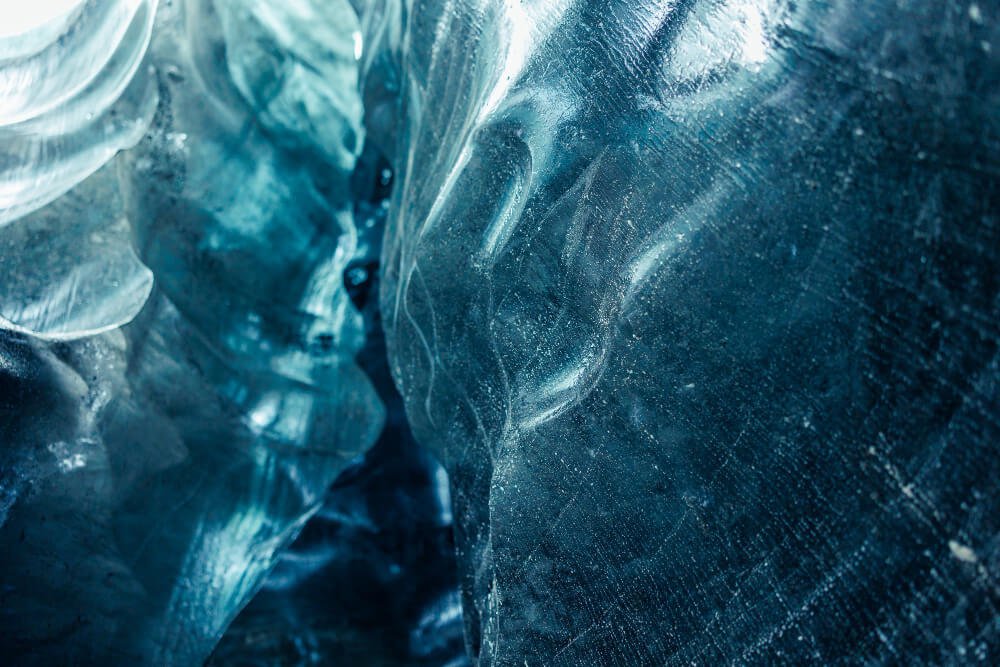
An ice cap is a type of glacier, but a huge one: mountain glacier fills the mountain valley and flows down it, and continental glacier — is a vast, shield-shaped ice sheet covering an area of over 50,000 km² and extending in all directions. Today, only two ice sheets exist—in Antarctica and Greenland—while mountain glaciers can be found on many high mountains around the world.
To sum it up
- «"Glacier" is a general term; ice sheet (continental glacier) is the largest type.
- A mountain glacier moves along a valley, an ice sheet - in all directions from its center.
- The ice cover covers an area of over 50,000 km² and is several kilometers thick; the tongues of mountain glaciers reach thicknesses of several tens to several hundred meters.
- Mountain glaciers carve U-shaped valleys and cirques; ice sheets leave behind lake areas, moraines, eskers, and boulders.
How is a glacier formed?
All glaciers, large and small, form in the same way. Where more snow falls annually than melts, that is, higher eternal snow line , snow accumulates in layers. Under the weight of successive layers, it thickens, turning into granular firn , and finally into dense glacial ice. When the ice mass becomes large enough, it begins to slowly shift under its own weight.
It is this movement that distinguishes a glacier from a regular patch of snow or ice. Thus, the difference between a glacier and an ice sheet lies not in the material itself, but in its scale, location and mode of movement .
A mountain glacier is ice flowing through a valley.
A mountain glacier forms in high mountains. Snow and firn accumulate in a depression high on a slope called a firn field , and the ice flows down the valley in the form of glacial tongue . Thus, the movement of a mountain glacier is determined by the terrain—the ice "flows" in the direction the valley takes it.
The thickness of glacial tongues in the mountains ranges from several dozen to several hundred meters. Such glaciers are found, among other places, in the Alps, the Himalayas, the Andes, the Caucasus, Alaska, and Scandinavia. Today, there are no glaciers in Poland, but during the Pleistocene, they existed in the Tatra Mountains—their traces include glacial cirques (which now contain, among other things, ponds), U-shaped valleys, and moraine ridges.
An ice sheet is a sheet of ice on a continent.
Ice cover , also called a continental glacier, is a sheet of ice in the form of a slightly convex shield of considerable thickness, covering an area of more than 50,000 km² . Smaller layers of this type are called ice caps. The ice sheet is not confined to any single valley; it covers entire plains, highlands, and even mountain ranges, with only the highest peaks protruding above the ice.
The ice sheet moves away from its highest, central part in all directions to the shore. On the coast, it often flows into the sea, and fragments break off, forming icebergs. Currently, there are two ice sheets:
- Antarctica – with an area of about 14 million km², it is the largest ice mass on Earth; its thickness in places exceeds 4 km.
- Greenlandic – an area of approximately 1.7 million km², covering most of Greenland.
During the Pleistocene, ice sheets covered much larger areas, including Northern Europe and North America. The Scandinavian Ice Sheet advanced several times into what is now Poland and significantly shaped the lowland landscape. Its formation includes lake regions (Pomerania, Masuria, and Greater Poland), terminal moraines, flat moraine plateaus, eskers, kames, lake channels, sandurs, and boulders, imported from Scandinavia.
This clearly demonstrates the difference in scale: a mountain glacier carves out individual valleys, while an ice sheet transforms the landscape of entire regions.
Comparison Chart: Glacier vs. Ice Sheet
| Characteristic | Mountain glacier | Ice cover |
|---|---|---|
| Position | Valleys and slopes of high mountains | Vast areas of land, entire continents or islands. |
| Form | Firn field and tongue in the valley | Convex shield |
| Surface | Small compared to the ice sheet. | More than 50,000 km² |
| Thickness | From several tens to several hundred meters | Several kilometers (Antarctica – in some places more than 4 km) |
| Direction of movement | Along the valley, down the slope | Radially, in all directions |
| Sculptural forms | Cirques, U-shaped valleys, lateral and terminal moraines | Lake districts, moraines, eskers, kames, sandurs, channels, boulders and erratic stones |
| Examples today | Alps, Himalayas, Andes, Alaska | Antarctica, Greenland |
| Traces in Poland | Tatra Mountains | Polish Lowland, Lake District |
How to distinguish glacier traces from ice sheet traces in the field?
- Are you in the high mountains and see a wide, flat valley with steep sides or a round depression with a pond under the ridges? These are traces of a mountain glacier - a U-shaped valley and a glacial cirque.
- Are you in a lowland area surrounded by lakes, hills and large, unusual rocks scattered across the fields? This is the landscape left by the glacier – a lake region with moraines and boulders.
- See the long, narrow, winding embankment of sand and gravel? It is likely an esker formed by water flowing through cracks in the ice sheet.
Frequently Asked Questions (FAQ)
Is an ice sheet a glacier?
Yes. An ice cap is the largest type of glacier, also called a continental glacier. However, in everyday speech, the word "glacier" most often refers to a mountain glacier, so the two terms are often used interchangeably.
How many ice sheets exist on Earth today?
Two ice sheets: the Antarctic (approximately 14 million km²) and the Greenland (approximately 1.7 million km²). Other ice sheets also existed during the Pleistocene, including the Scandinavian Ice Sheet, which reached Poland.
What is the difference between a glacier and an ice cap?
Both glaciers are shield-shaped and not confined to a valley. Traditionally, an ice sheet larger than 50,000 km² is called a continental glacier, while a smaller one is called an ice cap.
Are there glaciers in Poland?
Not at present. During the Pleistocene, mountain glaciers existed in the Tatras, and the lowlands were covered by the Scandinavian Ice Sheet. Their traces—sinkholes, U-shaped valleys, lake areas, and boulders—are still clearly visible.
Why is the glacier moving?
Ice under heavy load behaves plastically and flows slowly, while a glacier can also slide along the ground. A mountain glacier flows down a valley, and the ice sheet spreads from the center to the edges.
See also
- What is the difference between a sea and an ocean?
- What is the difference between seasonal and episodic rivers?
- What is the difference between an island and a continent?
- What is the difference between a circle and a wheel?