

Food! Many of us live for food. Almost all of our food comes from markets. We see processed fruits and vegetables and often have no idea how they are grown in the fields or the processes they undergo before reaching our tables. If you saw some of the produce we eat every day in the fields, you probably wouldn't recognize it. Here are photos showing what 30 everyday foods look like before harvest. It's time to learn more about how we get what we eat. It will make us appreciate food even more.
1. Cashews

Nearly 60% of cashew nuts are produced in India. In winter, cashews ripen and are ready to harvest. Some people wait until the fruit falls to the ground before removing the nuts. Cashews are actually the stems of an apple-like fruit. The nuts must be twisted off the fruit by hand, a dangerous process because the shell surrounding the nut is poisonous and contains a liquid similar to poison ivy. (source)
2. Peanuts
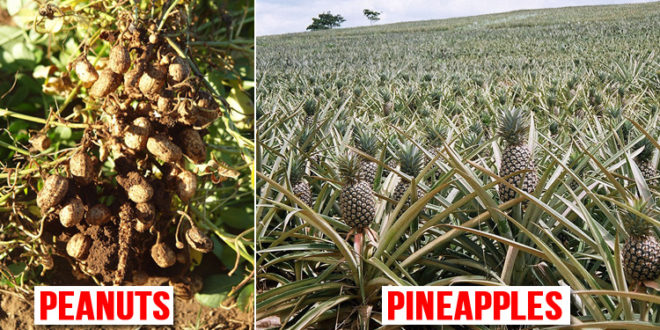
The peanut plant flowers above ground, but the fruit grows underground. Approximately 140-150 days after planting the seeds, farmers can harvest the peanuts, which require very little water. At the right time, an excavator digs up the plant, shakes the soil off the peanuts, and spreads them out in the field to dry. After drying, a combine harvester separates the roots from the nuts, and the peanuts are ready for market. (source)
3. Dates

Dates are typically grown on palm trees found in the hot, arid regions of South Asia and North Africa. Date harvesting can be carried out in three stages: halal, rutab и Tamar. The harvesting stages determine the dates' moisture content and characteristics, as well as their perishability. Harvesting is done by hand, and although attempts are made to do so by shaking the palm trunk, climbing the tree is unavoidable. Harvest time varies depending on the growing region and the stage of harvest. (source)
4. Coffee beans

Favorite coffee! When we drink brewed coffee, we are actually consuming dried, roasted, and ground coffee beans. Coffee plants begin to bear fruit three to four years after planting. In flat areas, the process is mechanized, but on hillsides, harvesting must be done by hand. After harvesting, which can be done either dry (leaving the cherries to dry in the open air for several days) or wet (first removing the pulp, then fermenting, washing, and drying the beans), the coffee beans are ready for sale. (source)
5. Pineapples

Expensive Pina Our tropical vacation wouldn't be complete without pineapples. About 15 months after planting, pineapples are ready for harvest, usually between May and August. Harvesting is done by hand with a knife, cutting 5-7 centimeters of the pineapple plant's stem, along with the fruit. Pineapples grow above ground on a plant whose leaves can reach five feet in length. (source)
6. Quinoa
Thanks to quinoa, we have a protein-rich grain that helps us stay fit. Quinoa is rarely harvested by machine; the grains (actually seeds) are hand-picked from tall, green plants. To avoid loss, the seeds are collected from the flowers growing on the plant, which can reach a meter in height. When all the green leaves have fallen and the plant and flower are completely dry, the seeds are ready to be harvested. (source)
7. Artichokes

Artichokes are typically harvested in the spring, but the harvesting process differs from that of other crops. The plant's flower buds are edible only before they bloom, as they become tough after they open. They are cut from the stem, leaving one to two centimeters of stem. The peak commercial harvesting season is spring and mid-fall. (source)
8. Brussels sprouts
Eighty days after planting the seeds, Brussels sprouts are ready to harvest. When the heads begin to form near the lower leaves and reach a diameter of one to two inches, they are ready to harvest. They are twisted until they detach from the plant, and any yellow leaves are removed. The plant then grows and produces new heads. (source)
9. Saffron

Orange saffron is obtained from the purple flowers of the saffron crocus. These are actually the stigmas of the flower. Each flower produces three stigmas, which must be carefully plucked with your fingers immediately after blooming. Since each flower produces only three saffron threads, large numbers of flowers must be planted to obtain a marketable quantity, which explains the high price of saffron. (source)
10. Black pepper
About nine months after the pepper plant blooms, ripe berries containing the pepper balls can be harvested. The berries are initially green, then turn yellow, and finally red when picked. Black peppercorns are picked green, boiled in water, and then sun-dried for 16-20 hours, producing peppercorns that can be used in a variety of dishes. (source)