

Fossils are one of the most important historical records, helping us understand how life on Earth originated and how it evolved over millions of years. In their quest to understand human evolution, a group of archaeologists discovered human fossils that challenged some previously held theories. Based on DNA studies of modern populations and the oldest known fossils of Homo sapiens, it was believed that the ancestors of modern humans migrated from East Africa approximately 200,000 years ago. However, recent excavations and dating of fossils from Jebel Irhoud in Morocco, once a cave used by ancient humans and now an archaeological site, have proven otherwise.
In 2004, Jean-Jacques Hublin and his team conducted archaeological excavations at Jebel Irhoud, located 100 kilometers west of Marrakesh, Morocco. They discovered more than 20 human bones belonging to at least five individuals, dating back between 280,000 and 350,000 years.

Human fossils in Jebel Irhoud were first discovered in the 1960s, when miners found a complete human skull. When Chris Stringer, a paleoanthropologist at the Natural History Museum in London, saw the fossils, he was puzzled because they didn't belong to Neanderthals, but they also looked too young and primitive to be Homo sapiens.
Later, one of the study's authors and director of the Max Planck Institute for Evolutionary Anthropology in Leipzig, Germany, Jean-Jacques Hublin, visited the site and, by 2004, was able to fund excavations in the hopes of re-dating the fossils using modern equipment. During these excavations, Hublin and his team discovered 20 new human bones belonging to at least five individuals—three adults, one adolescent, and a seven-and-a-half-year-old child—including a complete jaw, skull fragments, stone tools, teeth, and limb bones.
An interesting discovery during the excavations was the elongated shape of the skulls of the fossil remains, which suggests that the facial features of anatomically modern humans evolved before their brains did.
The elongated shape of the braincase was one of the first features noted by archaeologists in the Jebel Irhoud fossils, differing from the rounded skulls of modern humans. The evolutionary changes that led to the current shape of the human brain are likely linked to genetic changes in its organization, connections, and development. Therefore, according to the researchers, the brain's shape, and possibly its functions, evolved relatively recently.
The fossils discovered refute the theory that modern humans originated from East Africa around 200,000 years ago. Researchers now believe they may have been present throughout Africa 100,000 years earlier, when the Sahara was green and humid, facilitating their spread.
According to Hublin, by 300,000 years ago, a primitive version of humans dispersed across the African continent. This led to the emergence of modern humans in different locations, meaning that different parts of Africa contributed to the emergence of modern humans, not just East Africa, as previously thought. The dispersal of these early humans was also facilitated by "a wetter climate that created the 'green Sahara' approximately 330,000 to 300,000 years ago," meaning that the evolution of modern humans occurred on a continental scale, not just in one part of Africa.
Among the fossils, Hublin and his team also found pieces of charcoal and tools indicating that these people used fire and tools for cooking. These charred tools helped the researchers determine the cooking time using thermoluminescence dating. These measurements, indirectly, helped determine the age of the fossils.
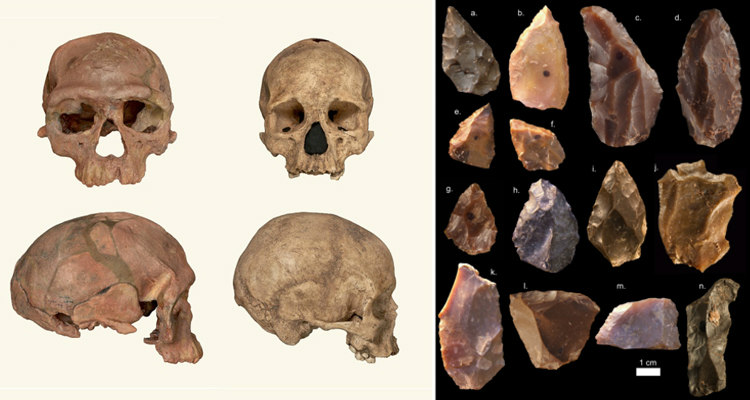
In addition to evidence of fire-based cooking, characteristic signs of butchering were also discovered, such as cut marks and incisions indicating the extraction of bone marrow. Some of the tools used for cooking were charred during the process, allowing the researchers to date them to approximately 315,000 years ago. These estimates were confirmed by re-dating a previously discovered jawbone, which yielded a range of 280,000 to 350,000 years.
[Source: nature, Wikipedia]