

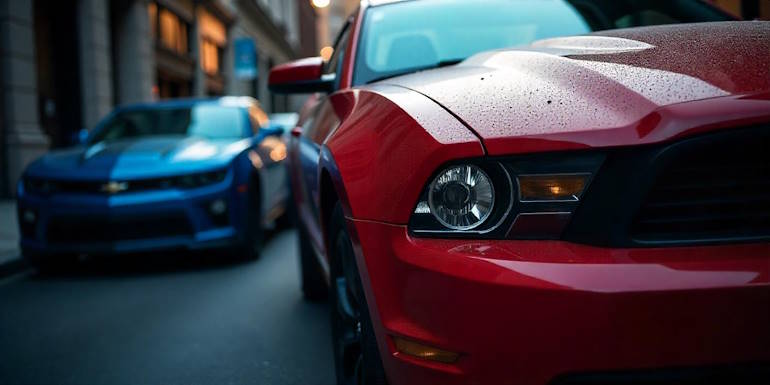
The Chevrolet Camaro and Ford Mustang are iconic representatives of the sports muscle car segment, competing with each other for decades, attracting millions of fans around the world.
Their rivalry began back in the 1960s, and each new release adds fresh elements to this automotive duel. These cars not only differ in appearance and performance, but also embody distinct spirits that appeal to different types of car enthusiasts.
What are the main differences between the Camaro and Mustang? Let's find out.
History and philosophy of brands
Ford Mustang The Mustang debuted in 1964 and became the first of the so-called "pony cars." This car combined an affordable price, sporty style, and a wide range of trim levels. The Mustang was conceived as a versatile model, suitable for both everyday driving and exciting track days. Check out our review of the first-generation Ford Mustangs, which we previously did.
On the other side, Chevrolet Camaro, The Camaro, which debuted in 1966, was created in response to the success of the Mustang. The Camaro was initially positioned as a more aggressive and powerful alternative. General Motors invested considerable effort in making the Camaro stand out with its advanced technology and high-speed tuning.
Design and appearance

The design differences between the Camaro and Mustang are immediately apparent.
- Mustang Retains the classic pony car lines that evolve with each generation. The long hood, tapered front end, and compact rear end give it versatility. The latest Mustang models strive to maintain a balance between retro styling and modern elements.
- Camaro The Camaro boasts a more aggressive design. Its low stance, prominent wheel arches, and narrow headlights create the impression of a track-ready sports car. The Camaro has a bolder appearance, appealing to those who prefer to stand out.
Engines and performance

Driving performance is the key difference between the two cars.
- Ford Mustang The company offers a wide range of engines. The base model comes with a turbocharged 2.3-liter EcoBoost engine producing 310 hp and 475 Nm, suitable for everyday driving. For speed enthusiasts, powerful 5.0-liter V8 versions are available, such as the Mustang GT and Shelby GT500, which offer outputs ranging from 450 to 760 hp. There's also a street-legal V6 version producing 305 hp and 380 Nm of torque.
- Chevrolet Camaro The Camaro also has a wide range of engines, from a turbocharged 2.0-liter four-cylinder producing 275 hp and 400 Nm to a 6.2-liter V8. The Camaro ZL1 version can produce up to 650 hp, making it a direct competitor to the Shelby GT500. There's also a street-legal version with the LFX series V6, producing 323 hp and 373 Nm.
On average, when choosing between V8s, the Camaro offers a slightly more aggressive chassis and suspension setup, making it preferable for track use. The Mustang, on the other hand, is slightly more comfortable, making it more suitable for everyday use.
Engines - differences
The Chevrolet Camaro (see review) still uses the LS series engines with two valves per cylinder and an overhead camshaft (OHV), which is quite archaic design by modern standards. These engines, despite their outdated architecture, are characterized by a simple design, compactness, and high reliability. Furthermore, thanks to fewer moving parts, LS engines provide excellent power and torque at low rpm, making them ideal for conditions requiring rapid acceleration. However, their drawbacks include limited high-rpm potential and a less efficient cylinder filling system compared to overhead camshaft (OHC) engines.
LS series engines use only a single timing chain, simplifying the design and reducing the risk of failure. Furthermore, there are LS versions without variable valve timing (VVT), such as the LS3 or LS7, which makes them even more reliable but less efficient at high rpm.
Ford Mustang, on the contrary, is equipped with modern engines overhead camshaft. This design allows for more valves per cylinder, improving combustion chamber airflow, increasing fuel efficiency, and delivering more power at high rpm. This makes the Mustang more versatile for a variety of driving styles, including aggressive and high-speed driving. However, these engines are more difficult to maintain, take up more space under the hood, and can be more expensive to repair.
The choice between these systems depends on priorities:
- For those who love simplicity and torque, GM's LS may be ideal.
- For those who value modern technology and high-revving dynamics, Mustang engines will be the preferred choice.
Special versions

Since 2012, the Chevrolet Camaro has featured powerful and exclusive versions designed for performance enthusiasts. Camaro ZL1, Released in 2012, the ZL1 has become one of the most recognizable models. Under the hood is a 6.2-liter supercharged LT4 engine producing 580 hp. This version received improved aerodynamics, Brembo brakes, and a Magnetic Ride adaptive suspension. In 2017, the ZL1 was updated: power increased to 650 hp, and a 10-speed automatic transmission ensured lightning-fast gear shifts.
Another unique version - Camaro Z/28 (2014–2015) – pictured above. This track-ready monster features a 7.0-liter naturally aspirated LS7 engine producing 505 hp. The model features a lightweight body, advanced braking system, and aerodynamic elements that make it one of the best for track use.

Ford Mustang also pleases with a variety of exclusive versions. Shelby GT500, Introduced in 2013, the Shelby GT500 was the most powerful Mustang ever made. Its supercharged 5.8-liter V8 produced a whopping 662 hp and allowed it to accelerate from 0 to 62 mph in under 4 seconds. Since 2020, the Shelby GT500 has received a 5.2-liter supercharged engine producing 760 hp, making it a true supercar competitor.
The model is designed for track racing Mustang Shelby GT350 (2015–2020) – pictured above. Its naturally-aspirated 5.2-liter V8 engine (526 hp) featured a flat-plane crankshaft, providing high revs and an aggressive sound. Add to this the MagneRide adaptive suspension and improved aerodynamics, and you have a superb combination of power and handling.
Controllability and comfort
- Mustang Renowned for its versatility, the suspension is tuned to provide comfortable driving in the city and on the highway. Even in sporty trims, this car remains relatively soft.
- Camaro It has a stiffer suspension, which makes it sharper to handle, but less comfortable on regular roads. This is a car for those who appreciate a sporty feel even in everyday driving.
Interior and technology
The interior space of the Camaro and Mustang is very different.
- Mustang interior:
- More spacious interior and better visibility.
- Modern technologies, such as the SYNC 4 system with a large touchscreen, make driving convenient.
- High-quality materials are used, which adds to the premium feel.
- Camaro:
- The interior is sportier, but less spacious. This is especially noticeable in the rear seats.
- The central console is oriented towards the driver, which emphasizes the sporty character of the car.
- The Camaro is a bit behind the Mustang in terms of convenience, but offers more advanced features for customizing the car to your specific needs.
Price and availability
In the Russian and American markets, prices for these cars may vary depending on the configuration.
- Mustang The base version usually costs less, making it more accessible. This appeals to those who want a sports car without breaking the bank.
- Camaro Slightly more expensive, especially in the higher-performance trims. This reflects its narrower focus on sporty driving.
Conclusions
Mustang Over the years, the Mustang has focused on versatility and everyday usability, including comfort and practicality, while maintaining sporty qualities. It may be less aggressive in styling than the Camaro, but thanks to its wider choice of engines and configurations (such as the GT version or newer models like the Shelby GT500), the Mustang is also capable of delivering excellent performance and performance.
Camaro, The Camaro, on the other hand, has always been more focused on aggressive, sporty styling, powerful engines, and improved aerodynamics, especially in the ZL1 and Z/28 versions. While the Camaro can also be quite comfortable for daily driving, its primary focus has always been on performance and visual appeal for performance enthusiasts.
In summary, your choice between these two models depends primarily on your style preferences and expected performance, but both cars can be used as daytime vehicles. Both are high-quality sports cars, but the difference lies in their emphasis on practicality and aggressive styling.