

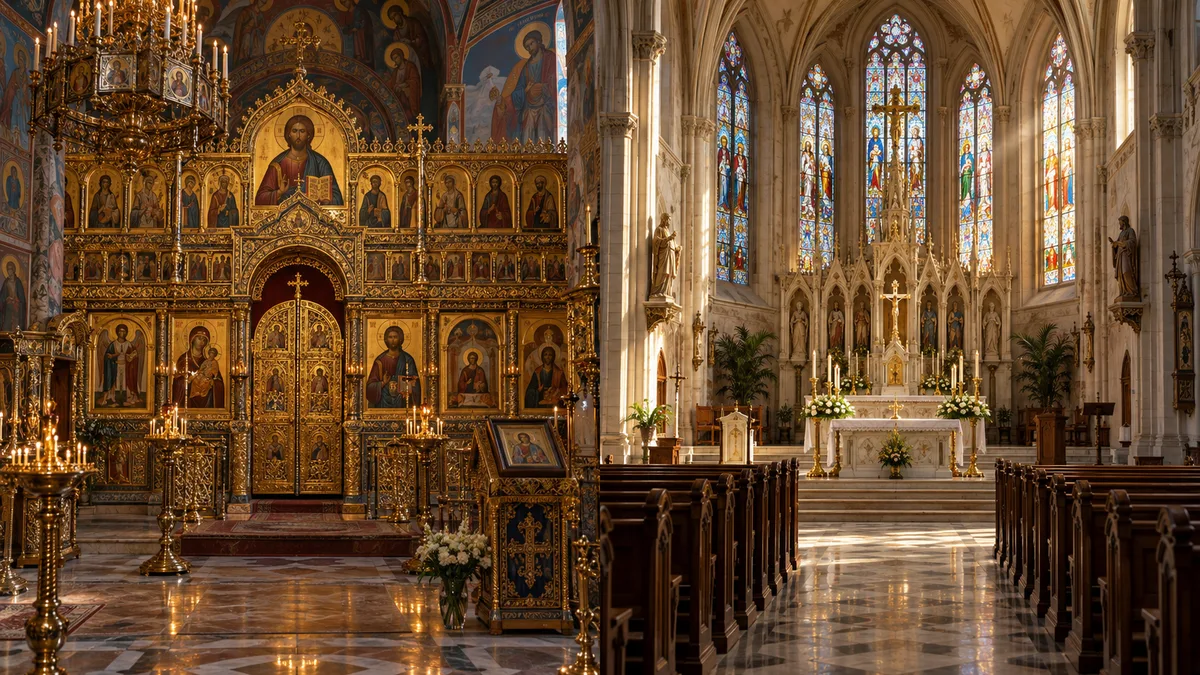
Orthodoxy differs from Catholicism primarily in its church structure (Orthodoxy is a community of independent autocephalous churches, while Catholicism is united around the Pope), a number of doctrinal provisions, as well as liturgical tradition and calendar. Both denominations descend from the united Church of the first millennium and recognize the same Bible, the Holy Trinity, and the seven sacraments. Below, we explain the origins of this division and the differences in practice.
To sum it up
- Authority: Catholics recognize the authority and infallibility of the Pope in matters of faith; Orthodox Christians form a family of independent churches headed by patriarchs and metropolitans.
- Doctrine: the dispute about the "Filioque" (from whom the Holy Spirit proceeds), as well as the dogmas about the Virgin Mary and the teaching about purgatory, proclaimed in the Catholic Church, which Orthodoxy does not accept in this form.
- Clergy: In Orthodoxy, a married man can be ordained a priest; in the Latin Church, celibacy is obligatory.
- Liturgy and calendar: Orthodox Christians use leavened bread and receive Communion under both kinds; most parishes in Poland celebrate services according to the Julian calendar.
Where did the division come from? The Great Schism of 1054.
The symbolic date of the split is 1054 , when the papal legates and the Patriarch of Constantinople mutually excommunicated each other. However, historians emphasize that East and West had been drifting apart for centuries: they differed in language (Greek and Latin), in theological practices, and in their understanding of the role of the Bishop of Rome.
The Eastern Patriarchates recognized the Pope as "first among equals," but understood this primacy as honorary, not as authority over the entire Church. On December 7, 1965, Pope Paul VI and Patriarch Athenagoras I jointly lifted the mutual excommunications of 1054. This did not signify unification—the two Churches remain separate and engaged in dialogue.
Orthodoxy and Catholicism – system and power in the Church.
В Catholic Church Supreme authority belongs to the Pope, the Bishop of Rome. The First Vatican Council (1870) proclaimed the dogma of papal infallibility, solemnly promulgating teachings on matters of faith and morals. Bishops throughout the world remain in communion with Rome.
Orthodoxy does not have a single chapter. It consists of autocephalous churches , that is, independent churches headed by their own patriarchs, archbishops, or metropolitans. The Patriarch of Constantinople has honorary primacy, but not jurisdiction over the others. In Poland, the Polish Autocephalous Orthodox Church operates, headed by the Metropolitan of Warsaw. Important questions of faith are decided by councils of bishops.
Differences in doctrine
The oldest theological debate concerns «Filioque» ("and the Son"). The Latin Church professes in the Creed that the Holy Spirit proceeds from the Father and the Son. Orthodoxy preserves the original text of the Nicene-Constantinopolitan Creed, according to which the Holy Spirit proceeds from the Father.
Orthodox Christians hold Mary in great esteem as to the Mother of God , but do not accept the dogmas proclaimed by the popes Immaculate Conception (1854) and Assumption (1950). In the East, the feast of the Dormition of the Blessed Virgin Mary is celebrated without establishing it as a dogma. Orthodoxy also does not accept the Catholic teaching on purgatory in its Western interpretation, although it prays for the dead.
Liturgy, Sacraments and Calendar
In the Orthodox Church Divine Liturgy is performed according to the Byzantine rite, most often according to the formula of St. John Chrysostom. The presbytery is separated iconostasis - a wall with icons. It is used for the Eucharist. leavened bread , and the faithful receive Communion under both kinds, serving it with a spoon. In the Latin Church, unleavened bread (the consecrated breast) is used, and Communion under both kinds is possible, but it is usually administered under the kind of bread.
In Orthodoxy, baptism, confirmation, and First Communion are performed simultaneously, even for infants. In Latin Rite Catholicism, these sacraments are performed sequentially. The sign of the cross also differs: Orthodox Christians make it from the right shoulder to the left, while Latin Rite Catholics make it from the left shoulder to the right.
The major difference in Poland is calendar . The Polish Orthodox Church calculates most holidays according to the Julian calendar, which is used by the vast majority of parishes. Therefore, fixed holidays fall 13 days later than those observed by Catholics—Christmas is celebrated on January 7. The date of Easter is also calculated differently, so Orthodox and Catholic Easter only occasionally coincide.
Clergy: celibacy and marriage of priests
In the Latin Church, priests observe celibacy . In Orthodoxy, a married man can be ordained as a deacon or priest, but the marriage must take place before ordination. Bishops They are chosen exclusively from among the celibate clergy, most often monks. It's worth remembering that Eastern Catholic churches (for example, the Greek Catholic Church) also allow married priests, even though they recognize the Pope.
Comparison Chart: Orthodoxy vs. Catholicism
| Characteristic | Orthodoxy | Catholicism (Latin Rite) |
|---|---|---|
| Superiority | Autocephalous Churches, Patriarchs and Metropolitans | The Pope as Supreme Leader |
| The Origin of the Holy Spirit | From the Father | From the Father and the Son (Filioque) |
| Marian dogmas | Veneration of the Holy Mother of God without dogmas of 1854 and 1950. | Immaculate Conception and Ascension |
| Eucharistic bread | Leaven, Communion under both kinds | Fresh (basic), usually in one form |
| Mysteries of initiation | Baptism, anointing and communion together. | Distributed over time |
| Priests | They may be married (married before ordination). | Celibacy |
| Calendar in Poland | Mainly during the Julian period (Christmas on January 7) | Gregorian (Christmas December 25) |
What connects the two churches?
Despite their differences, Orthodoxy and the Catholic Church have much in common. Both Churches recognize seven sacraments , the apostolic succession of bishops, the teachings of the early Ecumenical Councils, and the veneration of saints and icons (paintings). They mutually recognize the validity of each other's ordinations and sacraments. Therefore, members of both faiths may enter into mixed marriages, and detailed rules—for example, regarding the wedding venue and the upbringing of children—should be discussed with the pastor.
There is no definitive answer to the question "Which is better, Orthodoxy or Catholicism?" It's a matter of faith and conscience, not a product comparison. This text presents the differences descriptively, without condemning either tradition.
Frequently Asked Questions (FAQ)
Do Orthodox Christians recognize the Pope?
They do not recognize his authority over the entire Church or the dogma of infallibility. Historically, in the East, the Bishop of Rome was granted honorary primacy as "first among equals," but not jurisdiction over other patriarchates.
Why do Orthodox Christians celebrate Christmas on January 7?
Most Orthodox parishes in Poland observe holidays according to the Julian calendar. It currently differs from the Gregorian calendar by 13 days, so December 25th on the old calendar corresponds to January 7th on the new calendar.
Can an Orthodox priest have a wife?
Yes, if he married before ordination. After ordination, he cannot marry. Only celibate clergy become bishops.
When did the split between Orthodoxy and Catholicism occur?
The year 1054 is considered symbolic, as it marked the mutual excommunication of Rome and Constantinople. However, the process of separation between the churches lasted longer. The excommunication was lifted in 1965.
What is the difference between Orthodoxy and the Greek Catholic Church?
Greek Catholics, like Orthodox Christians, celebrate the liturgy according to the Byzantine Rite and may have married priests. The difference is that they remain in communion with the Pope and belong to the Catholic Church.
See also
- How is Catholicism different from Christianity?
- How are evangelicals different from Catholics?
- How is Judaism different from Christianity?
- What is the difference between a priest and a father?