

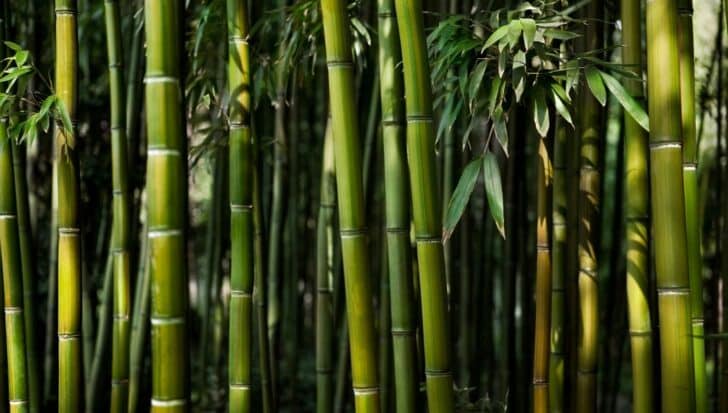
Bamboo is rightfully considered one of the most versatile and hardy plants on the planet.
This diverse species boasts incredible characteristics and a surprising range of uses, making it a true wonder of nature.
Without further ado, let's take a look at 25 facts about bamboo you may not know.
- Bamboo is the fastest-growing plant in the world. Remarkably, some species of bamboo can grow an incredible 35.83 inches per day.
- You might think bamboo is a tree, but it's not. Bamboo is actually a type of grass belonging to the grass family.
- Bamboo has been used to create a variety of musical instruments throughout history. Among these popular instruments are various flutes and xylophones.
- Bamboo grows on only five continents of the world: Africa, Asia, South America, North America, and Australasia, all of which have diverse ecosystems.
- There are 31.5 million acres of bamboo forests worldwide. Some of the most popular bamboo forests visited by tourists are the Arashiyama Bamboo Forest in Kyoto, Japan, and Juknokwon Bamboo Forest in Damyang, South Korea.
- A panda's daily diet consists primarily of bamboo. However, since bamboo is nutrient-poor, pandas consume between 27 and 84 pounds (12–38 kg) to meet their energy needs.
- Individual bamboo stems are called culms. Bamboo culms can reach an incredible 151 feet (46 meters) in length!
- There are approximately 1,500 species of bamboo worldwide, typically growing in warmer tropical climates. However, many species can adapt to more challenging conditions.
- Another incredible feature of bamboo is its drought tolerance, although it may take several years for its roots to become strong enough to withstand longer periods of drought.
- Bamboo produces approximately 35% more oxygen than trees! It's certainly an excellent plant for the world's fight against climate change.
- Bamboo has significant symbolic significance in many countries. It symbolizes honesty in China, prosperity in Japan, and friendship in India.
- Most bamboo species cannot withstand freezing temperatures. However, some species, such as Fargesia nitida, can survive temperatures as low as -20°F!
- For centuries, bamboo leaves have been a key ingredient in traditional medicine in China, Japan, and Southeast Asia. The leaves have been used to treat conditions such as high blood pressure and fever.
- Bamboo grows to its full height in just one growing season, which lasts only three to four months! It has a head start because its shoots emerge from the ground at full width.
- Bamboo shoots, also known as bamboo sprouts, are completely edible and are used in many dishes throughout Asia.
- Bamboo is able to quickly recover from damage and harvesting, easily recovering from a fall, ultimately demonstrating its incredible resilience.
- The longest known interval between flowering and flower appearance in bamboo is a whopping 120 years! Only a few bamboo species wait that long to flower.
- While many plants and trees struggle to maintain their leaves and color year-round, bamboo is evergreen. This means it remains green and leafy regardless of the season.
- Bamboo is fire-resistant due to its high silicon content. This natural property makes it an ideal material for areas where fire safety is critical.
- Bamboo charcoal can be used to purify water by absorbing impurities and improving its taste and odor. It can even outperform other chemical methods!
- Bamboo is believed to have natural antibacterial properties due to a substance called bamboo kun. This natural bioagent, found in bamboo fibers, helps inhibit the growth of bacteria and fungi.
- Bamboo clothing is not only very comfortable to wear, but it also decomposes quickly and can therefore be disposed of in an environmentally friendly manner.
- Bamboo can actually bend without breaking, making it super flexible. This makes it ideal for making items like fishing rods, which require a high degree of flexibility.
- For generations, bamboo has been used throughout Asia as scaffolding for buildings such as high-rise towers and apartment buildings. Hong Kong is one of the few places where it is still used today.
- Bamboo has another quality: it can be converted into various forms of biofuel, including solid, liquid, and gaseous, making it extremely versatile.
Thanks to its exceptional resilience and enormous versatility, bamboo has proven itself to be an exceptional resource in many ways.
Whether you're amazed by its many uses or fascinated by its eco-friendliness, we hope you weren't left too confused!
First of all, we hope you enjoyed learning all these fascinating facts about this incredible plant.