

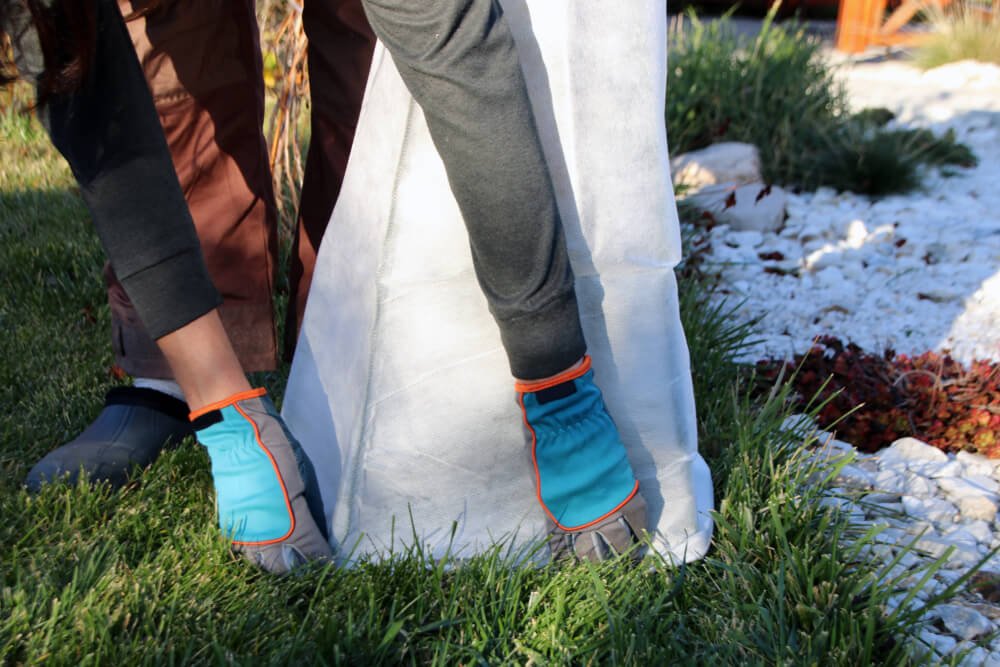
Geotextiles are thick, durable, technical nonwovens designed for installation in the ground. They separate layers, filter water, and protect elements such as drainage systems or foundations. Agrotextiles are thin, lightweight, nonwoven horticultural materials used to cover plants or soil. Both materials are synthetic non-woven fabrics, but differ in thickness, strength, and intended use. Substituting one for the other usually ends poorly: agrotextile under paving slabs will quickly tear, while geotextile on a flowerbed will significantly restrict light penetration.
To sum it up
- Geotextile – used in construction, road building, drainage, paving and as a base for stone; typically with a density of 100 g/m² and above.
- Agrotextiles – for the garden and crops: protection from frost (white) and weeds (black); usually from tens to several tens of g/m².
- Geotextile is used in the ground or under cover , and agrotextiles - on the surface , exposed to the sun, so it is resistant to ultraviolet radiation.
- Geotextiles are selected according to their function (separation, filtration, drainage, protection), and agrotextiles according to their colour and weight.
What is geotextile?
Geotextile A geosynthetic is a flat, non-woven textile product made from synthetic fibers—most commonly polypropylene or polyester—bonded mechanically (needle-punched), thermally, or chemically. It is a geosynthetic material, meaning it is used in contact with the ground. Its primary functions are described in standard PN-EN ISO 10318:
- Separation of layers – prevents layers, such as base filler, from mixing with clay or sand underneath.
- Filtration – allows water to pass through and retains small soil particles.
- Drainage – drains water along its plane and protects drainage pipes from silting.
- protection – protects, for example, films and membranes from stone penetration.
Traditional geotextiles are not used for soil reinforcement; geotextiles and geogrids are used for this purpose. In construction, the choice is based not only on density but also on tensile strength, puncture resistance, pore size, and water permeability, all of which are specified in the technical data sheet.
What is agrotextile?
Agrotextiles Agrotextile is a thin, non-woven material, typically made from polypropylene enriched with a UV stabilizer to prevent rapid degradation in sunlight. It is breathable and water-permeable, and in the white version, it also allows light to pass through. Two main types of agrotextile are found in gardens:
- White (covering) – the lightest varieties, for example, 17 g/m², protect plants from spring frosts, wind, hail, and bright sun; thicker ones, for example, 50 g/m², serve as winter shelter.
- Black (mulching) – usually around 50 g/m², distributed over the soil; it does not allow light to pass through, therefore suppressing weed growth and limiting water evaporation.
There are also two-color non-woven materials on the market, such as brown and black, which look more aesthetically pleasing on top of a flower bed.
Geotextiles and agrotextiles – a table of differences
| Characteristic | Geotextile | Agrotextiles |
|---|---|---|
| Fate | Construction, roads, drainage, gardens (for crushed stone and rock) | Gardening and agriculture |
| Raw materials | Polypropylene or polyester | Most commonly polypropylene |
| Typical weight | Approximately 100 g/m², in stores often 100–300 g/m² and more. | Approximately 17–50 g/m² |
| Sustainability | High resistance to punctures and stretching. | Small, easily torn |
| Workplace | In the ground, under crushed stone or paving stones. | On the surface, on plants or soil. |
| UV resistance | Depends on the product - usually covered by warranty. | UV stabilized |
| Color | Most often white, grey or black. | White (covering), black or two-color (mulching) |
| Main characteristics | Separation, filtration, drainage, protection | Protection from cold, mulching, weed control. |
Geotextile or agrotextile under stone, bark and paving stones?
This is the most common gardening dilemma. The rule is simple: the heavier the top layer and the longer it will be exposed to the elements, the more geotextile will be needed.
- Geotextile is used under pavers, driveways, and gravel paths . It separates the base from the underlying soil, preventing filler from falling into the base and slowing down surface collapse.
- Geotextiles should be used under decorative stones and gravel in a flower bed . Sharp stones and trampling will quickly pierce the thin agrotextile fabric.
- Under the bark in a shrub bed Black agrotextile mulch works well; the bark is lightweight and does not penetrate the material.
- For vegetable and strawberry beds - black agrotextile with cut holes for seedlings.
- For frost protection and early sowing – white agrotextile, loosely laid on plants.
- Around the drain pipe, in the perimeter drain and in the absorption well – filter geotextile.
In construction projects such as roads, heavy equipment access roads, slopes, or foundation drainage, geotextile parameters should be determined by the designer or contractor based on technical documentation, not just density.
How to recognize and choose the right non-woven material?
- Check the density – from a dozen to several dozen g/m² is almost always agrotextile, a hundred or more is geotextile.
- Check it out for yourself : agrotextile is thin, transparent (white) and easily torn; geotextile is thick, «felt-like» and difficult to tear.
- Please note the UV resistance information. – If the material will remain exposed to the environment, the manufacturer must indicate that it is resistant to ultraviolet radiation.
- Read the description of the functions Geotextiles are described according to their functions (separation, filtration, drainage), while agrotextiles are described according to their intended purpose (covering, mulching, winter use).
Frequently Asked Questions (FAQ)
Is geotextile permeable to water?
Yes. Geotextiles are permeable to water, which is why they're used for filtration and drainage. However, they retain small soil particles that could clog gravel or drainage pipes.
Is it possible to lay agrotextiles under paving slabs?
This is a bad idea. Agrotextiles are thin and won't withstand the pressure of filler or compaction. Geotextiles with load-bearing properties are used under the road surface.
Will geotextile help stop weed growth?
A layer of stones or gravel effectively prevents weeds from growing through the soil. However, it doesn't stop seeds from sprouting in the top layer, so such areas still need to be weeded periodically.
Which agrotextile should you choose for frost protection?
To protect against spring frosts, use white, lightweight, airy agrotextiles, such as 17 g/m², loosely laid over the plants. Heavier white fabrics, such as 50 g/m², serve as winter cover.
Can geotextiles be left in the sun?
It depends on the product. Many geotextiles are designed for use under cover, and UV radiation weakens them over time. If the material will be exposed, choose a product that the manufacturer claims is UV-resistant.
See also
- What is the difference between a border rose and a multiflora rose?
- What is the difference between ceramic and porcelain?
- What is the difference between winter and summer tires?
- What is the difference between a veranda and a porch?