

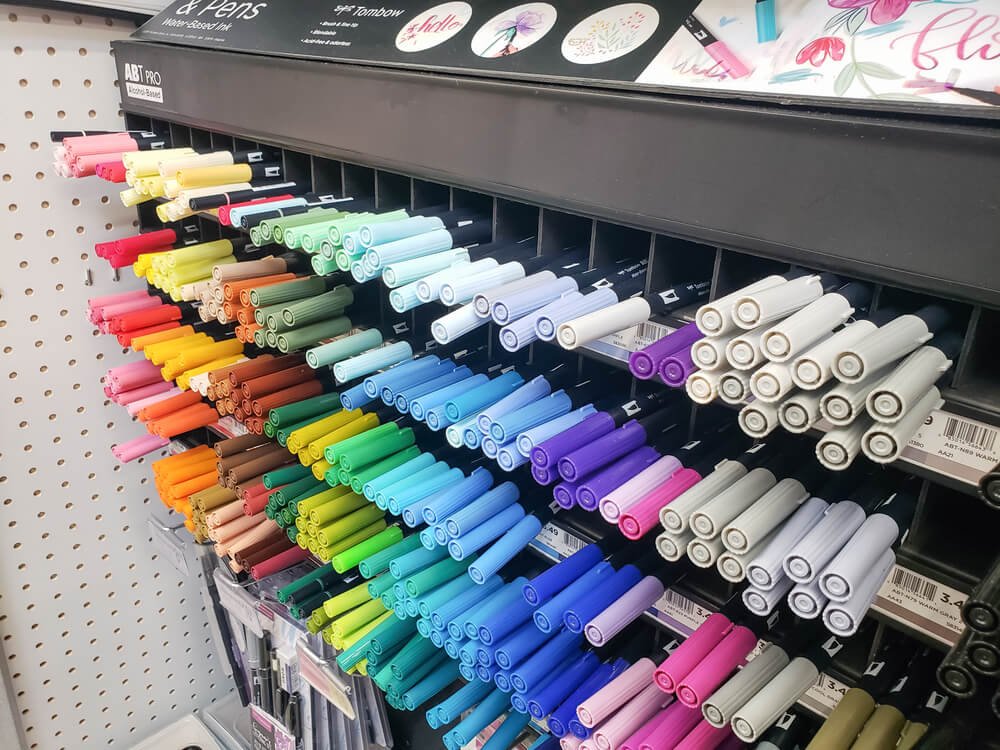
The Promarker and Brushmarker (now Promarker Brush) are alcohol markers from Winsor & Newton, differing primarily in the tip: the Promarker has a slanted, fine, round (bullet) tip, while the Brushmarker has a slanted, flexible brush tip. Promarker is better suited for precise drawing and design, while Brushmarker is better suited for illustrations, shading, and lettering, as it allows for line thicknesses of varying thickness. The ink in both series is alcohol-based and transparent, so both types can be combined in a single work.
To sum it up
- Adviсe: Promarker – beveled tip + fine round tip; Brushmarker – beveled tip + brush.
- Colors: According to the manufacturer, the Promarker marker is available in 160 colors, and the Promarker Brush marker is available in 72 colors.
- Mascara: Both series are alcohol-based, transparent, easy to layer and blend.
- Choice: Promarker marker for precise and designer sketches, Brushmarker marker for illustrations, smooth transitions and calligraphy.
Promarker vs. Brush Marker - The main difference is the tip.
Both markers are double sided and have wide beveled tip on one end. This tip is used for quickly painting large surfaces, drawing wide stripes, and shading.
The difference lies on the other side:
- Promarker marker has a thin, round and relatively rigid tip bullet-shaped . It produces a line of uniform thickness, making it suitable for contour drawing, detailing, technical sketching, design, and architectural drawings.
- Brushmarker has flexible brush tip (The manufacturer describes it as a Japanese brush tip.) Pressing hard widens the line, while pressing lightly narrows it. This facilitates smooth shading, painterly strokes, and calligraphy.
In practice, those who draw frequently often praise the brush for its ease of covering small areas without streaks and for reaching the edges. On the other hand, the pointed tip is more predictable when a straight line is needed.
How many colors are there in Promarker and Brushmarker markers?
The official website of Winsor & Newton Promarker states that the palette includes 160 colors , from rich tones to pastels. The Promarker Brush series (formerly Brushmarker) includes 72 colors . Older reviews and store data may differ, as the palette has expanded over time and some shades have been discontinued. Therefore, it's important to check the current color range before purchasing individual items.
Both series also include a colorless one. blender , which is used for lightening, softening transitions and correcting edges.
Ink and base
Both markers contain clear alcohol-based ink , which dry quickly and provide an even, streak-free finish. Colors can be layered to create a darker shade or mixed together. The manufacturer claims that Promarker also works well on low-absorbency surfaces such as foil (acetate), glass, plastic, and wood.
Alcohol ink bleeds through regular paper easily. It works best on marker pad (paper with a coating that prevents ink from bleeding) or on smooth, thick paper, placing an additional sheet underneath. Remember that alcohol ink is not "watercolor" and cannot be washed off with water. A separate series of water-based inks is available as an alternative. Promarker watercolor markers , which should not be confused with Brushmarker.
| Characteristic | Promarker | Promarker Brush |
|---|---|---|
| Ending 1 | Wide slit | Wide slit |
| Ending 2 | Thin round (bullet), hard | Setae-like, flexible |
| Line thickness | Constant | Variable, depending on pressure |
| Number of colors (according to the manufacturer) | 160 | 72 |
| Ink | Alcoholic, transparent | Alcoholic, transparent |
| Best suited for | Sketches, drafts, design details | Illustration, shading, brush calligraphy. |
| For beginners | Simplified line management. | Requires the ability to apply pressure. |
Promarker or Brushmarker – which one to choose?
Select Promarker, If:
- You are involved in design (fashion, interiors, products, architecture) and you need straight lines.
- You need the widest possible color palette.
- You're just starting out and want to have easy control over your line.
Select Brushmarker, If:
- Are you coloring illustrations, comics or coloring books and want smooth transitions?
- You will learn brush lettering.
- You like the "painterly" texture of the marker.
Since both series use the same ink type and a common angled tip, many combine them into one collection: brush markers for filling and shading, and Promarkers for adding outlines and details. A small set from each series, along with a blender, might be a good starting point, and then you can add individual colors.
How to distinguish Promarker from Brushmarker at first glance?
It's easiest to remove the cap from the thinner end: the hard, rounded tip is the Promarker, and the soft, flexible brush is the Brushmarker (Promarker Brush). When purchasing a set, check the packaging for the word "Brush"—in stores, both series are sometimes labeled the same.
Alcohol-based ink evaporates quickly, so always close both caps tightly after use. It's worth checking with the manufacturer for storage recommendations—for double-ended markers, it's usually recommended to store them horizontally to ensure even distribution of ink across both tips.
Frequently Asked Questions (FAQ)
Are Brushmarker and Promarker Brush the same marker?
Yes, Promarker Brush is the current name of the series previously sold under the name Brushmarker. It has an angled and brush-shaped tip and uses alcohol-based ink.
Can you mix Promarker markers and brush markers?
Yes. Both series use clear, alcohol-based inks, so colors can be layered and blended in a single workflow.
Which marker is best for coloring?
For coloring large areas and smooth transitions, a brush marker is more convenient. For small, precise details, a Promarker marker with a fine tip is better.
What paper should I use for alcohol markers?
It's best to use a marker pad or smooth, thick paper. Alcohol-based ink bleeds through thin paper, so using a protective film underneath is recommended.
What is a blender used for?
This colorless marker uses the same solvent. It allows you to lighten colors, soften the boundaries between shades, and emphasize lines that extend beyond the outline.
See also
- What is the difference between drawing and painting?
- What is the difference between digital printing and offset printing?
- What is the difference between a laser printer and an inkjet printer?
- What is the difference between toner and paint?