

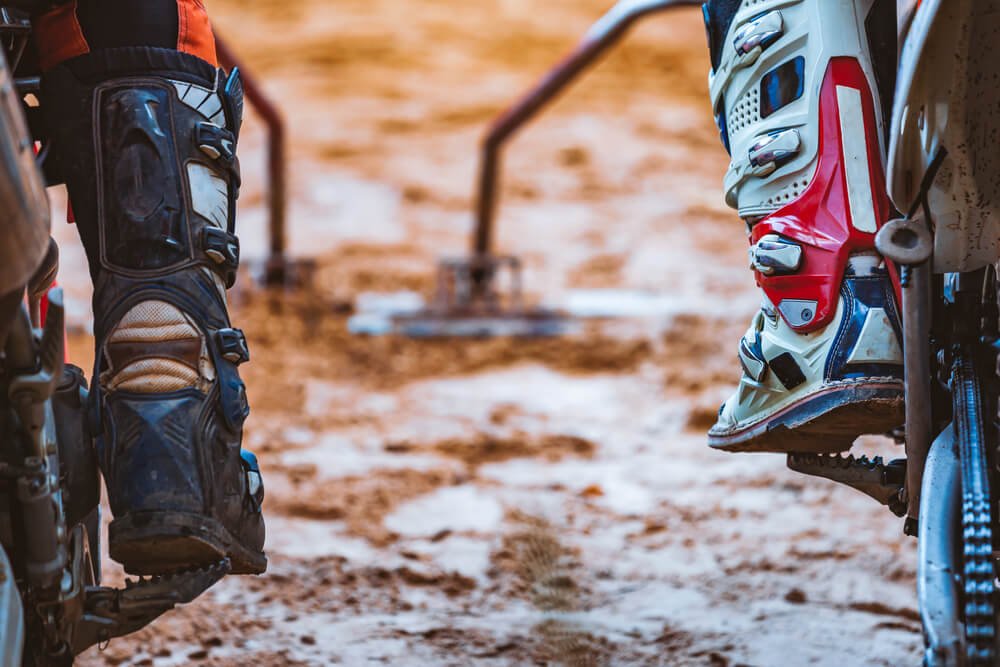
An enduro motorcycle differs from a motocross motorcycle primarily in that it is an off-road motorcycle that is usually homologated and can be used on public roads, while a motocross motorcycle is a racing motorcycle designed exclusively for the track and closed areas. The technical differences stem from their intended purpose: an enduro bike has lighting, a kickstand, a larger tank, softer suspension, and a more flexible engine, while a motocross bike is lighter, stronger, and focused on maximum performance over short distances.
To sum it up
- Public roads: Certified enduro motorcycles can be registered and used on public roads; dirt bikes cannot.
- Purpose: Enduro – long, varied off-road tracks; cross – relatively short, intense races on a track with jumps.
- Technique: Motocross has stiffer suspension, a short-ratio gearbox, and usually a 19-inch rear wheel; enduro has softer settings, a wider gear range, and usually an 18-inch rear wheel.
- Equipment: An enduro bike has a headlight, speedometer, kickstand, and a larger fuel tank, which makes it heavier; a motocross bike does not.
Purpose: motocross or enduro track.
Motorbike The motocross bike was designed for racing on closed tracks with jumps, turns, bumps, and sharp starts. The race is relatively short, and the bike must perform at its best during this time—maximum power, quick throttle response, and suspension capable of softening landings after a jump.
Enduro, On the other hand, it's an endurance race. In enduro rallying, riders complete long laps through forests, rocks, roots, and mud, with times measured on designated sections. These sections are connected by access roads, often running alongside public roads—so registration is usually required to participate in enduro motorcycle competitions. Above all, the motorcycle must be reliable, predictable, and comfortable for long rides.
Homologation and rules – where can you ride enduro and where can you ride motocross?
This is the most important practical difference. The Cross is not designed for driving on public roads. – it has no headlights, turn signals, mirrors, or license plate, so it cannot be used on public roads. Its legal place is a motocross track or private property with the owner's consent.
Homologated enduro It can be registered, insured (with liability insurance), and used on public roads with a driver's license of the appropriate category. This allows off-road use on your own vehicle, without a trailer. However, it's worth noting that there are also competition-only enduro versions without homologation—check the registration document or homologation certificate before purchasing.
Be careful, forest! According to Article 29 of the Forest Law, motor vehicle movement in forests is permitted only on public roads, and on forest roads only where permitted by road signs. This also applies to registered enduro bikes. A permit entitles you to ride on roads, not forest trails.
Technical differences between enduro and motocross
Engine and gearbox
Both classes are equipped with two-stroke and four-stroke engines—the distinction between "cross and enduro" is a myth. Their character differs: a cross-country engine is tuned for maximum power and quick response, while an enduro engine is tuned for smooth, easily controlled power delivery and traction on slippery surfaces. A cross-country engine usually has a gearbox. with close gear ratios , suitable for short sections between turns, while enduro the gears are spaced wider , which allows you to cope with both slow climbs and fast driving on the road.
Suspension, wheels and tires
Suspension on a motocross motorcycle tougher , since it must withstand landings after high jumps. In enduro the suspension is softer , which better copes with rocks and roots and reduces rider fatigue during long rides.
The front wheel of both types is typically 21 inches in diameter, but the rear wheel of a 'cross bike is typically 19 inches, while that of an enduro bike is 18 inches. The taller profile of an 18-inch tire provides greater flexibility and traction in the woods. Enduro tires, approved for competition, also have smaller knobs than standard 'cross tires, and 'cross tires are generally not suitable for road riding.
Equipment and weight
Enduro has it headlights, speedometer, horn, side stand , quieter exhaust and generally, larger fuel tank . The electrical system powering the headlights is more complex. All of this adds weight. A dirt bike lacks these components (not even a kickstand—it's on a lift), making it lighter and more maneuverable.
Comparison Chart: Enduro vs. Cross
| Characteristic | Enduro | Cross |
|---|---|---|
| Fate | Long off-road routes, enduro rally, off-road tourism | Closed course obstacle course racing |
| Public roads | Yes, if it has been homologated and registered. | NO |
| Road equipment | Headlights, instrument panel, horn, mirrors (in road versions) | Flaw |
| Engine characteristics | Smooth ride, good grip | Aggressive, power-oriented |
| Transmission of infection | Wide range of gear ratios | Close gear ratios |
| Suspense | Softer | Stronger |
| Rear wheel | Usually 18 inches | Usually 19 inches |
| Tank, on foot, on the ground | Larger tank, larger footprint, more weight | Smaller tank, no stand, lighter. |
Enduro or motocross – which motorcycle to choose?
- Choose enduro, If you want to go off-road in legal areas, get to places without a trailer, participate in enduro rallies, or simply have one motorcycle for everything. It's also generally an easier option for beginner off-roaders.
- Choose a motocross motorcycle, If you plan to primarily ride on the track, want to practice jumps and racing, and transporting the motorcycle on a trailer or in a van is not a problem for you.
- Check the documents – If you're talking about used enduro motorcycles, make sure they're registered or have all the necessary paperwork. Converting a motocross bike to a road bike is usually a complex process.
- Calculate operating costs – High-performance motorcycles require more frequent maintenance than touring motorcycles. Service intervals can be found in the manufacturer's manual for your specific model.
Regardless of your choice, ride in full protective gear: helmet, goggles, boots, knee pads, and gloves. Beginners should begin training at an off-road riding school or on the trail with an instructor.
Frequently Asked Questions (FAQ)
Is it possible to ride a motocross motorcycle on public roads?
No. A motocross motorcycle does not have a roadworthiness permit, lights, or license plates, so riding it on public roads is illegal. Motocross motorcycles can be ridden on trails and private property with the owner's permission.
Is it possible to register an enduro class vehicle?
Yes, as long as the model is road-legal. After registering it and purchasing liability insurance, you can drive it on the road with the appropriate license category. However, some enduro models are designed exclusively for competition and are not certified for road use.
Is it possible to ride an enduro bike in the forest?
Entry is permitted only via public roads passing through the forest and forest roads designated as accessible to traffic. The Forest Law prohibits the entry of motor vehicles, including registered motorcycles, from such roads.
What is better to start with – enduro or cross?
For most beginners, an enduro bike is the best choice: it has a smoother engine and softer suspension, and the certified version allows for off-road riding. A motocross bike is a good choice if you plan to ride on a track from the start.
Does this dirt bike have a kick starter and a kickstand?
Many modern motocross bikes are equipped with an electric starter, but they typically lack a sidestand—they're parked on a lift. A sidestand is a standard feature on enduro bikes.
See also
- What is the difference between winter and summer tires?
- What is the difference between a two-stroke and a four-stroke engine?
- What is the difference between a station wagon and a station wagon?
- What is the difference between 95 and 98 octane gasoline?