

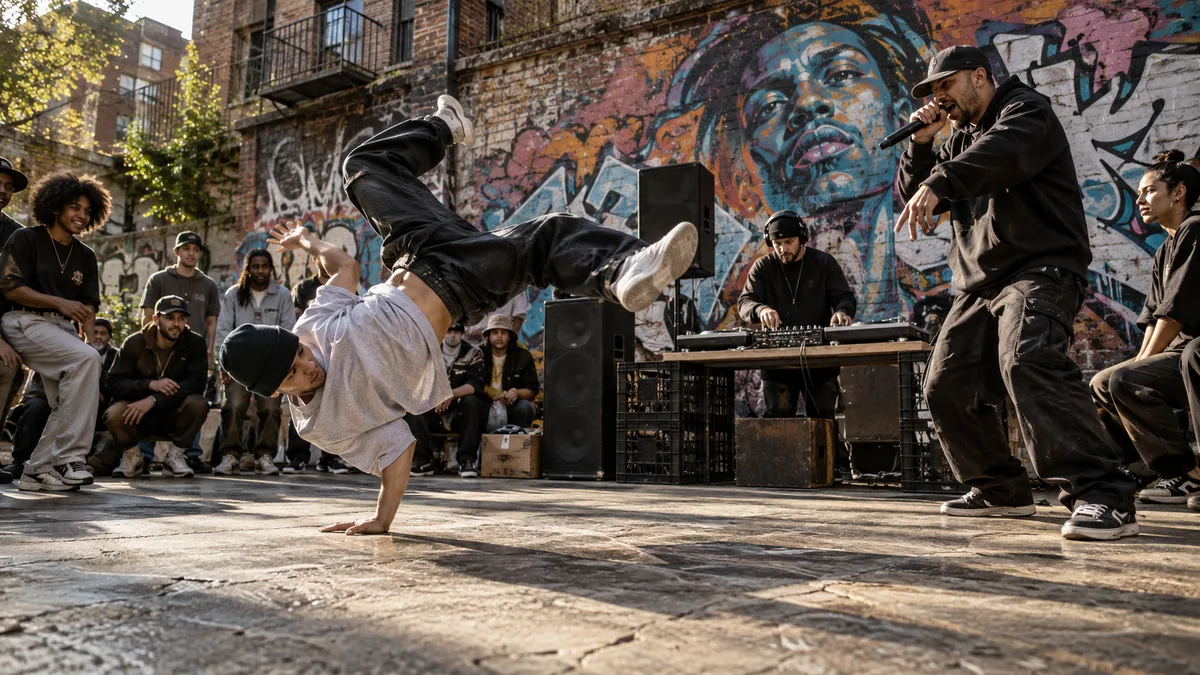
Rap differs from hip-hop in that rap is a vocal technique—rhyming, rhythmic melody set to a beat—while hip-hop is an entire culture, one of the elements of which is rap, along with DJing, breakdancing, and graffiti. In everyday speech, both words often simply refer to the same musical genre. However, to be more precise, hip-hop is a broader concept, and rap is a subset of it.
To sum it up
- Rap is a way of performing lyrics: rhythmic, rhyming, «speaking» to background music.
- Hip-hop is a culture that originated in the 1970s in New York City, primarily in the Bronx.
- The classic four elements of hip-hop are DJing, MCing (rapping), breakdancing, and graffiti; a fifth element, knowledge, is often added.
- Rap can also be found outside of hip-hop, such as in rap metal or pop music, and hip-hop also includes dance and visual arts.
Rap – what is it?
Rap — is a rhythmic, usually rhymed melody performed to a musical accompaniment, or beat. The key is flow — the way a rapper arranges syllables, accents, and rhymes to match the rhythm. A person who raps is called a rapper or MC (from English: Master of Ceremonies — Master of Ceremonies (MC). Initially, the MC led the event and energized the crowd, but over time this role evolved into that of a rapper.
The English word "rap" originally meant, among other things, a light, fast rhythm and rapid, animated speech. It became popular in the music world in the 1970s, alongside the development of hip-hop culture.
Hip-hop as a culture – four elements
Hip-hop originated in the 1970s in New York City, primarily in the Bronx, among African-American and Latino youth. It wasn't just music—DJs, rappers, dancers, and graffiti artists gathered at neighborhood parties (the so-called street parties и park jams ). From these practices arose four classic elements of hip-hop :
- DJing – creation of a soundtrack from gramophone records: mixing, expansion of rhythmic fragments (so-called breaks), scratching.
- MCing, that is, rap — a vocal element of culture: rhymed lyrics performed to a beat.
- Breakdance (breaking) – a dance performed to breakdance music played by a DJ, with acrobatic numbers on the floor.
- Graffiti — visual art of hip-hop: inscriptions, tags and murals, painted mainly with spray paint.
Knowledge — awareness of cultural history and values — is often cited as the fifth element. More recent studies also consider beat making, or beat production using samplers and sequencers. , separately.
Hip-hop pioneers
DJ Kool Herc , a Jamaican immigrant, is considered one of the founders of hip-hop. He used two turntables to expand the dance sections of his recordings. Afrika Bambaataa played a significant role in uniting DJs, rappers and dancers into a single culture, and Grandmaster Flash He developed a technique for working with turntables. The Sugarhill Gang's 1979 song "Rapper's Delight" became a breakthrough in popularizing rap itself.
Rap and hip-hop are the most important differences.
The easiest way to understand the difference is this: Rap is something you perform, and hip-hop is a culture you participate in. . You can be a member of the hip-hop community without ever rapping—for example, as a dancer, DJ, or graffiti artist. Conversely, you can rap outside of the hip-hop context.
Rap has long since transcended the confines of hip-hop. Rap sections can be found in pop music, rap metal, rap rock, and various genre hybrids. Therefore, not every rap song is considered hip-hop in the broad cultural sense.
| Characteristic | Rap | Hip-hop |
|---|---|---|
| What's happened | Vocal technique, form of performance of the text. | Culture and Music |
| Range | Narrower - only the verbal layer. | A wider range of topics – music, dance, art, lifestyle. |
| Elements | Song lyrics, rhymes, rhythm, melody | DJing, rapping, breakdancing, graffiti (and knowledge) |
| Executor | Rapper, MC | Rappers, DJs, B-boys and B-girls, graffiti artists |
| Event | In hip-hop, as well as in pop music, rap metal and other genres. | As an independent culture and musical genre |
| Start | The term became popular in the 1970s. | New York (Bronx), 1970s |
Why are rap and hip-hop often confused?
Hip-hop music is primarily based on rap, so in practice, the terms "hip-hop record" and "rap record" usually mean the same thing. The word "hip-hop" is also sometimes used to describe a musical genre rather than an entire culture. Consequently, the two terms are used interchangeably in the media, in record stores, and in common parlance.
However, within the hip-hop community, this distinction is sometimes significant. Some listeners and creators emphasize that "hip-hop" is a culture with its own history and values, while "rap" is merely one of its forms, which, in its commercialized form, may have little in common with that culture.
How to use the terms "rap" and "hip-hop" correctly?
- When it comes to manner of performance/pronunciation of song lyrics , use the word "rap" ("he raps well", "rap verse").
- When it comes to culture, environment, or lifestyle – the term «hip-hop» («hip-hop culture», «hip-hop dance») is used.
- In context musical genre Both words are accepted in practice, but "hip-hop" emphasizes the cultural context, while "rap" emphasizes the vocal component.
- If a rap verse appears in a rock or pop song, then it would be more accurate to say elements of rap, and not about a hip-hop song.
Frequently Asked Questions (FAQ)
Are rap and hip-hop the same thing?
Not quite. Rap is a vocal technique, and hip-hop is a culture, of which rap is one element. However, in everyday speech, both words often refer to the same musical genre.
What are the 4 elements of hip hop?
DJing, MCing (i.e., rapping), breakdancing, and graffiti. A fifth element is often added: knowledge, that is, familiarity with the history and values of a culture.
Where and when did hip-hop originate?
In New York City, primarily in the Bronx, the genre emerged in the 1970s among African-American and Latino youth. DJ Kool Herc is considered one of its pioneers.
What does the abbreviation MC stand for?
The term MC comes from the English word Master of Ceremonies ( Master of Ceremonies (master of ceremonies). Originally, it meant the person hosting the event, but today the term simply means a rapper.
Is it possible to rap without being part of hip-hop culture?
Yes. Rap as a technique is found in many genres—pop music, rap metal, and rap rock. An artist can rap without any connection to hip-hop culture.
See also
- What is the difference between opera and ballet?
- What is the difference between feminine and masculine rhymes?
- What is the difference between a Christmas carol and a pastoral?
- What is the difference between a keyboard and a piano?